

“I want to put a ding in the universe.”
—Steve Jobs
When we lost Clayton Christensen, I made a post on LinkedIn about how his work, specifically his books, helped an ignorant person like me develop some fundamental skills and insights.
One of my favorite areas is translating relatively softer disciplines into the world of hard and applied sciences, like analytics and technology. While definitely still learning the ropes of it, I enjoy doing that. And a significant part of the credit of my interest goes to books from Christensen. One of his books that I loved was “The Innovator’s DNA”.
In his book “The Innovator’s DNA”, Christensen highlights five skills that innovators possess. These skills, shown in Figure 1, are critical for any function that can act as an enabler to generate innovation (like technology). Analytics is obviously one of them.
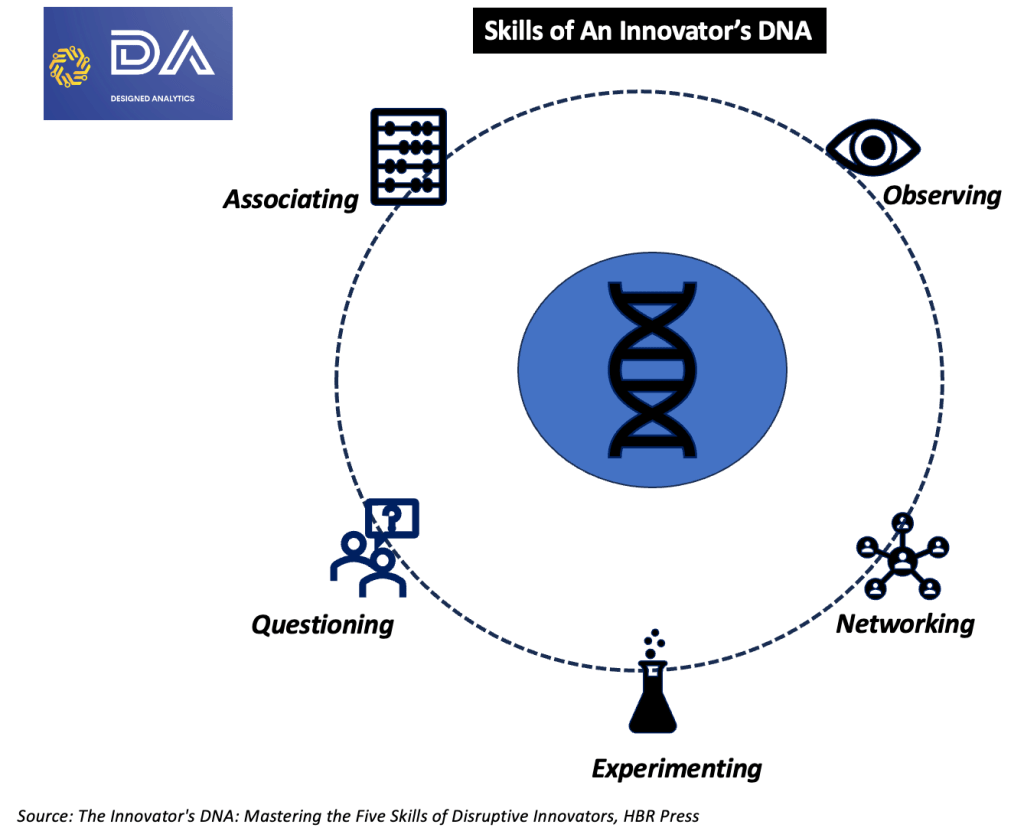
In this article, we will discuss how these skills can help generate innovation in analytics function. Before we move forward with that discussion, here is something to ponder about. Look at the skills in Figure 1 and then evaluate if you measure your prospective analytics candidates on these five. I can give you the answer beforehand-you DO NOT. I am familiar with the interview and evaluation process for data science across all key organizations. None of them span more than three of these and most of them are limited to two.
You can design a process that can evaluate across all these five skills. That will also mean that your recruitment cycle time will increase. But then the goal is not to hire x data scientists or analysts. The goal of recruitment is to hire brains that can make a difference. The goal of a leader is not to solve all problems themselves but inculcate a culture that embraces problem solving. This is a different topic and we will try to address this in a separate article. So for now, let us do a deep dive into the relevance of the five skills shown in Figure 1 in the world of analytics.
Skill 1: Associating
“Creativity is connecting things.”
—Steve Jobs
The skill of “associating” is about cross-pollination of ideas. I have written and spoken extensively about it. My concept of “Analytics Fragmentation” aligns with this skill set, where I state that analytics fragmentation is not about IT architecture fragmentation. It is about constrained thought process we follow in the world of analytics. Unless you want to keep solving problems like churn detection that have already been solved a thousand times (and that too not optimally), associating is critical to identify new problems, solving which can help address many existing and known problems.
As a leader, you have to ensure that this cross-pollination of idea happens not only in your head, but in the heads of your analytics professionals. A supply chain problem typically spans beyond supply chain. A marketing problem spans beyond marketing. Numbers in finance stem from transactions happening across functions. As long as do not associate with the cross-enterprise view of formulating problems in analytics, we will keep building the same churn detection models for eternity.
Skill 2: Questioning
“Question the unquestionable.”
—Ratan Tata
Imagine a scenario and think of an honest response. Not the one you would write on LinkedIn but what will actually happen in this scenario. You now lead a team of analytics professionals, the same team that you once joined as an analyst. As an analyst, you picked a portfolio of models and improved them. Your work was recognized due to those improvements and you are where you are because of that.
You recently hired someone who one day walks into your office to suggest that the way those very same models have been built, has a flaw. Though that flaw does not result in inaccuracy, the results can be better if the model is redesigned. Significant changes need to be made and as a result, everyone needs to be made aware of the gaps in the current portfolio.
Think about the actual and honest response. Not the ideal one.
The very day you empower your team to question anything and everything, you will start seeing drastic changes, including an increased confidence level. And this questioning needs to span not just into analytics work but other aspects like career development etc. You will clearly see how their confidence level translates into new ideas and innovative solution approaches.
Skill 3 : Observing
“
Throughout Tata’s life, he had seen thousands of families riding scooters in India. On one very rainy day in Mumbai, India, in 2003, however, he noticed a lower-middle-class man riding a scooter with an older child standing in the front, behind the handlebars. The man’s wife sat sidesaddle on the back with another child on her lap. All four were soaked to the bone as they hurried home. Tata saw with his eyes and listened with his heart to notice what he had previously failed to notice. He asked himself, “Why can’t this family own a car and avoid the rain?” Or, put another way, he thought about a job that needed doing (in this case, the job was to create safe, affordable transportation for a family that could not afford to buy a car, but could buy a scooter).
This singular observation sparked several provocative questions about the possibility of creating an affordable “people’s car.
“
Source: The Innovator’s DNA: Mastering the Five Skills of Disruptive Innovators, HBR Press
In a world that judges how long, how much and how loud people can speak in meetings, no matter how unproductive and contextless the narrative is, observing is the most underrated skill, but one that is among the foundational ones.
Have you asked your supply chain data scientists to go and sit in a warehouse and manufacturing plant for day or two, and then come back with five ideas where analytics can be leveraged to help improve the operations? The reason you have not done that is that our constrained thinking does not place any value on the power of observation as far as the field of analytics goes. And even if you had, the chances are the way we hire and train analytics professionals, they excel at building models for scenarios they are told. We do not encourage them to observe the world (of business) around them and find problems to solve.
In the second part of this article, we will explore the skills of networking and experimenting.
References:
- The Innovator’s DNA: Mastering the Five Skills of Disruptive Innovators, HBR Press


