
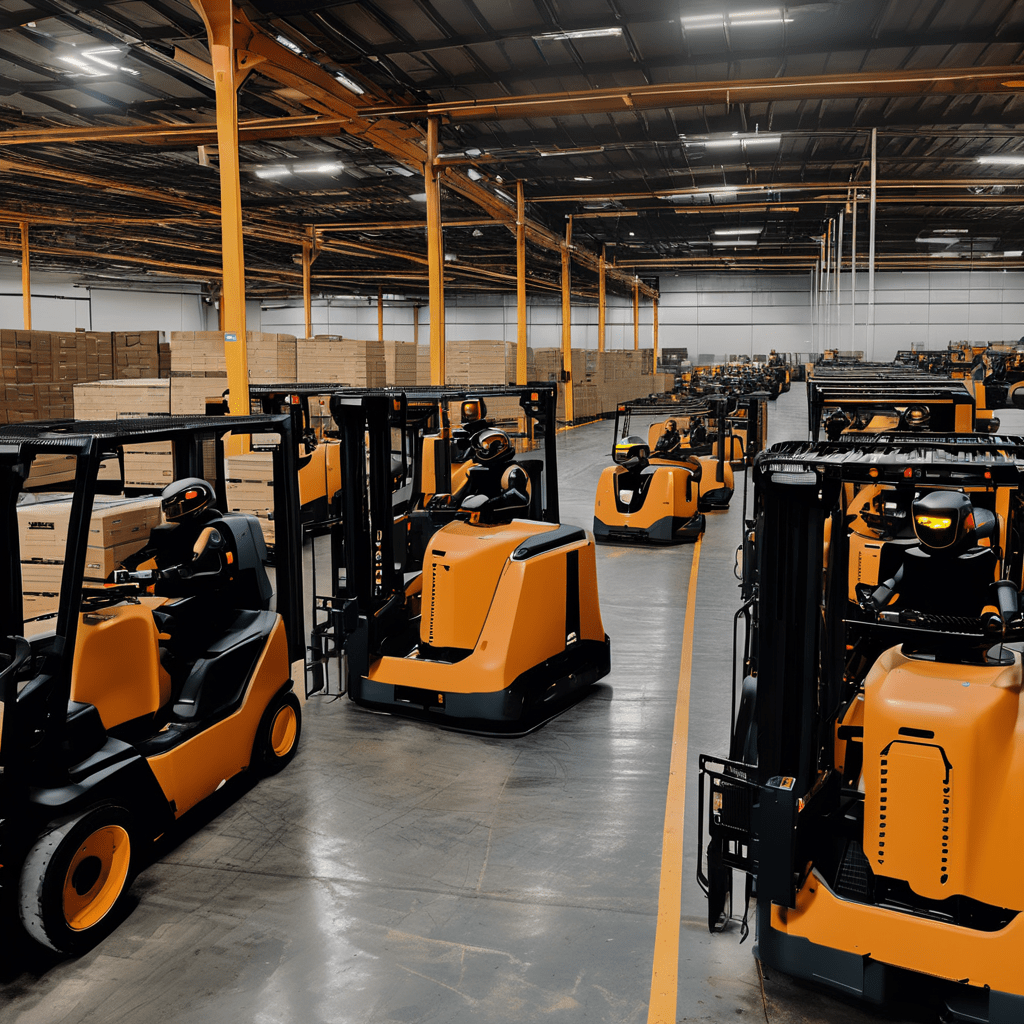
Sensors remain a crucial source of data in the Industry 4.0 context. Sensors were used on manufacturing floors to collect data before the arrival of Industry 4.0 hype. Sensors can be pretty rudimental (like legacy switches and variable resistors) or advanced (like LIDAR and thermal imaging), but from an Edge AI perspective, what is critical is that they are a source of data for our Edge AI devices.
This three-part article will overview prominent types of sensors leveraged in the Industry 4.0 context in logistics. While you may see many examples of Industry 4.0 in a manufacturing context, examples from warehouse operations are scarce. So, for this article, we will explore the types of sensors in an intelligent warehouse context.
There are a few different ways to categorize sensors. For example, one categorization can be based on the type of data they generate (time series, audio, image, video). However, we will explore the modality view in this article. The key modalities that we will explore in this series of articles are:
- Acoustic (includes vibration)
- Motion (includes position)
- Visual
- Force (includes tactile)
- Optical
- Electromagnetic
- Radiation
- Environmental (includes biological and chemical)
In this first part, we will focus on Acoustic and Motion sensors.
Scenario: ACME Inc. has a smart warehouses that caters to store deliveries as well as eCommerce volume. We will explore how ACME’s smart warehouse is using these sensors in its 24X7 operations.
Acoustic Sensors
Vibrations can indicate whether a machine is performing normally, through signal analysis of vibrations. All conveyor systems in the warehouse are fitted with these vibration sensors. Among other advantages, it allows ACME to be proactive about potential conveyor breakdowns, minimizing tactical logistics disruptions. These sensors typically transmit time series data that captures the pressure variation in its medium.
Motion Sensors
Motion and position sensors are leveraged throughout ACME’s warehouse. These sensors typically share data as a time series of readings. Let us explore some examples:
Tilt sensors: These are very basic forms of sensors, much like the on-off switches we have in our homes. ACME leverages these extensively in its smart warehouses. Equipment like forklifts gets powered through these tilt sensors. This allows the centralized algorithm to capture when a forklift is turned on. In tandem with motion sensors, the algorithm can analyze if the forklift was running ideal or was being leveraged effectively while it was turned on.
Accelerometer: These sensors measure the change in velocity over time across one or more axes. ACME leverages these to monitor the speed limit of the forklifts and other manually operated mobile equipment in the warehouse.
Gyroscopes: These sensors measure the rate of rotation of an object. Lift jacks that cater to loading shelves are fitted with these in tandem with accelerometers for safety purposes. Combined with accelerometers, it presents a picture of the motion in 3D space. Consider the scenario where an operator is trying to stack a heavy pallet on the top layer of the rack. If the combination of the tilt of the forks and the speed at which the mast is raised goes beyond a specific range, the operator may get a warning beep on his mobile device.
Rotary: These sensors measure the exact position of either an axle-like or linear mechanism. ACME leverages these in the automated packaging in the e-commerce section of the warehouse, where a bot performs the final packaging for a specific box size.
Time of flight: These sensors use some form of electromagnetic emission, like light, to measure the distance from the sensor to an object within the line of sight. These sensors are leveraged throughout the warehouse to capture the transit times of forklifts and other movements pertaining to putaway and picking operations. These captured times are utilized for flow optimization as well as performance management.
Real-time location systems: These sensors leverage a plethora of transceivers placed in a building to track the position of objects. Obviously, ACME is leveraging these to track the movement and position of pallets and packages within the warehouse.
In the second part of this three-part article, we will explore how ACME uses visual and force sensors in its smart warehouse. The second part of this series of articles can be found here.
References:


 Designed Analytics Blog