
Behind all the technical jazz, algorithms exist to help us with certain types of analysis. That is why I like the functionality view of AI algorithms much better when discussing their usefulness. So let us leverage this functionality view to understand how AI algorithms work in the Edge AI context.
In this example, we will explore the most commonly used algorithms using the example of an asset on a manufacturing shop floor. I decided to dust off my electrical engineering knowledge so that I could use an industrial induction motor for this overview. Through this example, we will explore the following algorithms by functionality:
- Classification
- Regression
- Object detection and segmentation
- Anomaly detection
- Clustering
- Dimensionality reduction
- Transformation
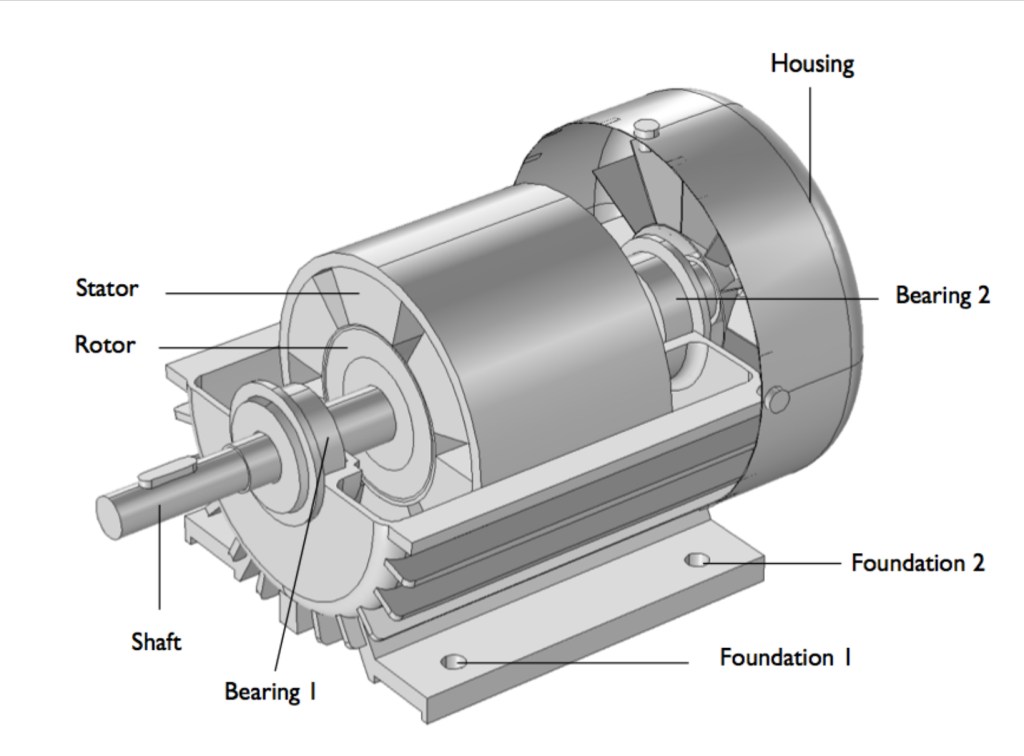
Figure 1 shows an overview of the key components of an industrial induction motor. Though not super detailed, it illustrates all the important components that we will touch upon in this article.
Let us say that you have been tasked to build a solution portfolio to help monitor the operations, health, and maintenance of industrial induction motors operating on the shop floor.
Figure 1: An overview of induction motor parts
Source: TheEngineeringKnowledge.com
Asset Utilization
Before designing fault detection and maintenance algorithms, you have also been tasked to develop an asset utilization algorithm. You need to understand how long a motor runs during a particular shift. The algorithm that can be leveraged for this is:
- Classification: Classification algorithms aim to distinguish between various types of classes. In this case, the classes are Running or Not running. A plethora of sensor data can be used to detect if the motor is running or not (e.g.: rotor blade acceleration sensors).
After checking off this box, you start working on the fault detection algorithms.
Fault Detection
Common sense detects that the parts that move are the ones that are more susceptible to defects. So, you focus on fault detection in the rotor and bearing system. In simple terms, fault detection algorithms observe parameters that typically show deviant behaviors in case of defects or faults.
Rotor fault detection
One of the common failures that induction motors experience in industrial settings is broken rotor bars. There are many drivers behind these bar failures, including overheating from frequent loaded starts, unbalanced thermal load due to air trap eccentricity, manufacturing defects, and corrosion due to the shop floor environment.
The first step, obviously, is to understand what parameters can be used to diagnose a fault. There are many characteristics and associated methods. For example, signal analysis can be leveraged to analyze induction motor current signals and detect breakage. Additional fault features can be drifts or deviated frequency trends etc.
Examples of algorithms that can be used for rotor fault detection are:
- Anomaly detection: This algorithm analyzes and flags when a signal has deviated from its normal behavior. In this specific case, we can use it to identify the deviated current draw as the rotor starts to break down.
- Clustering: Clustering algorithms build groups of inputs by identifying similarities; hence, these algorithms can recognize an input that is not similar to what it has seen before. In this specific case, if you have a group of fault features, like current draw, drifts, deviated frequency trends, etc., clustering can also help identify abnormalities.
Bearings fault detection
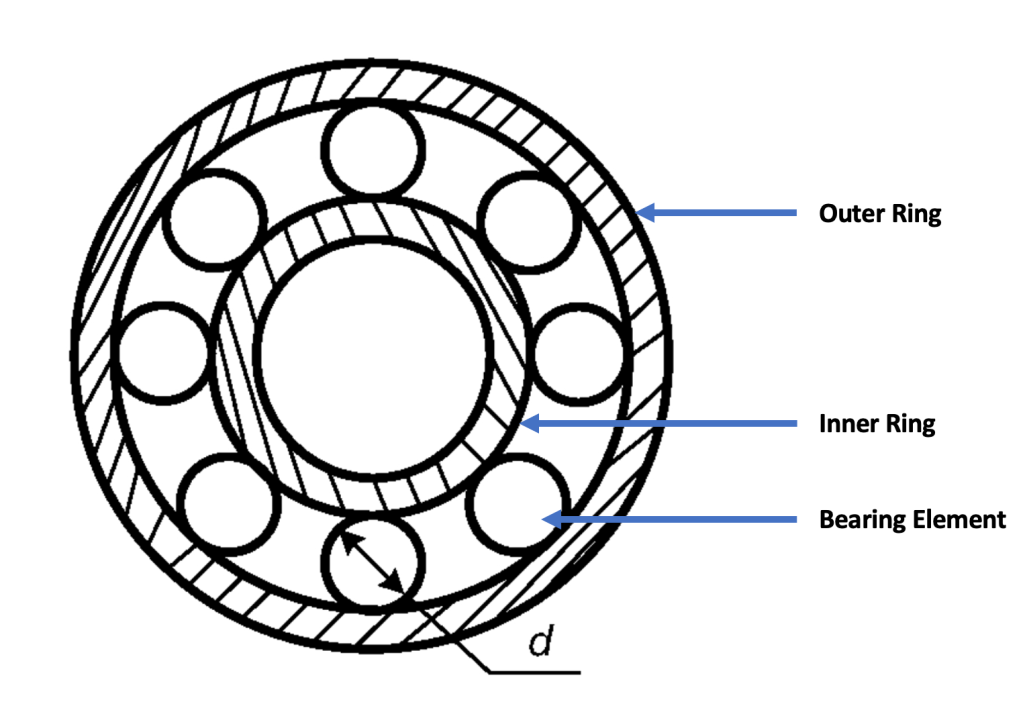
Rolling bearing elements are a key component in electric motors. The simplified general design is shown in figure 2.
Figure 2: An overview of the components of a bearing system.
Source: intechopen.com
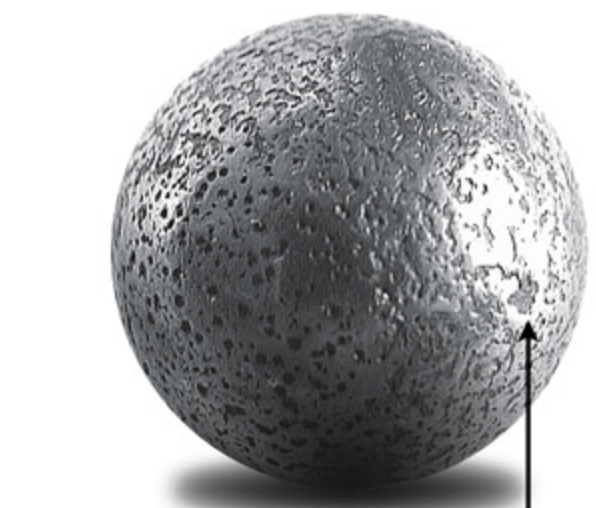
Fatigue pitting or micro pitting is the most common defect in bearing components. Defects can be in the outer ring, inner ring, or the bearing elements (balls). Figure 3 shows a bearing ball that has micro pitting.
Figure 3: Pitting faults in a bearing
Source: Machinerylubrication.com
As you can imagine, the performance gets impacted once bearing elements develop these pittings. Generally, stator current signal analysis can help identify fault features, but is a challenging approach. Bearing vibration frequencies can also be used to detect faults, and though it might not be as comprehensive, it can still help identify early faults. Sound-based methods for fault detection are not commonly used but can also be effective. If you decide to leverage this method, the algorithm will be:
Dimensionality reduction: Dimensionality reduction algorithms take a signal and produce a representation that contains equivalent information but takes up much less space. In this specific example, if we decide to leverage the sound-based fault detection method, the dimensionality reduction algorithm can work in tandem with other algorithms like anomaly detection.
A dimensionality reduction algorithm will help compress the audio so that it can be transmitted effectively from the edge device. Then, another algorithm like anomaly detection can analyze it.
Maintenance
Once you have checked off fault detection algorithms, you now focus on the proactive aspect, leveraging data science to perform predictive and prescriptive maintenance before a fault occurs in one of the motor parts. Examples of algorithms in this case are:
Object detection and segmentation: Object detection algorithms take an image or video and identify the locations of specific objects within them, often by drawing bounding boxes around them. They combine classification and regression, identifying specific types of objects and predicting their numeric coordinates.
These algorithms can be repurposed and then paired with technologies like augmented reality to help maintenance folks identify parts of the motor and flag any part that looks abnormal.
Regression: These algorithms are leveraged for predicting faults so that preventive and prescriptive maintenance can be performed on these motors. Based on historical fault data, they can predict future failures, and maintenance plans can be optimized leveraging these algorithms.
Please note that above examples are illustrative. All these categories (asset utilization, fault detection and maintenance) use a plethora of algorithms and usage is not mutually exclusive. The goal of the article was to illustrate the range of functionalities. The beauty of designing data science portfolios is the availability of wide range of algorithms for every problem type. This allows you to creatively build a portfolio based on your specific needs.

 Designed Analytics Blog