
Hope this article (https://lnkd.in/gAQRAVju) will help folks who are led to believe that neurons in an AI neural network mimic biological neurons understand the limitations of that approach.
Once you understand the fact that the concept of neurons in a neural network pertains to digital logic emulation and is dependent on some rudimentary math, you will also understand that true human-level intelligence may be challenging on this path.
In my opinion, while a start, this is a significant first step. Researchers at the University of Southern California (USC) developed artificial neurons that physically emulate the electrochemical behavior of biological neurons, rather than just algorithmically simulating them.
I have been thinking about a few pathways to true superintelligence, and this just adds another one. And this is the most interesting one. The authors
believe that this is a more feasible path to neuromorphic computing hardware (brain-inspired chips). I think this can go beyond that.
Why?
Because it can help us mimic human emotions and consciousness more accurately. Aspects that no algorithm can simulate.
But the key barrier that remains (in my opinion) is that we need to decipher the exact electrochemical science that takes place in the human brain for consciousness and emotions.
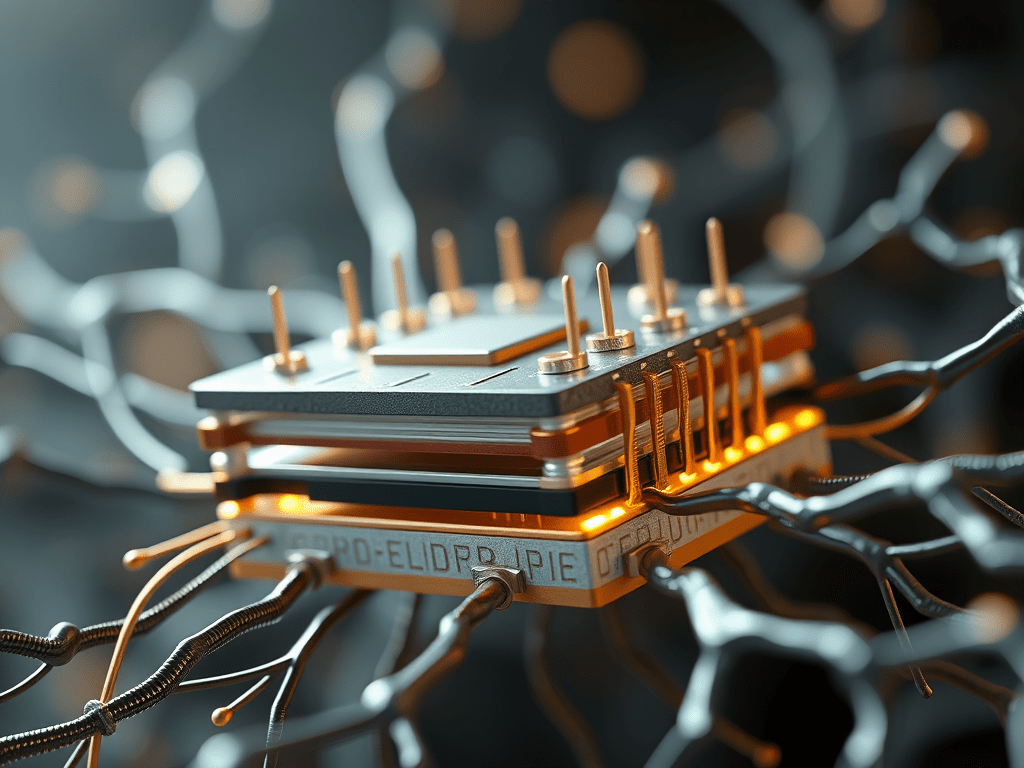
Anyways, coming back to this research, these artificial neurons are based on a diffusive memristor device (ion diffusion-based) stacked with a transistor and a resistor, achieving a footprint of about 4 µm² per neuron.
Because they leverage ionic motion (in this case, silver ions) rather than purely electronic switching, the devices promise much lower energy consumption and much smaller size compared to conventional neuron-emulation hardware.
So how do these work?
Biological neurons use a combination of electrical and chemical/ionic signals: ions cross membranes, change potentials, trigger synapses, etc. In this work, the artificial neuron uses a diffusive memristor where ions (silver ions) move in an oxide matrix, mimicking those ionic-motion dynamics.
By stacking the memristor device with a transistor and resistor, they achieve spiking neuron behavior (i.e., event-based firing) with high fidelity to biological behavior (rather than simple digital logic emulation).
No comments on Artificial Neurons Replicate Biological Function
Artificial Neurons Replicate Biological Function

 Designed Analytics Blog