
Back in 2023, when I was publishing a series of articles on various swarm optimization approaches, I highlighted that the mass use of drones for tasks like delivery needs a very different type of dynamic routing paradigm.
An approach that I suggested was real-time information sharing and analytics on the edge, i.e, on the drones themselves, leveraging data in real-time from ground infrastructure. This paper is similar in terms of concept. https://lnkd.in/eHDVZ_yi
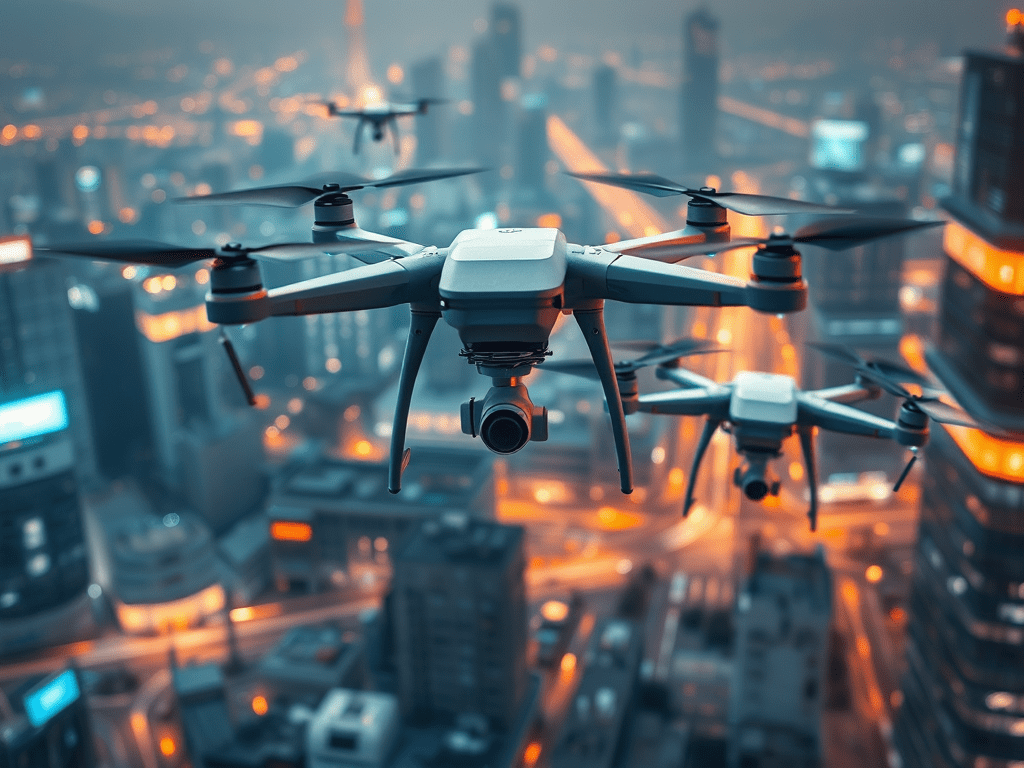
The authors address the problem of designing a network of multiple unmanned aerial vehicles (UAVs) that assist an Internet-of-things (IoT) deployment—specifically:
UAVs act both to collect data from IoT devices (ground nodes) and participate in a federated learning (FL) procedure to train models using distributed device data, without sending all raw data centrally.
They integrate two key optimization components:
1. UAV placement/deployment optimization (to maximize coverage, improve signal-to-noise ratio (SNR), etc)
2. Resource allocation and operational dynamics (power, CPU frequency, bandwidth, trajectory, etc) under dynamic network conditions.
The interesting part here lies in jointly combining these two (deployment + dynamic resource control + FL) using a hybrid of Particle Swarm Optimization (PSO) for placement and Deep Deterministic Policy Gradient (DDPG) for resource/allocation control.
The approach aims to address an emerging convergence: UAV/airborne platforms + IoT + federated/distributed ML + resource/trajectory optimization. With UAVs becoming more capable (e.g., in 6G/next‐gen networks), the integration of FL + dynamic deployment is quite timely.
The hybrid methodology (metaheuristic + RL) is pragmatic: PSO for the “static” or longer‐timescale placement, RL for the real-time/control side. That’s a useful architecture for complex system design.
The focus on privacy (via federated learning) is aligned with contemporary constraints (e.g., data must stay local, edge computing) in IoT ecosystems.
The performance improvements (throughput, latency) suggest the framework could be practically useful in dense IoT + dynamic UAV scenarios (e.g., disaster recovery, remote sensing, smart city sensing, emergency communications).
No comments on DRL and Federated Learning For UAV Routing
DRL and Federated Learning For UAV Routing

 Designed Analytics Blog