
Before we could see “crash reported ahead” or “Police car ahead” on map apps, truckers had their own real-time information-sharing network. I assume they still use their radios to connect with other truckers on the road in real-time.
That kind of real-time information sharing should (will?) become standard in approximately ten years. The difference is, it will all be automated, with onboard computers doing most of the sharing, unless a human intervention is required.
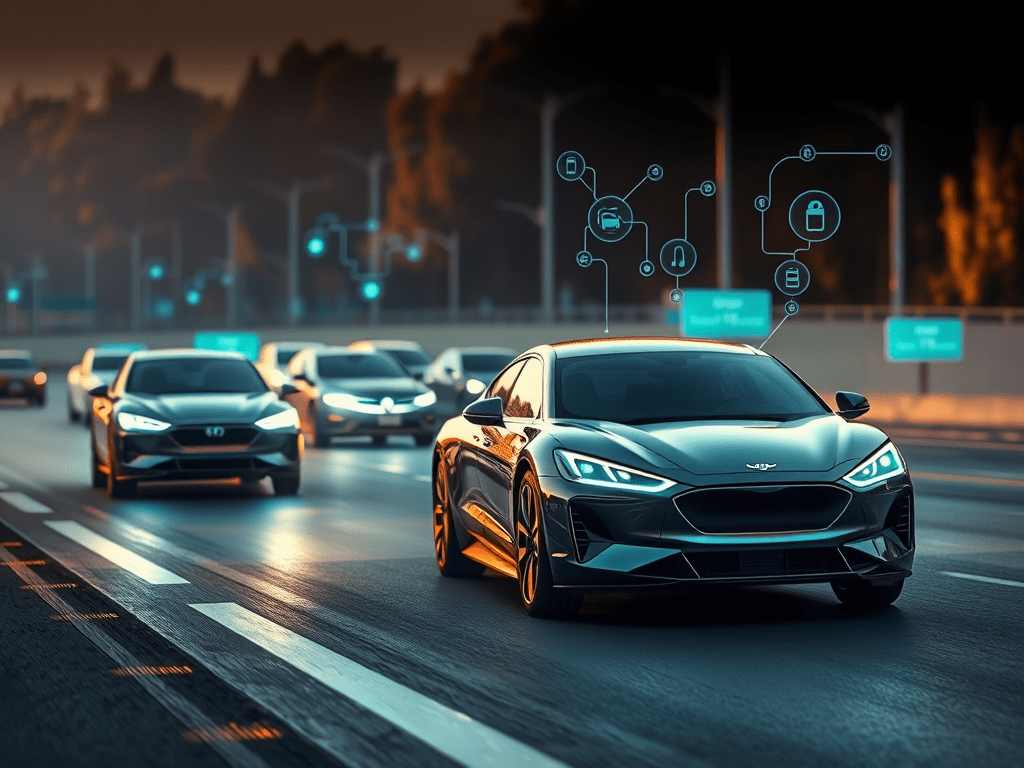
Essentially, each car can be a moving computing unit, connected with others.
Tesla’s plan to implement a feature where every Tesla can “talk” to the other one is stage 1. At some point, interoperability will come into play as well. The evolution will be a multi-step process.
Here is an interesting research in this domain, though a bit old and focused on self-driving vehicles. https://lnkd.in/gC-rq6Vx
But this is a good example of a feature we would want with that network of interconnected vehicles. Irrespective of whether the vehicle is fully autonomous or has co-pilot capabilities.
As you can imagine, even with cars without self-driving, such a feature can help prevent a pile-up. A car involved in a crash immediately starts pinging any car approaching it, within a certain radius.
But let us explore this research for now.
The paper surveys strategies and research on collision avoidance in automated vehicles (AVs), especially in multiple-vehicle scenarios (chain collisions, rear-end crashes, etc.), not just single-vehicle avoidance.
It develops a taxonomy of existing methods/techniques, examines challenges, and identifies gaps. Then it proposes an AI‐enabled conceptual framework for dealing with “Multiple Vehicle Cooperation and Collision Avoidance” (MVCCA) in AVs.
To address gaps, the authors propose a framework with five phases:
Perception Phase: Advanced detection of surrounding vehicles, mapping, object refinement, risk indexing (recognizing whether only one vehicle nearby or several) etc.
Communication & Coordination Phase: Leveraging V2V / V2X / 5G or other low latency links to share information, allowing cooperative maneuvers like platooning, merging, etc.
Threat Assessment Phase: Classifying risk levels (regular, higher, critical) and estimating when chain collisions are likely so the system can proactively act.
Decision-Making Phase: Using learning-based (e.g. reinforcement learning, multi-agent RL) or hybrid methods to decide maneuvers that avoid or mitigate collisions.
Vehicle Control Phase: Executing braking, steering, and trajectory control in real time, under constraints (kinematic, dynamic) and accounting for uncertainties.
No comments on Predicting AV Path With AI
Predicting AV Path With AI

 Designed Analytics Blog