
A few years ago, a comedian from India visited Harvard for a speech. The core theme of his speech was that there are two versions of India. It was a very critical speech with political biases embedded within. With free speech taking a hit worldwide, needless to say, the speech led to a lot of controversy back home.
There are two worlds in every country. The divide between rich and poor is stark in Western countries as well. But the comedian’s perspective was beyond the wealth distribution. Why do I bring this up ? Someone messaged me yesterday asking for my perspective since I am back in India after 9 years. The question they had was that as someone who is seeing India after almost a decade, what are my observations?
My answer to the question will avoid the political elements. There are certainly some big issues there, but this blog is devoted to technology and strategy.
The last time I was in India was in Dec 2015. If I look at this from purely Infrastructure, and technology perspective, and the distribution of benefit of this infrastructure and technology, few key aspects emerge:
1. Significant improvement in infrastructure (I know many of you may quip that the build quality is not holding. That is what this article will discuss).
2. Technology penetration in governance is mind-blowing, considering the scale.
3. Beyond public governance and infrastructure tech, indigenous tech companies dominate the local scene. Hopefully, this will eventually lead to some truly global Indian product companies.
4. Last but not least, a major proportion of the population is not able to harness the benefits above to move forward in the social ladder.
In two separate articles, I plan to focus on two of the four aspects highlighted above:
1. Making sure that corruption embedded in infrastructure building is put in check using processes and technology.
2. Use processes and technology in a way that integrates a massive % of population that has not been touched by the developments.
In this article, let us touch upon the first one. How can we minimize corruption in infrastructure projects so that the build quality gets better. Note two things here. In previous section, I mentioned “…..using processes and technology” and I am using the term “minimize”, not eliminate. Because the third element, the “people” element, can always find a way around the best of the processes.
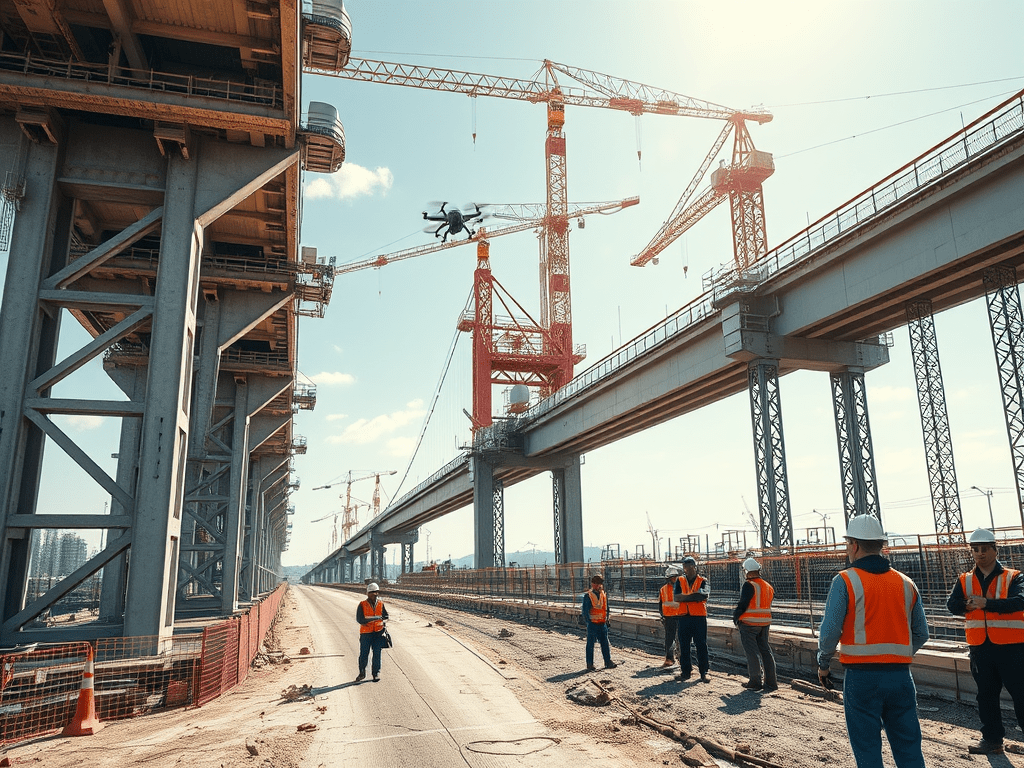
I will again try to stay away from the political elements as much as I can. Let us start with a hypothetical scenario that there is a bridge being built and tenders have already been allocated.
The bridge is massive hence falls in the category of a mega project. On a large scale project like this, there may be several subcontractors involved. I bet that in the current state, quality check throughout the process are manual, with no involvement of high-level officials. Again I am assuming that the system is fair, beyond the contractors, to keep the political narrative out. We are assuming that the contractors are able to “game the system” during quality checks. What is presented as quality checks is accepted as the ground truth and the process keeps moving forward.
Realistically, you cannot accept Mr. Nitin Gadkari being neck-deep in the details of an infrastructure project progressive quality evaluation. You could not imagine the Prime Minister analyzing the quality of Shri Shivaji Maharaj’s statue. But the fact is, when the infrastructure collapses, the buck always stops at the top. That too in the political environment in India. Afterall, in a healthy democracy, the job of opposition is to highlight such events. That is what accountability is all about.
Imagine you are Mr. Modi and think about this objectively from a purely political perspective. He wouldn’t risk a statue of Shri Shivaji Maharaj that he was going to inaugurate in the state of Maharashtra collapsing in less than a year, more importantly, in an election year. They would also love to have a process in place to curb things like these from happening.
It is obvious that the corruption in the system below these high-level officials is winning and that is scary. What this means is that even if there is a PM from another party down the line, the cycle will continue. Bridges will keep collapsing, and roads will keep caving. But technology can help minimize the corruption to a level where the build quality will improve significantly. We will use this same example of a bridge mega project to understand the process.
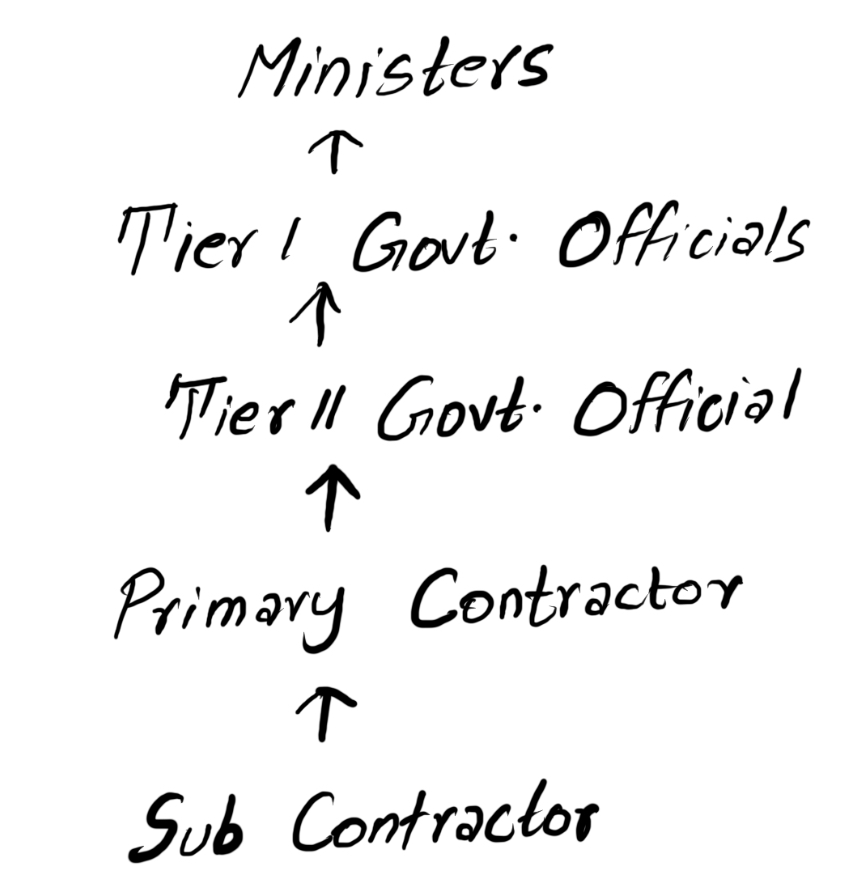
Every technology element of this use case is supported by mature technologies, including deep learning algorithms that have already been perfected. However, in some cases, you will have to integrate several technologies into one single solution. From a project management perspective, there obviously will be an organizational hierarchy for each such project. Let us assume that the figure below is the hierarchy.
There are also project milestones spread throughout the project plan.
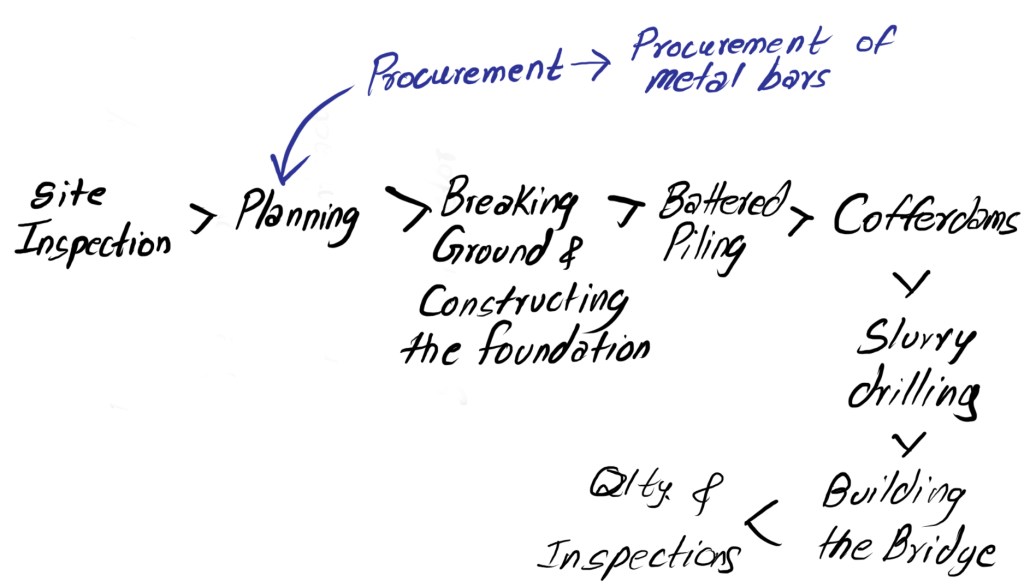
We have used one specific element, a raw material within one part of the project (procurement), as an example to illustrate how AI-enabled technologies can help. Let us say that within all the materials, steel bars that support the integrity of the structure are an important one. You have vision technologies available that can scan the bars to determine structural capabilities and parameters like tensile strength, grade, dimensions, ductility, bond strength etc. Vision and non-vision-based technologies currently exist to capture all these. They just need to be integrated to build one comprehensive solution. In fact, with some more modifications that include integrating additional algorithms, the same software can be leveraged for detecting build quality in later stages of the project as well.
We are assuming that the structural requirements of the project have been captured in the planning phase. The illustration below highlights an example of how technology can help improve build quality.
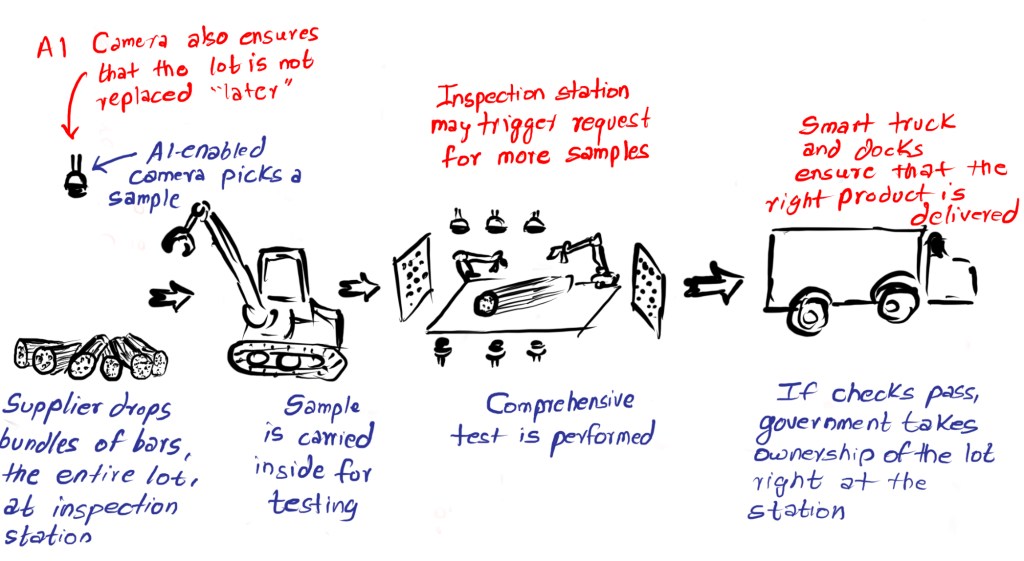
When a batch arrives at the dock, an automated system picks a lot and makes it goes through the vision test. If the parameters fail, an alert is triggered throughout the hierarchy introduced earlier. See the beauty of it? Mr. Gadkari’s laptop now has an annoying notification right on the desktop that won’t go away till someone below him in the hierarchy clicks on” resolved”. While he may not notice it, an IAS below him knows that Mr. Gadkari has also been sent this notification. Basically, everyone in the hierarchy knows that this is a shared information.
When anyone in the hierarchy submits the flag as” resolved”, they have to fill a “mitigation form” first. This mitigation form template is generated by AI based on the specific issue that has been detected. AI can highlight specific mitigation aspects. To close an issue after filling out the mitigation form, some very specific datasets and images will be needed. In our specific case, this means procuring a new lot, at the expense of the supplier.
As samples of the new lot arrive, they will be tested again to make sure that the batch parameters match the data on the mitigation form.
We have used one specific element, a raw material within one part of the project (procurement), as an example. But the fact is that checks and balances can be built, leveraging advanced tech, to curb corruption at every step, using AI-enabled technology. Governments will come and go, but unless India addresses this corruption embedded in infrastructure projects, we will always take one step backward for every two steps taken forward.

 Designed Analytics Blog