

This article is the fourth part of a series of articles. You can read the previous parts using the links below.
In the third part of the article, we started discussing the “supply side” dynamics of reselling and skill development. The supply side in our context is the population that is currently in undergraduate degree programs, across various disciplines across India. Their number may very well be more than the entire population of the United States. We overviewed the process shown in the illustration below:
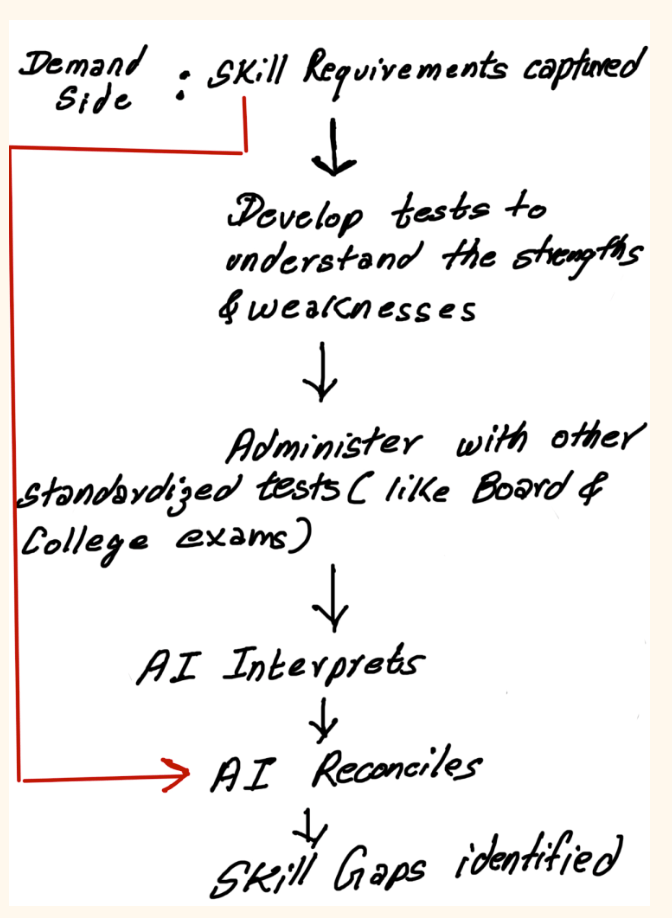
Let us try to now explore the above process with an example. Let us say that one of the top skill area that has been captured is Artificial Intelligence (AI) skills. I mentioned in the second part that the core of capturing demand (skills needed) will be a template. What can be the format of such a template? There can be various versions. Let us explore an example.
One element that we need to understand is that behind the need for any skill gap is a capability. A capability that we want to develop. Let us assume that using that same template and Generative AI, we have defined AI as a key skill area, with the skill levels shown. Note that this doodle is illustrative and not comprehensive.

The layers of skills within the capability are also illustrative but are robust representation. If you are thinking about AI capabilities, first of all, the skill requirement will not be same across industries. As an example, from the perspective of solution provider, development of AI-enabled solutions is a critical skill. That may not be applicable to industries that will use these solutions. For them, management and application of those solutions to business processes will be a critical requirement.
Once you map skills at a high-level, you will then determine what I like to call “defining traits”. What this means is that if you are facing a skill crunch of AI solution developers, you will test for certain defining traits that highlight that a particular individual has the skills to become a good developer, given training, if they already are not one.
We often are so obsessed with programming language and technical aspects that we forget that most of that does not translate into skills that are actually needed in industry, even for technical roles like solution development. It is not difficult to determine the “defining traits” for all layers, across industries.
Leveraging these defining traits, you will have to develop very brief tests. The fact is that if designed properly, a 15-20 minutes test can capture the aptitude, unlike the aptitude tests that are typically administered in India. Note here that the approach means that there will be hundreds of versions of such tests, focused on various top skill needs. Hundreds, but short and crisp tests. These tests can then be administered with university and college exams. All you have to do is to let students know that this will provide data to create a national skill alignment initiative, to help graduates get jobs.
In the final part of the series, we will explore how AI can leverage the data collected from these texts. The final part will be published on 09/04.

 Designed Analytics Blog