

This article is the third part of a series of articles.
In the second part of the article, we discussed the demand side. In our specific scenarios, the demand side is the skill set demanded by various industries across India. We discussed the challenges of capturing this demand, but we also emphasized how it was relatively easier to capture than capturing the current state of supply. The supply side in our specific context is the population willing and open to work and may have a varied set of foundational skills.
The challenge, as identified in the second part was to match this supply with that demand. It should be obvious, that if the supply or the characteristics of the supply, in this case the skill set, does not match the demand, then we refurbished the product, which in this case means rescaling. After all, remember that we are trying to leverage generative AI to understand the rescaling requirement.
In the first part, we explored the characteristics of a model, specifically a generative AI model, that can help capture the demand side of skills. Now, let us turn our attention to the supply side.
The median age of an Indian in 2021 was 28.7 years. More granular data is not available, and this data is from 2021 since we have not done a census for a long time. But the same 2021 dataset captured that 26% of the population was under 15 years of age and 67% between 15-64.
Assuming a uniform distribution in this 15-25 age group, we can estimate that approx. 40% of population is below the age of 25, and the prime resource for industries. This is the first category that needs to be evaluated. Let us pick one sub-segment as an example. 20-25 years old who will be graduating from undergraduate and graduate programs.
That category of 20-25 years old itself translates to maybe more than the population of the United States. No other country in this world has that level of untapped resources. But that makes capturing the current state of skills as well as re-skilling endeavors challenging as well. If executed properly, this could be the largest such initiative in the world but can totally transform the country and its position in the world. The good aspect of this approach is that once you put a system in place, it can be leveraged every few years.
Just like capturing the skills needed on the demand side, at the core of this quest is standardizing the way current-state skills and strengths can be captured in the form of a test. The good news is that most in this age group go through some form of standardized testing system, like their college exams. This system can be leveraged to capture the key strengths and weaknesses. There can be an incentive offered to take this short test at the end of any of the exams.
The first critical step is to design a standardized 10-15 minute aptitude test that captures the skills without being too technical in many cases. The rough doodle below highlights the process.
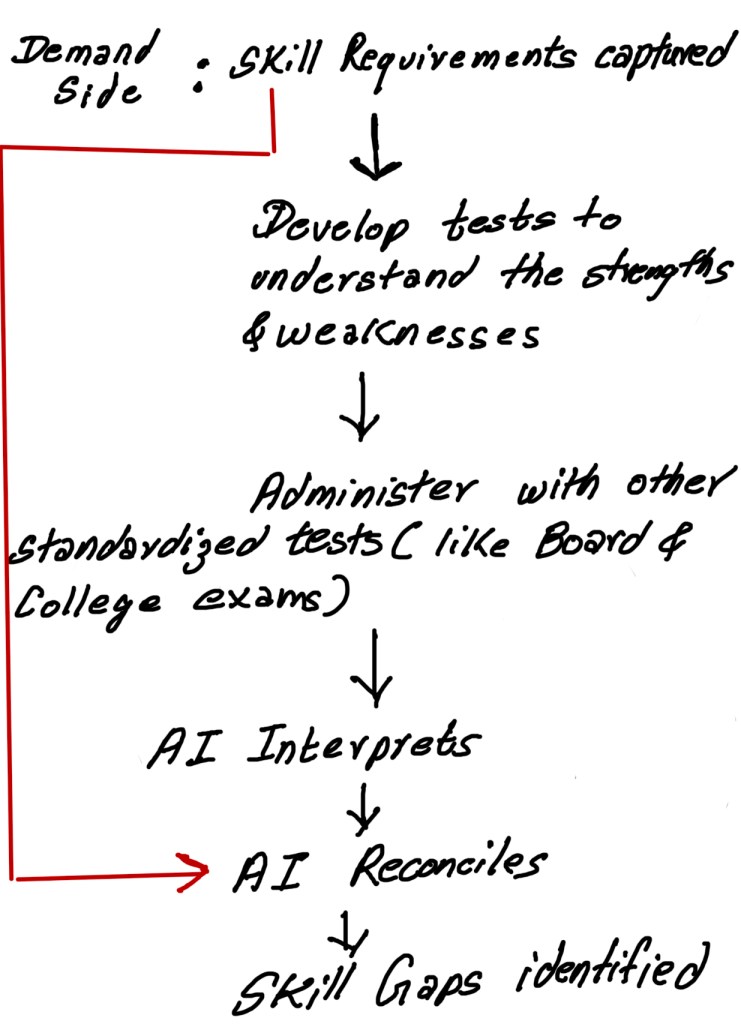
The content, structure, and format of the skill test will be based on the demand analysis that should have already been done and will also be based on the segment that is being tested.
Hence, there will be different categories of this test. For example, if we want to evaluate whether non-technical graduates can be trained to work in smart factories, we will have to design a test that is non-technical but still can test for aptitude for the skill. We will understand what this means in the final part of this article series, which will be published on 07/20. In that part, we will also explore the role of AI in evaluating the test responses.

 Designed Analytics Blog