

Recently, I have observed a growing consensus in mainstream media articles suggesting that artificial intelligence algorithms exhibit limitations in handling factual information and may be better suited for creative endeavors. One such article is linked for your reference. I discussed this topic in this week’s episode of So what? You can watch the episode below.
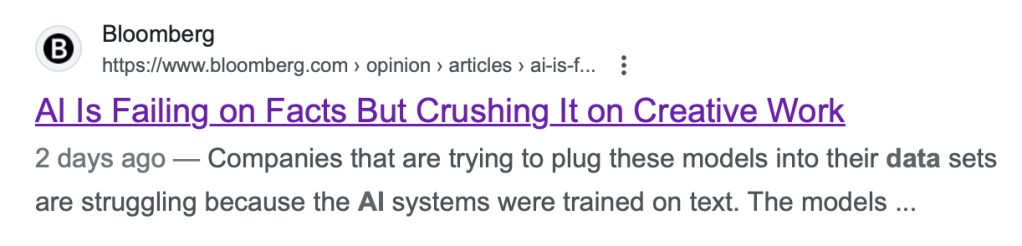
There are several undesirable nuances to this type of generalization. To begin with, we have to remember that when non-technical authors read about AI, they primarily encounter information about large language models geared toward generative AI. As demonstrated in the video example below, the constraints on the output are not stringent when it comes to producing images, videos, essays, and stories. The AI can take “creative” liberties.
This implies, as shown in the example, that two images generated by a large language model based on the prompt “A cat in a hat wearing a business suit,” while distinct, would still be considered accurate outputs. The essence is that the model can generalize more and still be considered accurate. However, that is not the case when discussing hard sciences and facts.
As highlighted in the video, the amount of learning these extensive language models must undertake to become comprehensive knowledge repositories is colossal.
When a model makes a factual error, it is not due to inadequate learning of that factual data. Instead, the model’s challenges with facts, such as hallucinations, inaccuracies, or errors, arise only when a prompt either requests information beyond its training scope, inadequate training on that certain domain of facts, or the prompt is structured purposely in a manner that confuses the model.
It is concerning that if the notion that artificial intelligence algorithms are ineffective with facts becomes widely accepted, significant and lucrative opportunities may be missed in the near future. Organizations may hesitate to adopt these technologies for factual applications due to concerns about their maturity. However, the reality is that these technologies, both independently and in combination with other AI algorithms such as deep learning algorithms, offer substantial potential for businesses.
As observed in the video above, there is a clear need for the development of specialized and focused Large Language Models (LLMs) that focus on facts and analytics. However, the optimal approach to achieving this remains a topic of discussion. We will explore the identification of opportunities for creating such models and the subsequent steps involved in their development in the upcoming Design Analytics Report, titled “Avoiding the Third AI Winter.”
The report will be published on July 8th.

 Designed Analytics Blog