
Last Saturday, I started a two-part article on how countries like India can leverage Generative AI to help plan a strategy for addressing skill gaps and unemployment. My goal was to publish the second part today. However, many events took place in India over the last week.
If you are an Indian citizen, you probably are aware of some of those unfortunate events. India is currently, or at least some parts of India, experiencing heavy rainfall. Three different airports in three different cities in India suffered infrastructure damage over a period of three consecutive days due to heavy rain. Some of these structures were built recently.
In the business world, cosmetic innovation ends up hindering an organization more than helping it. Cosmetic infrastructure does the same in urban planning and design. It is obvious that these structures had construction issues. While they looked good enough to inaugurate, they were definitely not robust enough to sustain the local environment even for a few months. Equally disturbing is the fact that there has been little or no accountability for these disasters.
Then there was the challenge of major cities getting flooded due to massive rain. Footage of cities inundated with rain, whether in the national capital or other parts of India, abound. The worst part is that it looks like citizens have been left on their own in most cities and states.
So when I sat to write the second part of the “Generative AI for re-skilling” article, these recent events kept bugging my mind. But there is still time to leverage technology to ensure we avoid these from happening in the future. Hence, I decided to write on this topic today. I will still go ahead and write the second part of that Generative AI article next week .
While developing countries face the challenge of catching up to build the infrastructure that developed countries already have, they also have an advantage in today’s digital age. That advantage is building digital capabilities within that infrastructure.
My thoughts kind of got fixated on why these cities, some of which are metro cities, get flooded, specifically areas in the capital city of Delhi. Mumbai gets flooded every year or almost every year. And there is a rationale behind that. Mumbai’s sewage system goes out into the sea. During monsoon season, the level of the sea rises, thereby causing the sea water, in some instances, to flow inwards into the drainage system. That is not the case with Delhi.
Delhi’s misery is a result of bad urban planning. Too much development and construction has happened in many areas of Delhi during the last decade. One result of this development is that these areas have become concrete jungles, and there is very little soil for the rainwater to percolate naturally into the ground. So, while on the one hand, water floods the streets, on the other hand, ponds and lakes in many areas are dying.
The good news is that a digital twin of the infrastructure, coupled with a deep learning algorithm and simulation tool, can help address these challenges. In fact, it must be in place as infrastructure is built in countries like India.
India forayed into the world of smart cities more than a decade ago, at least conceptually. However, like many other things smart, the world, not just India, has not yet deciphered the true meaning of building smart entities. The purpose of any smart entity is not that it’s connected to the Internet or captures data, but that it harvests that connection and data in an efficient way.
If we had built a truly smart city or at least smart blocks in areas of Delhi, the government could have acted proactively. That form of a smart city, which, in my opinion, should be the only form of a smart city, can also help with proactive infrastructure planning. The definition of smartness, whether a smart factory, a smartwatch, or a smart city, is that the data it captures through its smart devices can be leveraged to change how something is done.
For example, measuring the blood pressure on your watch while still being connected to your smartphone and then being able to get insights based on the readings is what makes the watch an actual smartwatch. The same goes for a smart factory. If you start following my smart factory insights video series, after a few episodes, we will discuss why just automating a factory does not make it a smart factory. The same goes for smart cities.
Many may have frequently pondered what exactly makes a smart city smart. Let us use these unfortunate events to explore smart city capabilities. Remember that this is just an example, so the kind of sensors or smart infrastructure that are being described are not exhaustive but specific to this scenario only.
Refer to the illustration below.
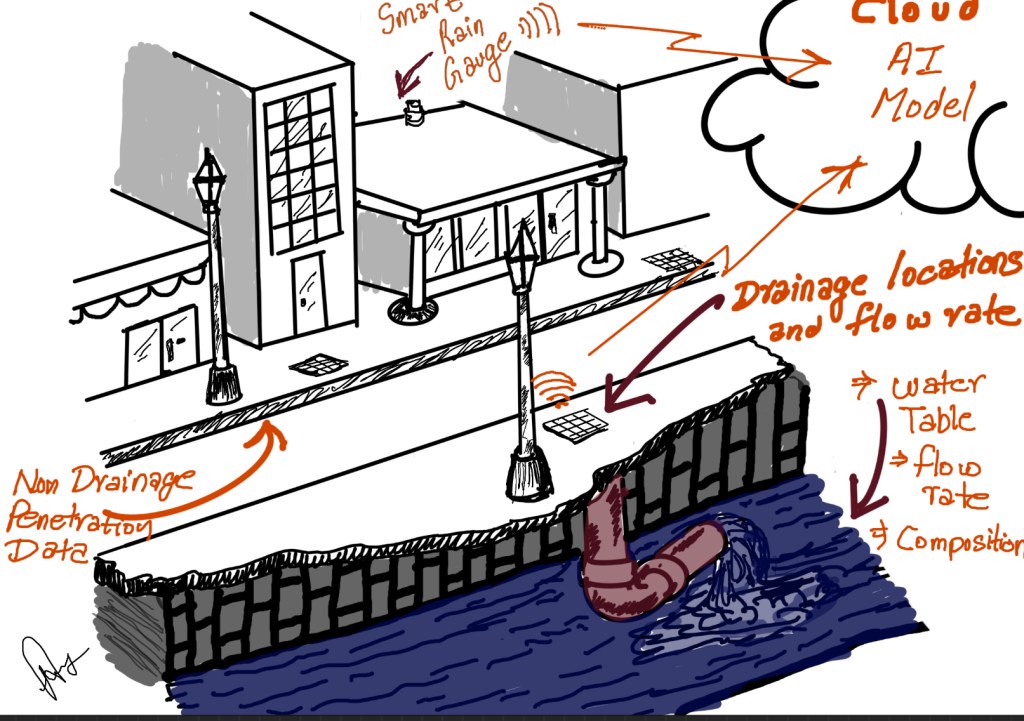
A true smart city would allow you to capture a digital twin of the city. In this specific scenario if we consider a block of the city, we would have details captured in the form of a simulation model that leverages a plethora of data points captured through various devices and sensors as shown in examples. A high-level data point is the surface area of the block. It would also leverage information like how much surface area is not concrete and allow the water to percolate into the ground.
In the areas that do allow water to percolate into the ground, there will be sensors to measure the percolation amount, flow, and properties of the soil medium. Similarly, there would be equipment to capture the groundwater table into which the water will eventually percolate. All that data being captured by these equipment and sensors will be relayed directly to a digital twin model hosted in the cloud.
Every drainage outlet within that block would have water flow sensors installed to measure the rate at which water flows into these drains. There would be sensors to measure the amount of rain across landmark buildings in the block. You can already start seeing how these example parameters can help a digital twin or a simulation model hosted in the cloud to evaluate the impact of rain in specific areas.
You can think about it from a very high-level overview of input and output. If you know how much rain a specific area is receiving, how much can percolate into the ground, and then what is not percolating is going into the drain, you would understand, just by a high-level insight of inflow and outflow rate, what the risk of flooding is. The twin can also capture the underground drainage system, as shown in the illustration above. Again, flow measurement sensors and water table measurement sensors installed in the underground drainage and sewage system can help if the infrastructure is on the brink of failure because of more than usual rainfall.
Having a digital twin that is capturing data from a plethora, ideally, millions of sensors across the city to keep building a picture of a digital twin of a city every few minutes beyond this specific scenario is what can be termed as a truly smart city.
Let us revisit the three airport infrastructure collapse scenarios. A simple combination of sensors combined with some pre-programmed data, based on the physics of the structure and physical properties of the material used for construction, can easily relay information that can then be leveraged by an algorithm to understand at what point the structure will fail or collapse, in near-real time. Of course, the efficacy of all this also depends on whether the contractor or the vendor that constructed the structure will provide accurate and honest data on the properties of the structure and failure thresholds.
This approach of building an actual smart city also brings accountability into play. Right now there is a blame game going on, but the fact is that if there is a system in place, enabled by AI, to give proactive warnings about such kind of situations, there cannot be a blame game and someone will have to take accountability.
As the structure started warping in the airport collapse scenario, it could have been detected and analyzed in real time via installed sensors. The algorithm could have triggered a warning to an official who was already registered as the contact point. This process could have not only brought accountability but could have also helped evacuate the effected area.
Opportunities to leverage AI in the public sector, both in developed and developing countries is so massive that the revenue opportunity can be larger than the total revenue generated by big tech companies. And it is high time we tap into this opportunity.

 Designed Analytics Blog