

With the recent explosion in the Generative AI domain, like many other industries, healthcare organizations are also exploring ways to integrate LLMs into their workflows. In this five-part article series, we will explore how Generative AI can enhance experience in healthcare from the perspective of both the patient and the provider. This is the final part of this series. You can read the first, second , third and fourth part on this blog site.
In the second part of the article, we touched upon a provider LLM that helps in patient management. The same LLM can also help service providers. Following the trend that from the previous parts of the article, we will explore scenarios as examples. In each scenario, we will explore how a LLM powered co-pilot helps in patient management, productivity automation and knowledge management.
Adam is a staff member at Good Health Associates, a primary physicians practice. He is just settling down with his morning coffee when the phone rings. On the other end is John, an existing patient. While Adam is reaching out to receive the phone call, he glances at this notification on his screen from the co-pilot (the co-pilot can read data from the call management system):
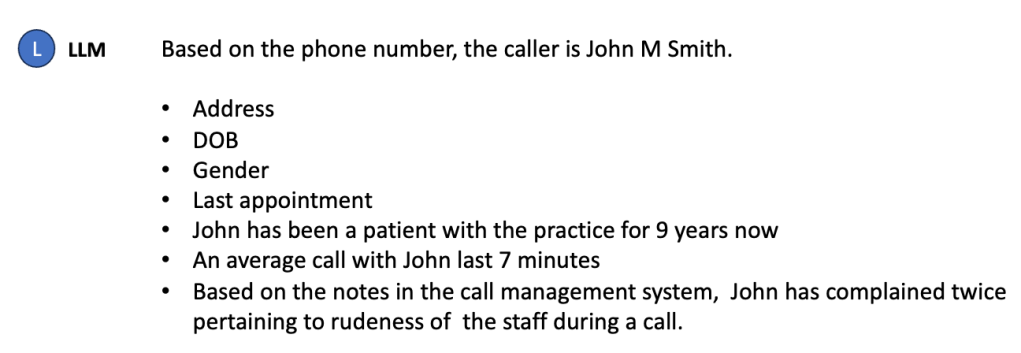
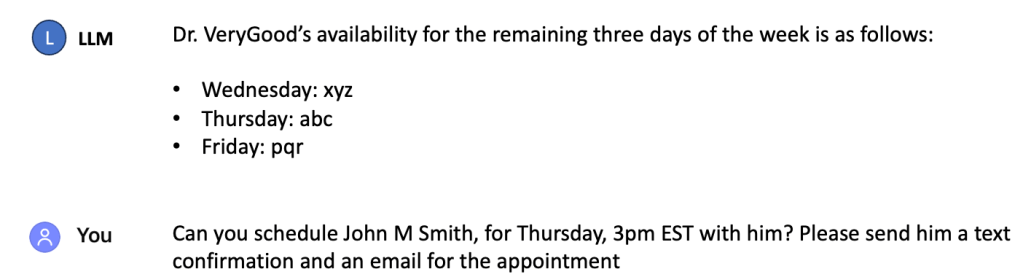
The notification provides some useful context to Adam before he starts the conversation. He tries to be as polite and patient as possible. Looks like Jon is experiencing neck pain and wants to see the doctor for that. As Adam is conversing with John, he is also using the co-pilot to keep the scheduling process moving in the parallel.

Adam shares the availability with John and based on John’s conformation, he confirms the appointment in the system, leveraging the co-pilot.
John arrives on the day of the appointment, and thanks to the pre-work that LLM helped him with (as explained in the second part), he does not have to do a lot of paperwork. Meanwhile, the nurse assistant checks her system for details on the next patient. The co-pilot helps her with some background.
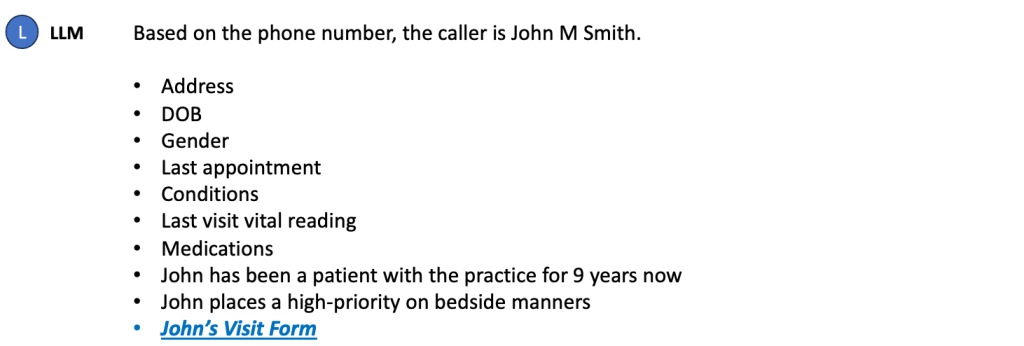
The nurse assistant whisks John inside to prep him for the appointment. She tries to be as nice as possible based on the notes from the co-pilot. She enters John’s vitals like his heart rate, oxygen level and blood pressure in the system and asks him to wait for the doctor.
Within next 10 minutes, Dr. VeryGood enters the room and greets John. They have known each other for years now. As Dr. VeryGood is engaging in small talk with John, she looks at the system and sees some notes there from the co-pilot, based on the vitals data entered by the assistant.

Dr. VeryGood jokes with John, asking him if he is excited to meet her, since his heart rate is elevated. John indicates that he is nervous because of the consistent pain in his neck. At this point, Dr. VeryGood starts examining John. She notices a lump on John’s neck which is firm and fixed. She asks if John can feel any pain as she presses the lump and John replies in negative. The lump is worrying Dr. VeryGood. She suggests to John that he should see a specialist. In her mind, she is worried that cancer can often be asymptomatic in the early stages.
John reluctantly agrees for the specialist appointment and after thanking Dr. VeryGood, walks towards the reception to get help scheduling the appointment with the specialist. Meanwhile, back in the consultation room, Dr. VeryGood starts interacting with the LLM, and provides some inputs on her observations.

Satisfied that her observations were in sync, she called reception to help John get the earliest available appointment with the specialist and inserted her notes in the appointment request. She then moves into the other consultation room to meet the next patient.
Throughout this article series, we have used examples to highlight how a LLM can help. As you can imagine, these scenarios were not exhaustive. The fact is, LLMs can significantly enhance both the provider and patient experience. The future of LLMs in healthcare is exciting !

 Designed Analytics Blog