

The double-edged sword of population
Population can be both a bane and a boon. The same holds for India. While it is now among the top five economies in the world, when it comes to the real measure of any country’s development, per capita GDP, it lags significantly. Some economists consider $12,000 to $15,000 per capita GDP to be sufficient for developed status while others do not consider a country developed unless its per capita GDP is above $25,000 or $30,000. For benchmarking purposes, some per capita GDP numbers have been shown in the figure below.
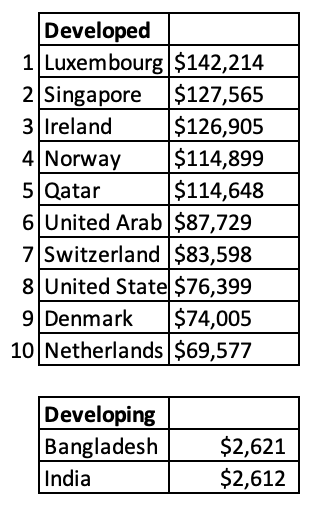
India’s per capita GDP is approx. $2,612. So even if India becomes a $10 trillion economy (approximated to be by 2031-32), and with the unreasonable assumption that the population does not increase at all by the time we get there, we will still not be considered a developed country ( as we will still be below the $12,000 threshold).
Our most significant resource, our population, is dragging is down.
But the same population can be used to accelerate the economy’s growth faster than our population, in a way that our per capita GDP breaches the $10,000 mark by 2035. If you can leverage a significant percentage of the population to contribute to the economy. The problem is, we are really struggling in that aspect.
India’s unemployment challenge
A recent International Labor Organization report highlighted that 83% of India’s unemployed are youth. Since it was published amidst Indian elections, the numbers were disputed by the Indian government. Though the percentage may not be that high, the fact is that umemployment among youth is significantly high. A statistic that highlights this is that almost 40% of students from India’s elite Indian Institute of Technology (IIT) are struggling to find a job on campus.
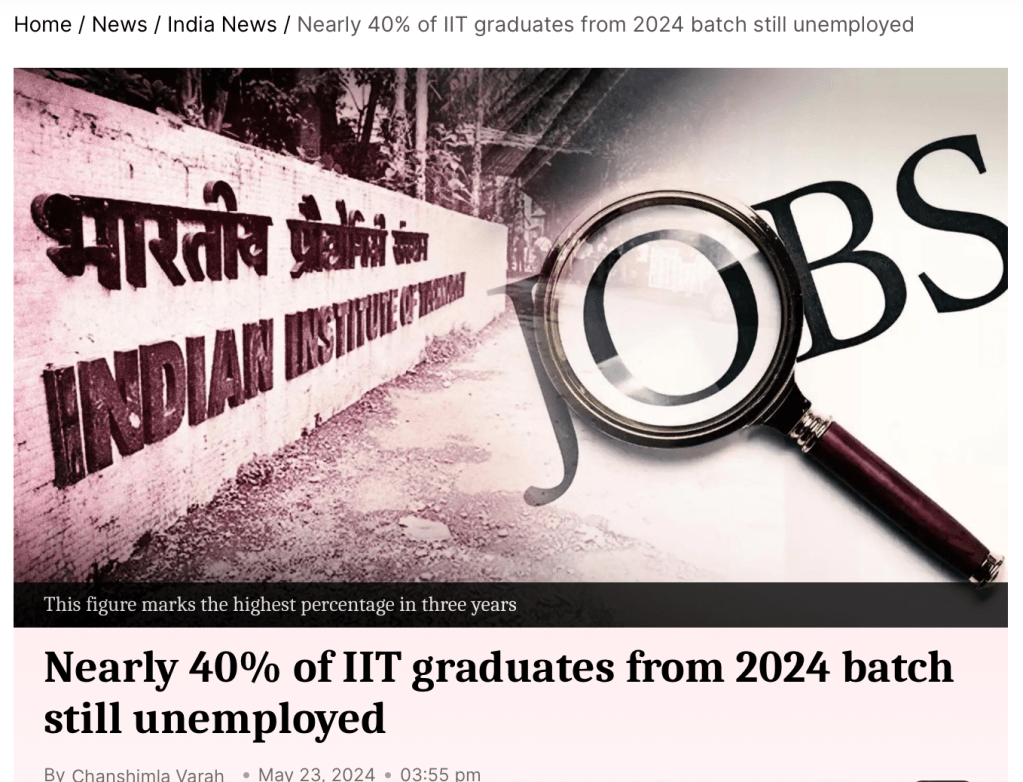
This percentage highlights that the percentage approximated by ILO may not be very off from reality. Therein lies a big problem. India is failing to leverage its biggest resource, its youth, to power its economy. A key question arises, why? One key challenge is that a majority of youth in lower-tier towns (like the one I come from) are extremely risk-averse and, hence, are obsessed with government jobs. These job vacancies have slowed in the last few years, but the fact is that even if you doubled these numbers, it would address only a minuscule part of the problem.
The root of the problem can be found in the screengrab from a LinkedIn post.
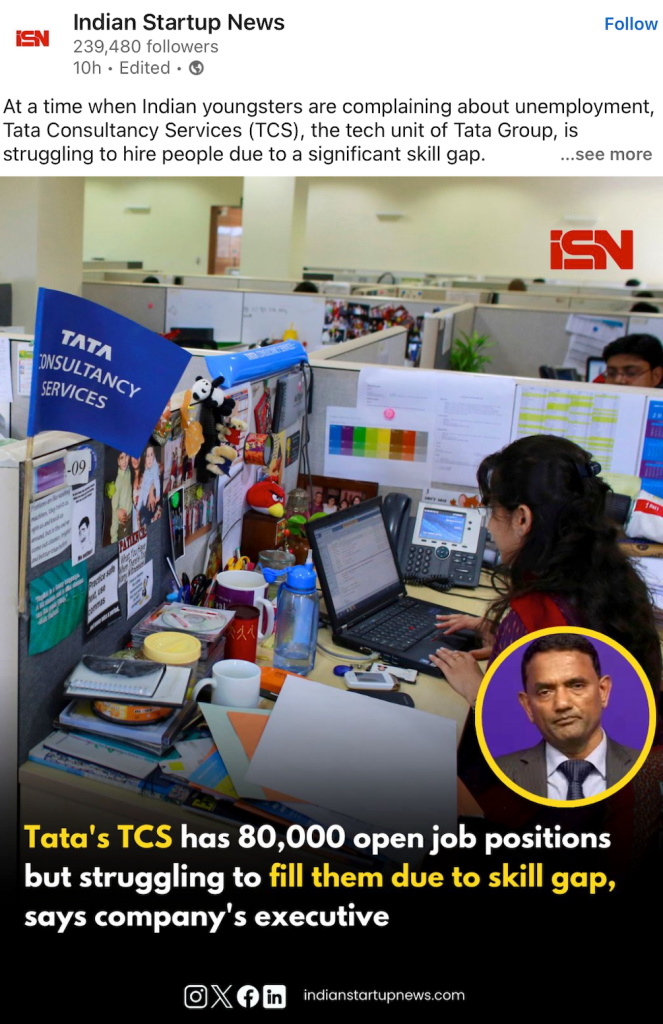
Yes- the root cause is skill gap and the answer to the unemployment challenge hence is reskilling.
The massive reskilling imperative
The most recent chief minister of Andhra Pradesh (a state in India), Mr. Chandrababu Naidu, who has largely been credited with making Hyderabad, the capital of the state, one of the major IT hubs, recently said something along the lines of:
“India does not need a cast census….it needs a skill census.”
The need for a skill census totally resonates with me.
I certainly do not agree with no cast census at all. You need to know what percentage of your population needs more attention. Unless you pay that attention, you will not meet your development goals. But let us not divert into that arena.
The gist is that there is definitely a need to understand the skill levels of today’s youth and then reconcile it with the skill requirements. This needs to happen before reskilling strategy can be formulated. However, doing it in a practical way, in a country with population the size of India, is extremely challenging. The good news is that Generative AI can help, by being a component of a solution that can help understand the skill gap. How? This is exactly what we will discuss in the second part of this article. The second part will be published on 06/29.

 Designed Analytics Blog