

With the recent explosion in the Generative AI domain, like many other industries, healthcare organizations are also exploring ways to integrate LLMs into their workflows. In this five-part article series, we will explore how Generative AI can enhance experience in healthcare, from the perspective of both the patient and the provider. This is the third part of this series. You can read the first and second parts on this blog site.
Like always, when thinking about how Generative AI can help patients, we have to think of the patient as a customer and then explore how we can make the customer’s life easier. The important first step is to understand what are the key tasks the patient has to do and where Generative AI can help. If we think about patient management in healthcare at a high level, we can divide it into two different buckets:
- Provider interfacing patient tasks
- Self-management patient tasks
Let us explore these two buckets, specifically the tasks that fall within these two buckets, and how Generative AI can help enhance productivity in both these buckets. We will use some examples of interactions to highlight the approach to thinking about such solutions.
Provider interfacing patient tasks
Picture your life as a patient of your specific healthcare system. This will help us understand the tasks that we need to perform that interface with the service provider. Those are the tasks that fall within this bucket. Let us explore this with the help of a scenario. You get up in the morning feeling under the weather. You decide to take the day off and sleep it out. But by afternoon, you feel you may have a mild fever, and your throat hurts. It may be time to see a doctor.
When we are in pain and feeling under the weather, the last thing we want to do is to go through a couple of holds on a phone call and explain whyand then your symptoms we are calling to multiple people. And to be candid, you know how many times you have called your physician’s office with such symptoms just to have the nurse tell you to take OTCs and wait and watch for 48 hours. But the good news is that the provider now has a LLM model that can provide the same insights. That LLM model will obviously be customized and will have many legal disclaimers. But the suggestion, when you explain your symptoms, will still be on the lines of what ChatGPT suggests:
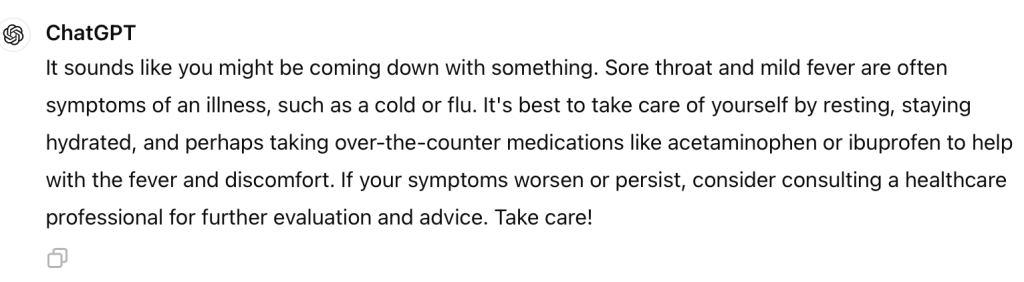
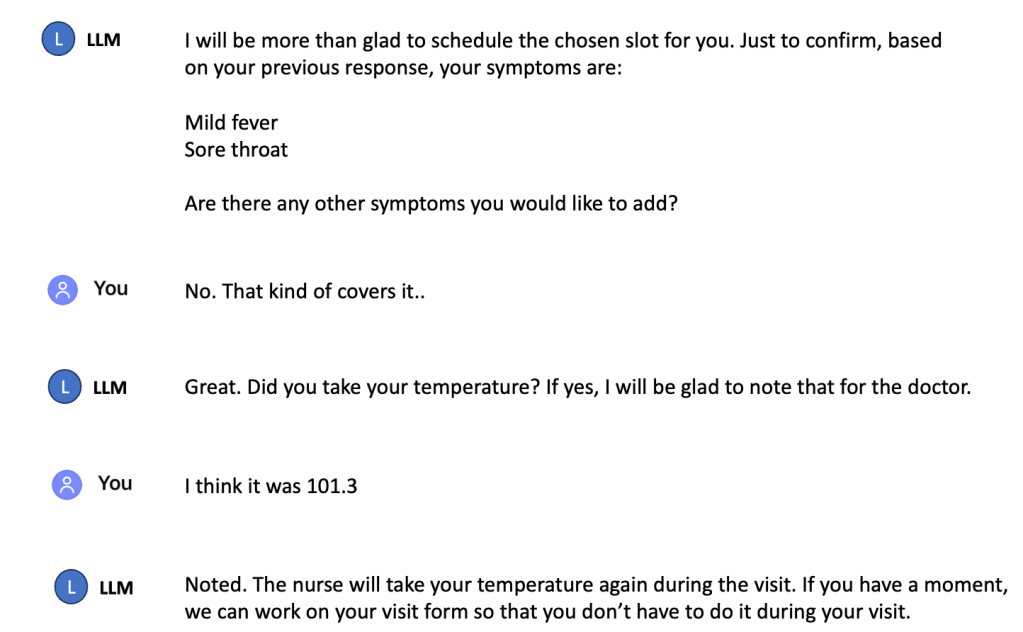
But let us imagine what the customized LLM may look like. As you know from experience, the above text is very similar to what nurses suggest. Now let us assume you did take these for the next couple of days, but you are still feeling like crap. It is time to see the doctor for sure. Let us assume you want to understand who you should see in the practice. You can have conversations like the one shown below with the LLM.

You go ahead and select a specific day and time. There may be some follow-up conversations and you are all set to see the doctor.
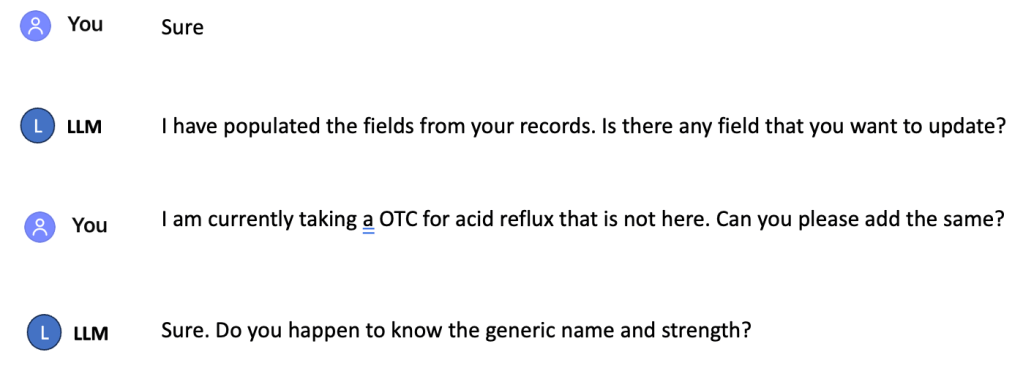
So you went to see the doctor and were prescribed an antibiotic. You come back home, planning to ask your wife to pickup the prescription on her way back home. Then you realize that you did not update the pharmacy, while you have moved to a different neighborhood in the city. You get back on your laptop.

Great. Come evening, you wife is home with the medicine and is now hovering around you to make sure you take it on time. Suddenly, you remember that as a child, you once had an allergic reaction to a specific group of antibiotics. Is this the same group? Well, back to the laptop again.

But what about drug interactions?
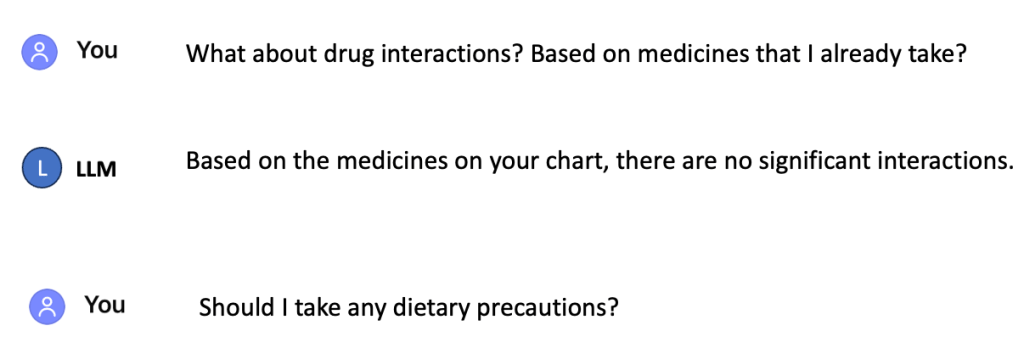
Well, the conversation will continue, but you get the gist. This LLM, provided as a tool by the healthcare provider, will aid in patient management aspects that do not require significant expertise. The key is to understand what tasks the patient needs help with during their interactions with the provider.
In the fourth part of the article, we will explore the bucket of patient-managed tasks. The fourth part will be published on 06/24.

 Designed Analytics Blog