

The post below, which I came across on my LinkedIn feed, is funny and ironic at the same time. It also highlights the fact that like many other “reskilling” initiatives, we have started checking boxes with GenAI as well. You will read claims like ” we have improved productivity of our workforce by x% due to GenAI.” But like many other technologies, when it is time to show the outcome, companies do not have or will not have anything to show for it.
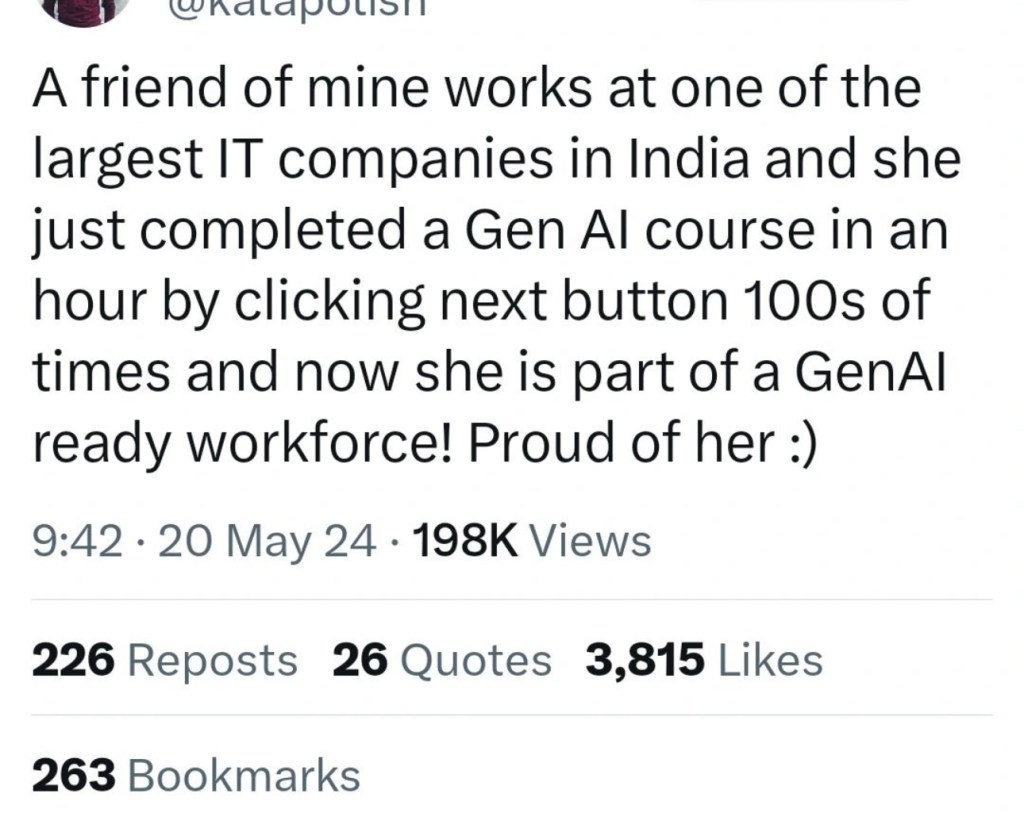
Like almost every skill penetration strategy, GenAI initiatives must be “interesting” enough to be absorbed by those working within the processes. The “interest” factor is paramount. For most organizations, the set of employees within the processes who will embrace GenAI in their work is those already interested in the tech, playing around with it, and probably using it to enhance their productivity.
Those not interested will see the reskilling initiative as another mandatory training. They will complete the training. When forced further to reskill, they will probably also use it somehow. But that is not how GenAI’s real potential for productivity enhancement is unleashed. Only the individual employee knows what is the best way to leverage GenAI for their own unique needs.
The keyword here is “interest.” Here is another perspective on this: When we talk about productivity, the meaning or priority of productivity may differ from one employee to another. If you despise taking minute notes during meetings, you may consider doing that to be a productivity kill. If you hate structuring and managing your Inbox because of the crazy volume of emails you receive, you may place that as the numero uno priority when leveraging GenAI. Hence, the definition of productivity enhancement, whether leveraging GenAI or not, differs from employee to employee.
The gist is that in order to leverage GenAI most effectively, employees need to be interested in exploring its underlying concepts so that they can then use it for their unique productivity enhancement needs. It is the “interest” factor that will lead to real re-skilling.
So the key question then becomes: How do we build interest in any technology, GenAI or not, if we want our workforce working within the business processes, to absorb new technologies in a way that allows them to use it in their own custom context? We will discuss this in our upcoming report “Business 4.0: Becoming a Technology-Driven Enterprise.”

 Designed Analytics Blog