

This article is the second and final part of a two-part article series. In the first part, we introduced the analytics problem behind the mobile orders bottleneck identified in a WSJ article. In this second part, we will explore how an AI-enabled system can help Starbucks tackle not just this challenge, but several more.
There were two scenarios that we covered in the first part of the article. The first scenario was where we do not do any price discrimination between store and mobile orders. The AI solution for that scenario has been described in today’s (tenth) episode of Maverick Mondays.
Let us explore the scenario where we need to invoke price discrimination. But before that, let us quickly explore another way to look at it.
As discussed in Episode 10 of Maverick Mondays, if the availability, in terms of the stores that can be activated or readied for mobile orders, is limited, the focus then shifts to how those stores can scale their resources so that they can deliver the true benefit or mobile orders to the customers.
The benefit obviously is minimal to no waiting time. There is obviously a cost involved here. Common sense dictates that if mobile orders are taking as much time as walk-ins or drive-thrus, then the number of resources at the store are not enough. Increasing headcount means increased cost. Hence, the fundamental analysis here is cost-benefit analysis.
One way to do this, without any AI, in Excel, is to understand the lost revenue. This is tricky to capture though in terms of data. Again, since I do not have access to the data, I will make assumptions. Unless you track a customer by their reward or customer ID, a canceled transaction in mobile order does not necessarily always mean that the revenue was lost.
It may be the case where the customer arrived at the store and saw no movement in their mobile order. They then decided to cancel the order and order in person. But if every transaction can be associated with a customer ID, you could identify if the customer ended-up not making any purchase at all. That is why I overemphasized the importance of customer level transaction data in today’s episode of “Maverick Monday”.
In that scenario, you can use basic analytics approaches to perform a cost-benefit analysis. The revenue lost due to canceled mobile orders, that did not translate into an in-person or mobile order at any other store, needs to be equal to or more than the cost of scaling-up for processing mobile orders fast.
But there is another way to approach it, where AI algorithms can help with price discrimination. Specifically, the setup of data and smart stores described in this morning’s episode. If you have not watched it, I strongly recommend to watch it before reading further.
Now let us use that setup to discuss the second approach. This is the price discrimination scenario. In this approach, we take the business case approach that we touched upon in today’s episode to justify the price discrimination.
If we want the customer to pay for the increased cost to process the orders fast, we need to build a business case for the same. Essentially, you tell your customers, why the increased price, in some cases in cents, are worth paying for, when using mobile ordering.
To understand the “value” aspect here, the value is the time the customer saves. This is the primary driver behind using mobile pay. So let us take another look at the illustration we used in today’s episode of Maverick Monday.
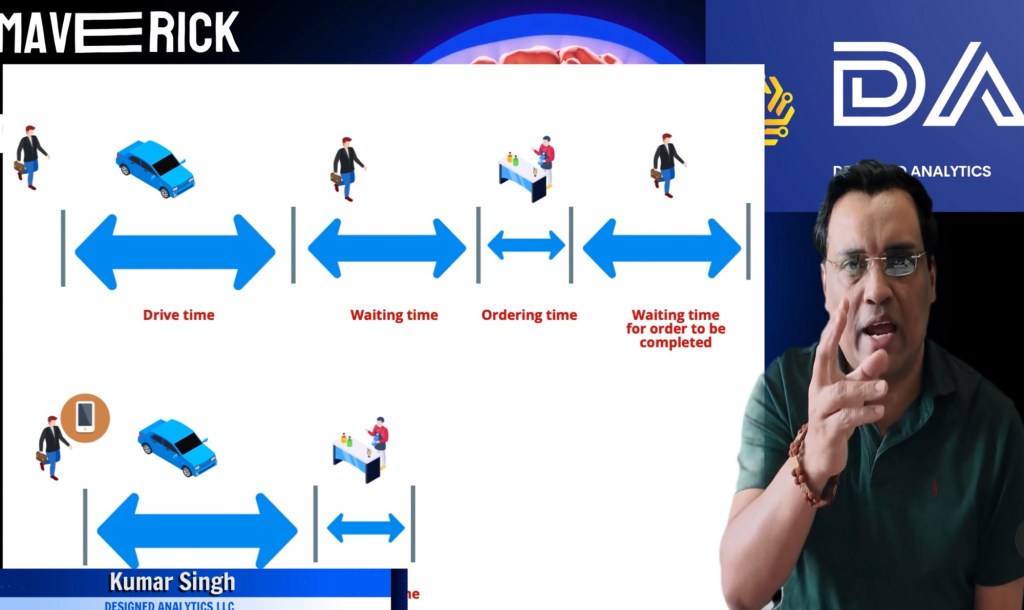
Just one quick look will help you realize where the value is. Which components of waiting time the customer can save. The question though is, how do you quantify it? The good aspect is that for making the business case, you do not need to translate the time saving in dollars. Just personalize the context.
But the question remains, what type of savings data can you use for the business case. And this is where we start getting into the setup. A segment of the solution, using the setup, has been shown below.
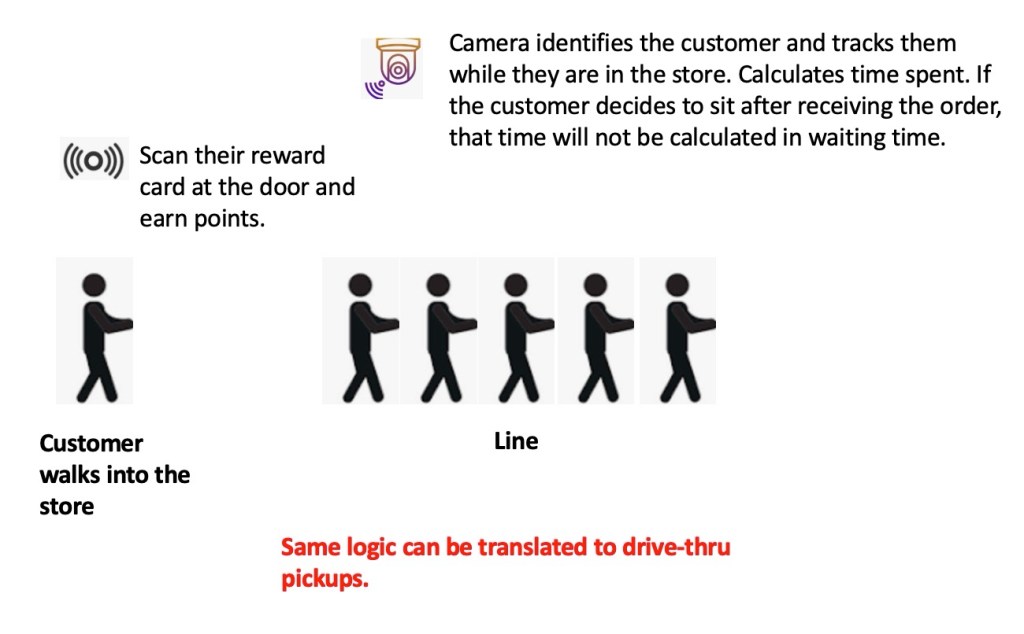
As you can see in the figure, the same setup that we used for previous scenario, allows us to build a hyper-personalized business case. This is one of the examples of the reason I highlighted that once you have the perfect combination of tracking each transaction (or most) at customer ID level, and have built smart store capabilities, the world is your playground.
What you are doing here essentially is that you tell the customer exactly how long they have waited on average, and exact numbers for the last one week, whether in drive through or in-person. The logic shown in the figure is at a high-level but will work perfectly when implemented properly.
The opportunities to leverage the infrastructure and data setup goes much beyond this use case. Starbucks can expand the portfolio of products and services in a way that can allow it to address slowing growth rate in the domestic market.

 Designed Analytics Blog