

This article is the final part in a series of five articles that aim to brainstorm ways to accelerate the adoption of massive advances in the AI arena into real-world solutions. In the first part of the article, we reviewed why this translation is an urgent imperative. In the second part, we started exploring industrial AI and its context, specifically the three broad categories or areas where Industrial AI needs to be adopted rapidly. In the third part, we used an example of a spend management solution I introduced in the second part, to understand an approach to accelerate adoption. In the fourth part, we concluded the discussion on industrial AI. We will conclude the series in this part by finalizing brainstorming opportunities and approaches in consumer AI.
Before we explore how we can accelerate consumer AI, let’s define consumer AI. In simple terms, consumer AI pertains to products and systems that leverage AI and are readily available for purchase by the public. So, while a smartphone that uses localized AI to translate is within the realm of consumer AI, AI-enabled equipment on the manufacturing shop floor is not.
Looking around you with this definition in perspective, you will find that you are probably already surrounded by consumer AI products. Smart locks, doorbells, security systems, TVs, refrigerators, microwaves—everything around us is now labeled “smart.” Some are indeed, and others probably aren’t. But one aspect is clear. The “smart” products that you are leveraging have been around for more than half a decade now. AI technology has progressed exponentially in these last few years. The fact that these “smart” products have not evolved in terms of the smartness they provide indicates that they are leveraging rudimentary forms of AI, primarily powered by the internet and almost decade-old voice assistant technologies.
So, what has been hindering consumer AI?
In the general architecture of these smart devices, they work as edge devices, connected to the cloud through WiFi (or ethernet cable if you have a dicey provider, like mine). The hardware capability on these devices constrains them in terms of what data they can capture, with little to no analytics being done locally. When these devices were initially introduced, the type of hardware that these devices could accommodate was not powerful enough to perform any sophisticated localized magic. While still present, that constraint has improved in the last few years. However, devices have not. Almost all “smart” devices that you can buy perform the same core tasks they were performing five years ago. It is nearly as if we have given up on consumer AI, a segment many times bigger than the industrial AI segment in terms of $ potential.
The key to reviving consumer AI lies in two words: Distributed EdgeAI
Consumer AI has long harped about ecosystems. You can build a smart home network. A network of smart devices. But if we look at these networks, we will find that there is not much intelligent exchange that happens. There may be a central hub that communicates with edge devices and centralizes all the information and data. But you will rarely have devices supporting each other., sharing data with each other in a way that one device can use the data generated by the other for their own capabilities. And that “mutual” support is the key to reviving and building consumer AI solutions that can perform tasks five times beyond the realm of current portfolios of “smart” products.
The gist of the approach is simple yet powerful. The hardware capability of edge devices has improved since they were first introduced. But still not powerful enough to perform siloed advanced AI. But they don’t always need to. They can work in unison as a network or hive. The illustration below highlights this approach.
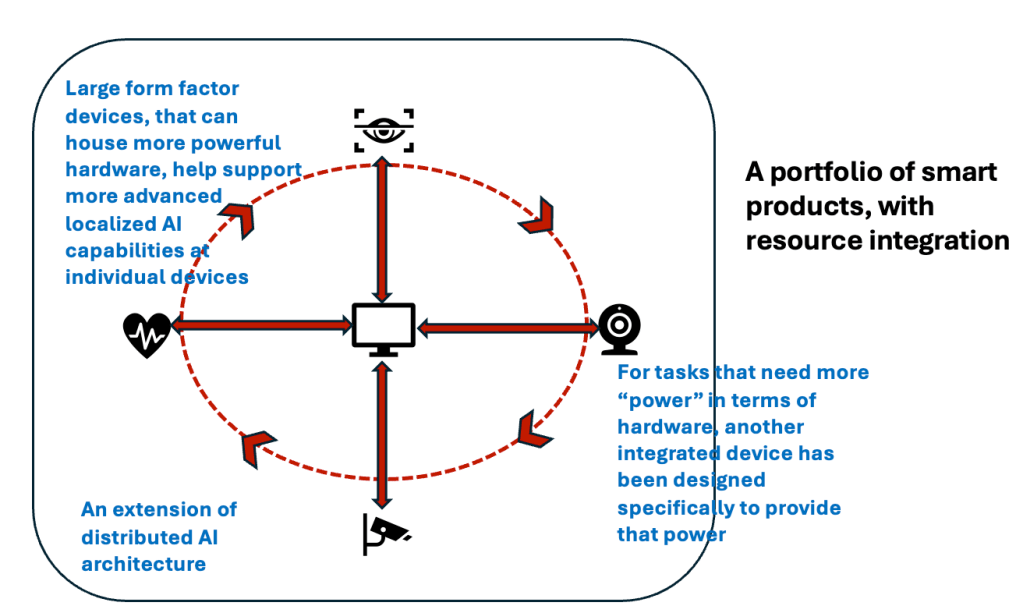
If your product is siloed, say a toothbrush, and you want the toothbrush to share data that can not be supported by the tiny chip in the toothbrush handle (like the time the brush is in contact with the teeth or number of circles you make while brushing, and similar dental hygiene patterns), you need to create a portfolio of products, which, can “help” the toothbrush capture the data. The general approach these days is to insert an ugly “hub” device, which has no standalone purpose and exists merely to help devices connect (not exactly provide AI support). What you need is an associated device, which is closely related, in terms of functionalities it can provide, to the device it is supporting. But many of these “supporting” devices will carry more powerful hardware than they need, so that they can support the “core” device features.

In the above illustration, you can initially bundle an expensive smart “dental hygiene” camera with your smart toothbrush. You offer it cheap, so that people go for the bundle and will eventually get hooked to your product. But there is another strategy to this approach as well. This camera can be installed somewhere near the bathroom mirror, in close proximity of the tooth brush. While the camera is connected to the cloud for updates, it had the form factor to carry hardware that can perform localized AI. While it has been bundled as a camera which can scan your teeth and provide insights on dental health and recommended steps and products, it also promises to work with your toothbrush to automate aspects (like a specific type of angular rotation is needed to take care of deposits in your molars. Press button X on your toothbrush and it will accept the routine suggested…yada…yada). the core of this arrangement however is that the camera is actually a central component of a network that can help take the smartness to a level that siloed smart devices never can. Imagine the impact of this approach on consumer AI.
With this approach, the canvas just widens significantly. Give me a product, and I can tell you exactly what type of portfolio you need to build. Together, these will provide features and functionalities consumers may have never seen before. This, combined with the power of small language models, will create an explosion in the world of consumer AI, thereby accelerating adoption.

 Designed Analytics Blog