

This article is the fourth in a series of five articles that aim to brainstorm ways to accelerate the adoption of massive advances in the AI arena into real-world solutions. In the first part of the article, we reviewed why this translation is an urgent imperative. In the second part, we started exploring industrial AI and its context, specifically the three broad categories or areas where Industrial AI needs to be adopted rapidly. In this third part, we used an example of a spend management solution I introduced in the second part, to understand an approach to accelerate adoption. In the fourth part, we will conclude the discussion on industrial AI. We will conclude the series in the fifth part by finalizing brainstorming opportunities and approaches in consumer AI.
In the third part, we looked at adoption strategies from a service provider perspective. Now, let us look at this from the viewpoint of businesses leveraging these solutions. Before we begin, the first three golden rules that you need to keep in perspective if you want to realistically leverage AI in your organization are:
- Forget about AI
- Forget about AI, and
- Forget about AI
No, it is not a typo. The above three rules are exactly the same on purpose. You can choose to label me whatever you want, but a large percentage of AI or ML projects fail because they are framed as such. There may be a chance that they could have solved the core issue the business was trying to solve, but the focus was too much on leveraging AI and ML and force-fitting the same. And that may have led to the failures. The mushrooming of off-the-shelf solutions with “AI capabilities” has just made this worse.
Businesses, when thinking about AI adoption, have two broad categories of options available:
- Use off-the-shelf solutions
- Build custom AI capabilities
Either or both are good enough to build actual AI capabilities if you know how to leverage these. I focused one entire part on the solution provider side of industrial AI because businesses do not have direct control over the features and functionalities of these solutions. The reason open source became the craze it did was because many organizations found the available features and functionalities of off-the-shelf solutions rigid.
This is the reason I have advocated building “flexible” off-the-shelf solutions. AI allows solution providers to infuse this flexibility. Generative UI can now turbocharge the flexibility approach. More importantly, off-the-shelf solution providers need to do the legwork for businesses by identifying the end-user’s key challenges and then working to leverage AI. The illustration below captures how identifying the “value area” shifts to the solution provider in case businesses leverage off-the-shelf solutions.

An organization needs to understand why it requires technology. AI, BI, or BS, whatever you want to label those technologies, the starting point is always a deep understanding of why it needs that technology. And that is not always defined by what current fire you want to extinguish. Your technology needs or technology strategy always originate from your corporate strategy. While corporate strategy is at a high level, it will always translate into granular needs. You can see the hierarchy in the illustration below.
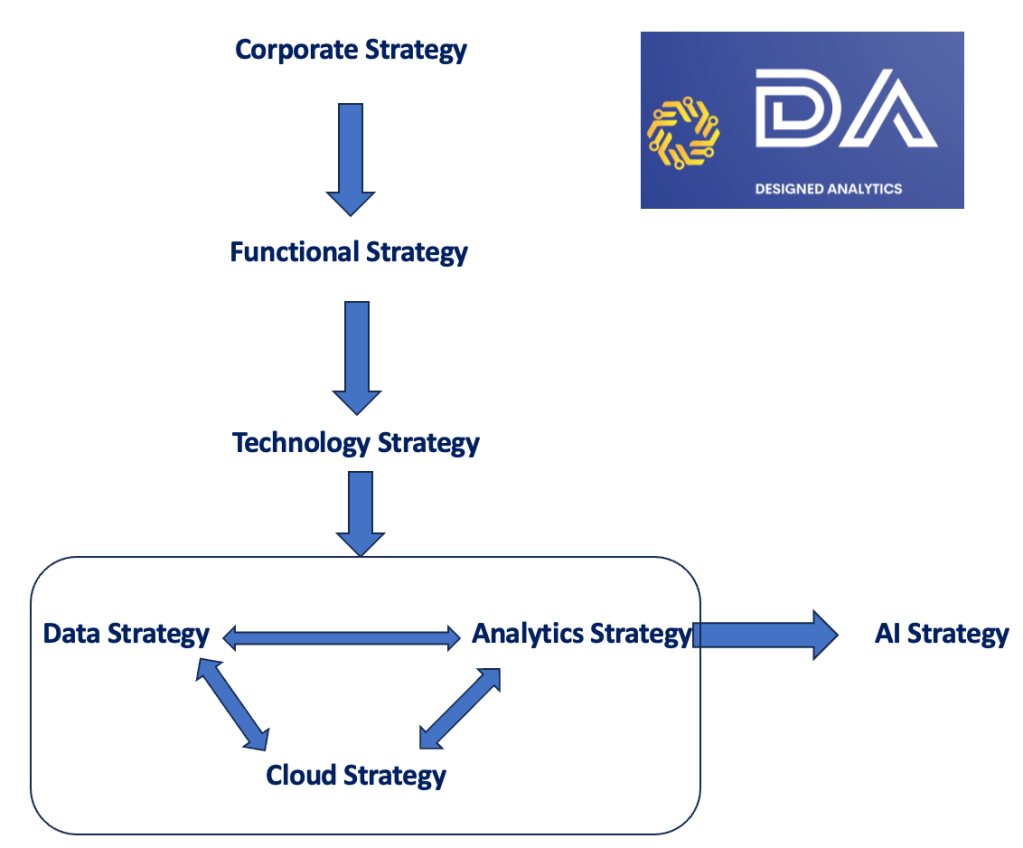
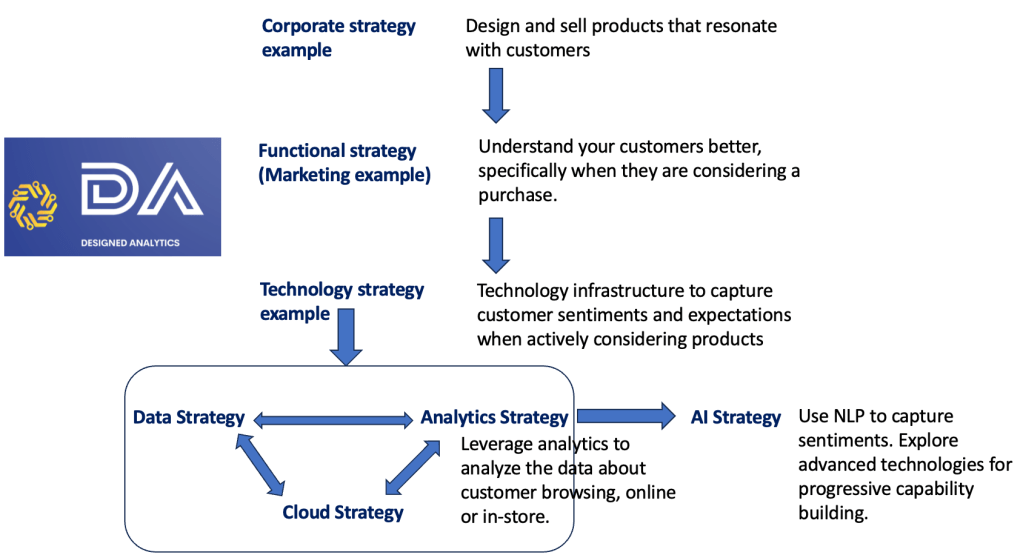
The example below highlights how the hierarchy above will translate into the specific needs that need to be translated into your technology and associated strategies like AI strategy. The examples are obviously representative, not exhaustive.
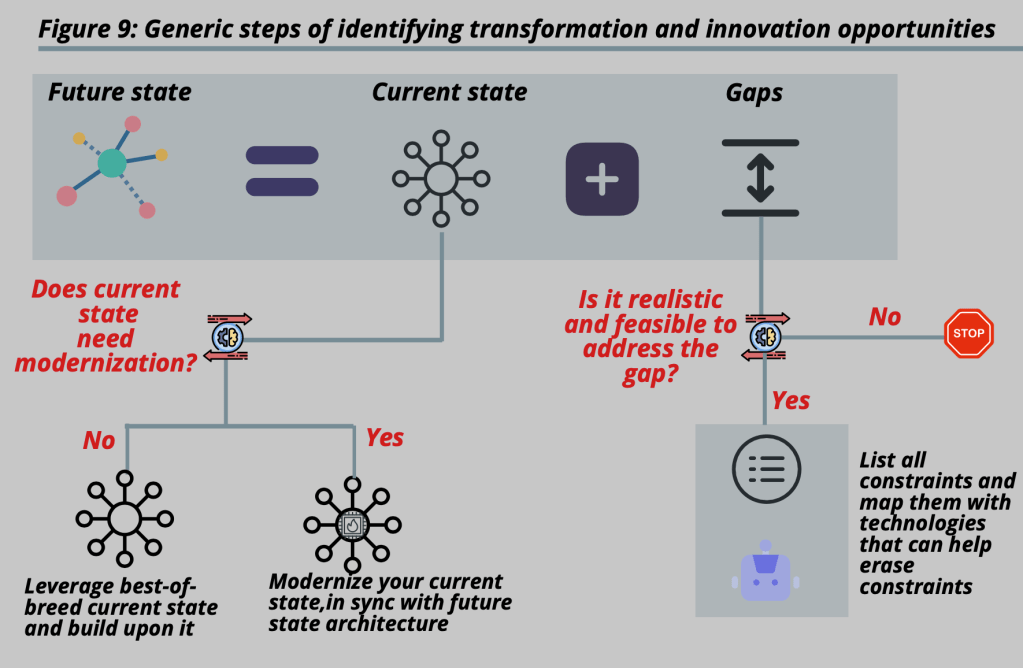
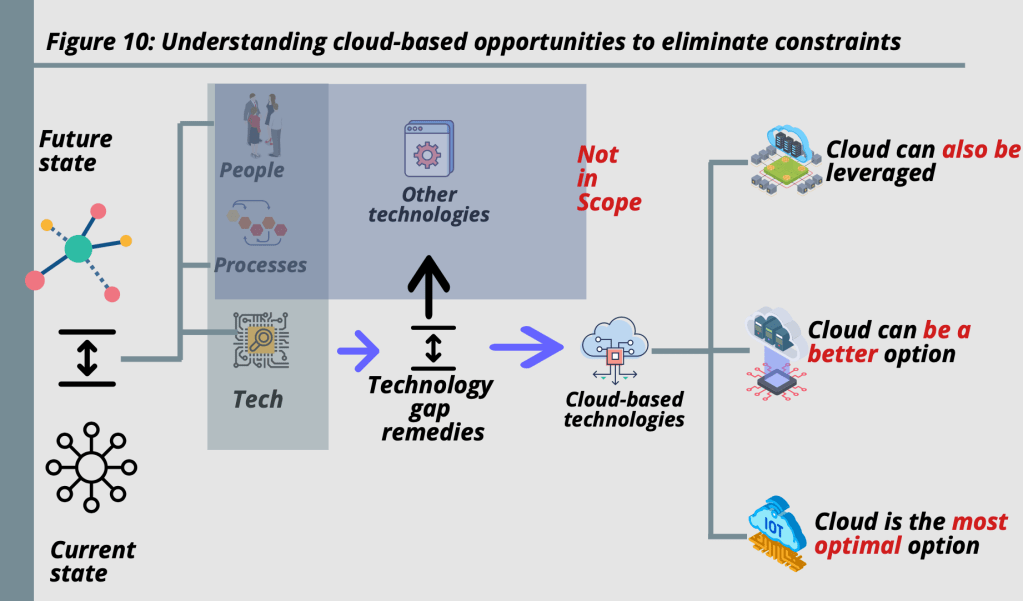
The critical aspect here is gap identification. It is that gap that will then translate into your technology-related strategies. An example of gap analysis from the Designed Analytics report, Innovating With the Cloud, is shown below.
Once you have defined an AI strategy, you can translate your AI requirements using a framework like the one shown below. Again, to understand the three buckets of efficiency, transformation, and innovation, refer to the report linked above.
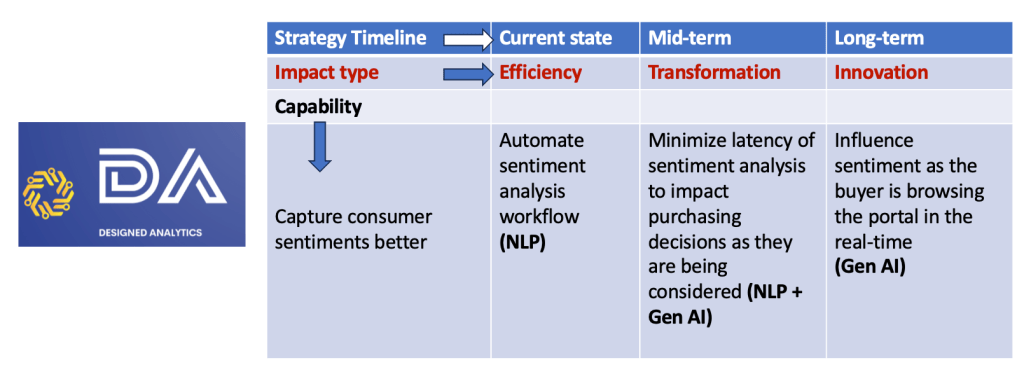
It should not be difficult to see how capturing the capability requirement and its evolution across your strategy timeline will allow you to capture your AI needs more prudently and effectively. You can precisely see where and why you need AI, vs. here is an AI approach and where can we force fit it. This will provide an exact way to accelerate the adoption of advanced technologies currently at the top of the hype cycle into real-world possibilities.
In this article series’s fifth and final part, we will explore consumer AI and understand how to accelerate innovation in the consumer AI domain. The fifth part will be published on 4/26.

 Designed Analytics Blog