

This article is the third in a series of five articles that aim to brainstorm ways to accelerate the adoption of massive advances in the AI arena into real-world solutions. In the first part of the article, we reviewed why this translation is an urgent imperative. In the second part, we started exploring industrial AI and its context, specifically the three broad categories or areas where Industrial AI needs to be adopted rapidly. In this third part, we will use an example of a spend management solution I introduced in the second part, to understand an example of a approach to accelerate adoption. In the fourth part, we will conclude the industrial AI discussion and foray into consumer AI. We will conclude the series in the fifth part by finalizing brainstorming opportunities and approaches in consumer AI.
We introduced a real-world problem that a business unit head is thinking about. They have a spend management solution and want to know how we do AI? The reason this question is so important is because, often, this is the primary bottleneck. I keep saying in many of my videos and posts that I do not consider myself an expert. It is impossible to be an expert in technology if you want to be a true expert. The fact is, I completed my part-time Masters in AI in 2022, and then by mid-2023, there was already so much that I did not know. And that will be the new normal.
The problem arises when “experts” proliferate. You will see many “experts” on AI these days, but the chasm between the available capabilities and their real-world applications widens. If these “Experts” were not selling AI snake oil, executives like the one in our example would have a clear vision of what needs to be done. Hence, the most important step, specifically in two of the three industrial AI focus categories defined in the second part, is to help executives, whether solutions providers or business executives, understand the answer to “How do we do AI” without selling the AI snake oil.
So, let us keep using that real-world example. Their top two USPs on their website are:
- Integrating spend data
- Spend control through visibility
Their product portfolio covers the following three categories:
- Invoice management
- Expense management
- Travel
For each of these three, they then highlight the key advantage:
- Invoice: Automate and integrate accounts payable
- Expense: Expense can be submitted from anywhere
- Travel: Travel and associated spend can be managed from any location.
The first temptation would be to “tweak” these to highlight or include capabilities with the magic letters A and I. And that is the reason many organizations struggle to understand how AI can be leveraged within their products or business processes. So, let us walk through what the approach should be. Let us focus on the expense management category. This product, which focuses on employee-initiated spend, has the following features:
- Spend management
- Compliance
- Cloud-based
- Customizable
- Provides data security
- Has latest AI tools
But before we even explore these features, what is the business process that this product is addressing? The business process can be represented as shown in the illustration below:
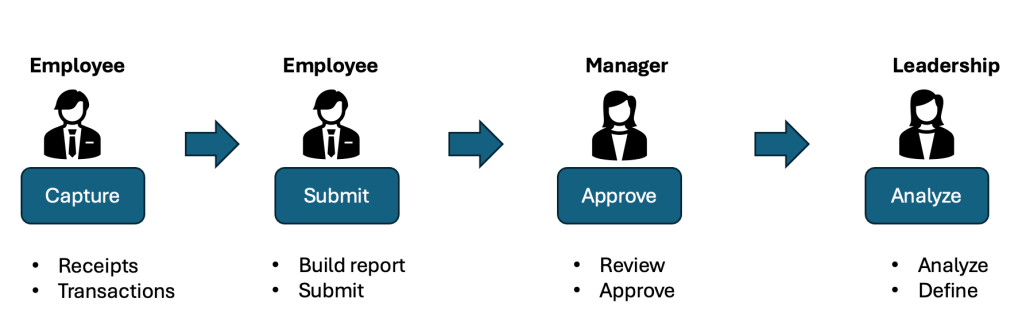
In the tasks defined below for each user in the above illustration, tasks are representational but are key to understanding where the opportunities lie when it comes to leveraging AI. Let us take a look at the illustration below. This is the same process but with a different view. Ignore the column headers for now. The first column, which is titled efficiency, shows the current state capabilities in Green and some pain points that users have discussed online in Red. With this starting point, we will understand how this framework can help you answer the question: “How do we do AI at Acme?”.
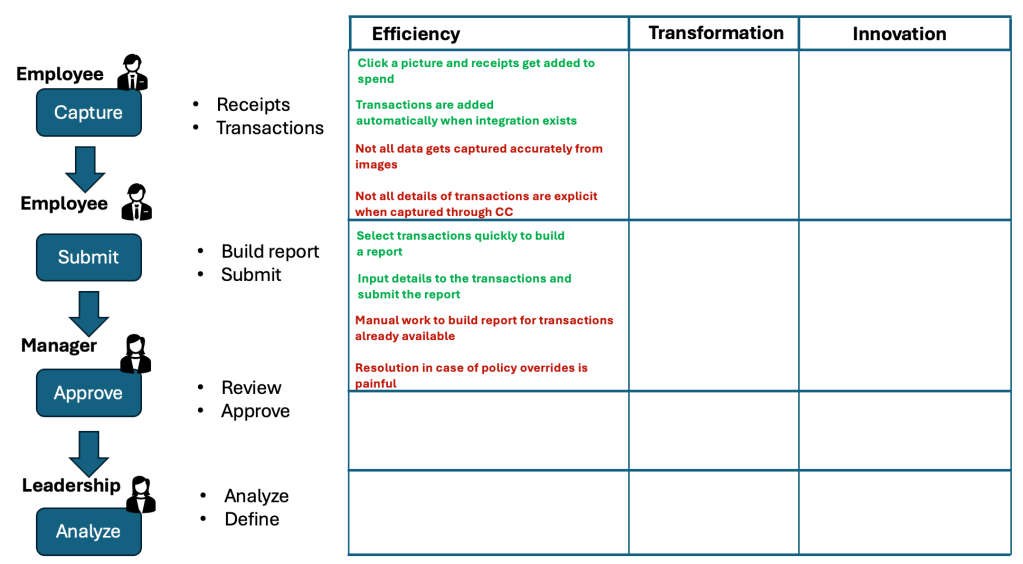
The reason that the above framework has categories of efficiency, transformation, and innovation is because AI, specifically the current generation of AI technologies that are on the hype radar, will consistently deliver capabilities that transform an existing capability or produce a new capability altogether. For insights on what these three categories mean, you can refer to the Designed Analytics report, Innovating With the Cloud. Now let us understand, using some of the opportunities in Red, in the illustration above, as examples, to know how these pain points can be the starting point to understand “How to do AI at Acme”. None of the suggestions here are based on any futuristic technology.
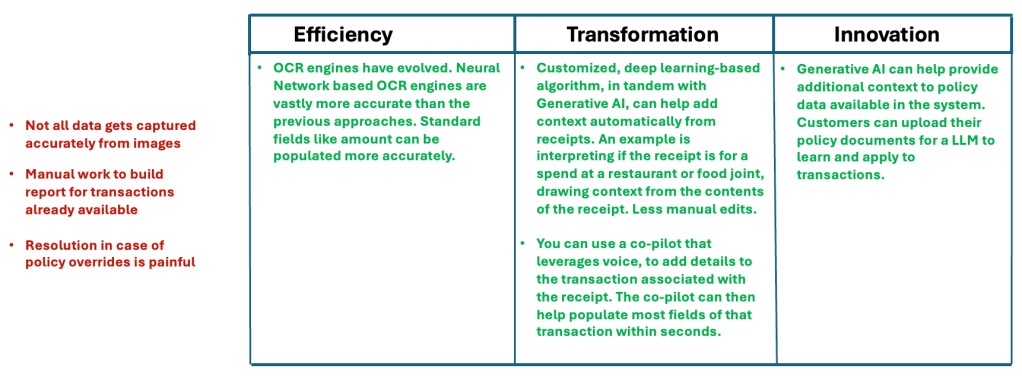
For every pain point or challenge that your current customer face today, you can use AI, specifically deep learning and Generative AI to alleviate. As you can imagine, you will go through this exercise for all the steps of the process shown above, and populate the matrix. Now if you look at these capabilities, they not only help you answer how to use AI, but will also allow you to use these feature descriptions instead of vanilla features like compliance, cloud-based etc., which almost a million spend management solutions currently use. If you design your AI right, it takes care of 25% of your marketing for you.
Having this or a similar approach in place is critical because, without it, it is almost impossible to quickly and productively leverage the current advances of AI into Industrial AI applications. Expectations from the hype will only turn into reality when they are capabilities that leverage advanced technologies. And to leverage them, you first need to understand why you need to leverage those technologies. If you keep shoveling automation to customers in the name of AI, it will only widen the disillusionment.
In the fourth part of this article, we will cover the remaining two categories of Industrial AI and start foraying into consumer AI. The fourth part will be published on 04/25.

 Designed Analytics Blog