

This article is the second in a series of five articles that aim to brainstorm ways to accelerate the adoption of massive advances in the AI arena into real world solutions. In the first part of the article, we reviewed why this translation is an urgent imperative. In this second part, we will start exploring industrial AI, its context and approaches to accelerate adoption. We will continue the industrial AI discussion in the third part. We will conclude the industrial AI discussion in the fourth part and foray into consumer AI. We will then conclude the series in the fifth part by finalizing brainstorming opportunities and approaches in consumer AI.
Just yesterday, I was reading an article that further asserts the concern. The capabilities that big tech has built are akin to a big promise. Technologies can create transformations that are unlike what we have seen before in the world of business. But to many, it now seems that those transformations, other than cosmetic demos, are not precisely transpiring into real-world, productive capabilities. Instances like Devine AI fiasco hurt us further.

I am not a fan of chasing shareholder expectations since it sometimes deviates companies from pursuing mid and long term strategies prudently. Sometimes, when shareholders understand the long-term strategy, like they did in the case of Amazon, they do know that you have to make long-term investments to build a solid foundation when it comes to game-changing capabilities. With tech capabilities like AI, that is only partially applicable though. Since you do not need to wait for a certain capability (like AGI) to start delivering results.
In the title of this article, I mentioned Industrial AI and Consumer AI as the two key areas where companies need to start exploring opportunities. In this part we will start with industrial AI. But a key question that we need to answer before we go any further is, what the heck is industrial AI? There may be many definitions out there but let me share my own definition before we move forward. Any AI solution, that is leveraged by companies across industries, within their business processes, across functions, falls within the realm of Industrial AI. While the definition is simple, the gamut of solutions that can fall within this definition are plenty.
Organizations today leverage a plethora of technology-enabled business solutions. From point systems to enterprise systems, every organization has a portfolio of solutions they use within business processes. From the industrial AI context, there are few stakeholders to these solutions:
- Solution providers: Companies that develop and sell these solutions.
- Implementers and designers: Tech consultants who help implement the solutions and help companies build add-on functionalities and capabilities.
- Businesses: Companies that leverage these solutions and services
It is important to understand these three different viewpoints of Industrial AI since the interest and objectives differ for each of these three segments. So let us understand what Industrial AI means from the context of these three segments, and concurrently explore how we can accelerate adoption of advanced AI into these solutions.
Industrial AI: Solution providers
From the perspective of solution providers, it is all about two broad segments of initiatives. One is enhancing their existing solutions with AI-enabled capabilities, and the second is launching additional AI-enabled solutions. Let us explore how companies need to approach these two categories.
Enhancing existing solution with AI
The real challenge hindering industrial Ai is that real AI-enabled solutions are rare and “AI-enabled” solutions are dime and dozen. And the reason we have an infestation of “AI-enabled” solutions is because of the constrained thinking that AI has to be leveraged within the current realms of the capabilities these enterprise systems have. This often leads to a rigid focus on leveraging AI for automation. While that still is an improvement, this is an easy part, in some cases not within the realm of true AI, and the biggest challenge is, everyone is doing it.
For example, pick any solution category, like pricing optimization. If you know top five players in this category, you will find that they all now claim to leverage AI in their solution. Next, compare what their solutions could do before the “AI-enabled” phase and what they do now. You will find that the end-result does not vary. Automation has been inserted, specifically,”AI-enabled” automation, to make some aspects easier. And you will find that this automation is exactly in the same area for every provider in this category.
We are living in an era where technology is evolving so fast that we normalize an advancement very soon. One challenge of the type of “AI-enabled” automation described previously is that even in cases where the automation was indeed a result of AI, since the core offering remains the same, it gets “normalized”. But more than that, since the core of this article is about how true AI capabilities need to be leveraged urgently, such vanilla applications of AI are not making use of the immense AI capabilities available out there. The technologies they are using are mostly from the pre AI-hype era. So the question then becomes, how should solution providers think about this, when they are looking to enhance an existing offering using AI?
We will use an example of a point solution. As I have mentioned before, I stalk online employee forums of tech companies, to understand what their employees are saying about their products and services. In a discussion yesterday, employees of a spend management company were discussing how their business head was lamenting in a town hall meeting that they are not sure how to make that specific product an AI product. Let us use them to highlight what I just mentioned above.
I can’t name the company but looks like the parent company is on the quest to become an AI-enabled products company, which I believe is the right strategy considering that it is the need of the hour for them. They obviously would want other products in their portfolio to follow the line. And the challenge that the business head of this product is running into is: “How do we do AI at Acme Corp.?”.
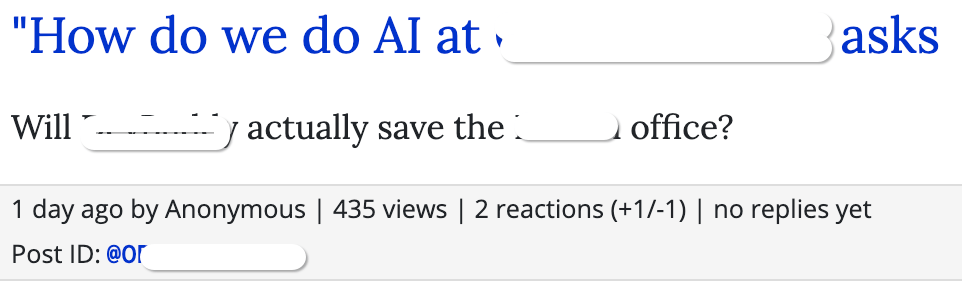
So the first thing I did was to look into the existing portfolio to understand what capabilities they currently have. And they do have many capabilities that are fueled by AI. Image to text, spend anomaly detection, automated audits are few examples. Some of these functionalities indeed use AI. But the toolset is “pre-hype” era. And then if you look at the competitors, every other competitor has these same functions. When any new functionality is no longer differentiating, it becomes the new normal. We then stop noticing it as a new capability. And so does the market and the end-users of these tools. The “automation” road of AI, though required to keep pace, will always merge with traffic from every other direction.
So in this specific case, how can AI, one that has hogged limelight recently, actually help build differentiating capabilities in the realm of the existing scope? Well, like always, start with the end-users. Let us say you use a spend management tool to submit your travel invoices. What are your top challenges, assuming you are in a job where you travel on a weekly basis? In one of my previous jobs, I used to travel every week. Fortunately, the employer took good care of us to ease the pain of travel but there was still some paperwork that needed to be done every weekend. In many other companies, such paper work can be much more. For us, we were required to submit receipts only above a certain threshold and the flight tickets were booked directly by calling a line so we did not have to expense that.
Now there are three different types of end-users of such a spend management tool (at a high-level). One, like me, who submit these expenses. Then there are folks who review and approve these expenses. Then operational finance professionals who analyze this spend and formulate strategies. You need to understand the pain point of each of these three categories. And then understand how deep learning and Generative AI can help address the pain points.
But aren’t the existing functionalities addressing these pain points? If the solution can extract text from a picture, and create a spend item, leveraging AI, isn’t that addressing a pain point? It definitely is. We do not look at it that way now since it is “normal” and has been around for a while now. If this is normal, what type of capability can we create which will be differentiating, new era AI-enabled and nurtures the offering tremendously?
We will explore that in the third part and continue our discussion of the three categories of Industrial AI. The third part will be published on 4/24.

 Designed Analytics Blog