

Symptoms were evident even before ChatGPT came on the horizon.
Yes, I am talking about the tempering down of AI hype. If you follow the world of technology closely, you may have noticed how the gap between the innovations in the realm of AI and the lack of corresponding real-world usage has been leading to a tempering down of AI hype. Since 2019, I have been harping about why we need to urgently start converting the capabilities we are developing into real-world applications. Those early Red flags of lag have begun showing symptoms now.
Sometimes, when the capabilities are real, like we currently have, keeping the hype alive is imperative since it makes translating capabilities into real-world applications and their subsequent absorption easier. If we go by the current trend, it looks like we may have missed the first bus on that one. But there are more buses on the schedule, meaning that we can still avoid the third AI winter or a major loss in interest.
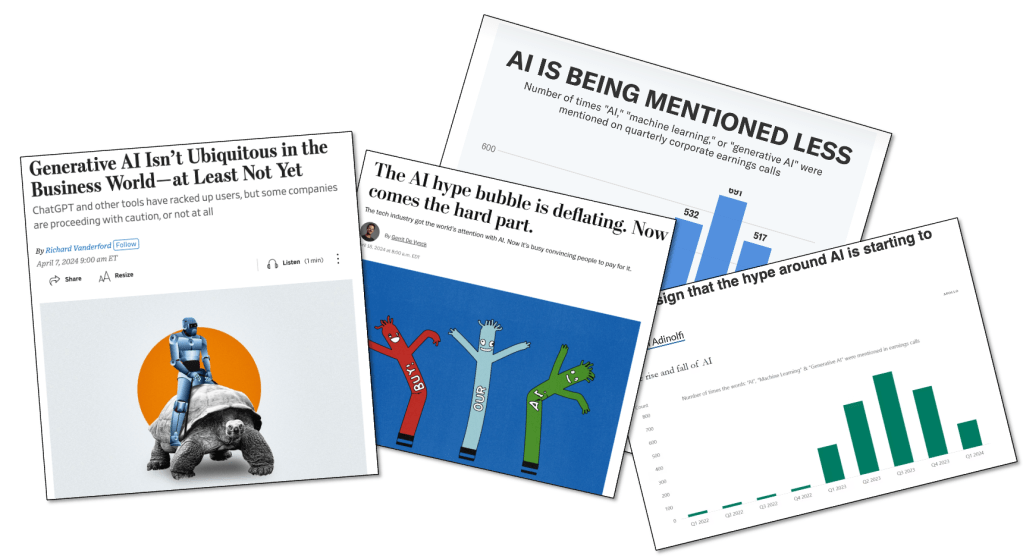
There is much more at stake this time than in the last two AI winters. There is also more robustness to back the hype, allowing us greater resources to mitigate going into the third AI winter.
Unlike last two AI winters, this time we have the necessary capabilities, more than needed to realize the hype into reality. But this also raises the stakes. Billions of Dollars of investment is now banking on the fact that the current trajectory will sustain. We have to remember that the explosive growth in advancing AI capabilities is fueling turbocharged growth in many other areas, like chip making. It is ok for hype to wind down and transform into real-world applications. But that part, labeled as the “hard part” by The Wahington Post, the part where the hyped capabilities transform into real-world applications is happening at an alarmingly slow pace. And if that pace does not accelerate, there may be challenges.
Capabilities need to be translated into both broad categories of Industrial AI and Consumer AI. The biggest burden to make that happen is on the big tech giants that have invested heavily in building these capabilities. The consequences of not being able to translate the hype into reality go beyond the sunk cost of investments for these companies. Before AI hype came on the horizon, most of these companies had products that had been around for decades. While the products were constantly and continuously being upgraded, nothing changed significantly in terms of the core value they provided.
If all the AI hype fizzles out, these companies are left with the same old set of products. They can claim to enhance those products in many ways, through AI. In many ways, AI improves functionality of these existing products vastly. However, the core USP of the product will remain the same. An operating system will still be an operating system and a search engine will still be a search engine.
The current prowess of AI has provided these companies a unique opportunity to translate AI into totally new capabilities and business areas. If that does not happen, there will be plenty of challenges. Some of the big tech companies are so big, in terms of revenue, that in order to achieve certain growth percentages year after year, they must create these new opportunities. Otherwise, sustainable decent growth will become a challenge.
In this article series, we will explore how companies can help build capabilities in the areas of Industrial AI and consumer AI. In the second part of this article, to be published on 04/23, we will explore, at a high level, how companies can think about leveraging their existing expertise to propagate industrial AI and build new capabilities.

 Designed Analytics Blog