
This is the second and final part of a two-part article series. The first part covered how AI can help automate and enhance commuter parking management. We then expanded the scope, discussed how the daily commute can be thought of as a process, and suggested that AI can help enhance this in the future. The illustration below, reproduced from the first part, shows the daily commute as a high-level process. In this final part, we will explore examples of how AI can help synchronize daily commute travel flow.
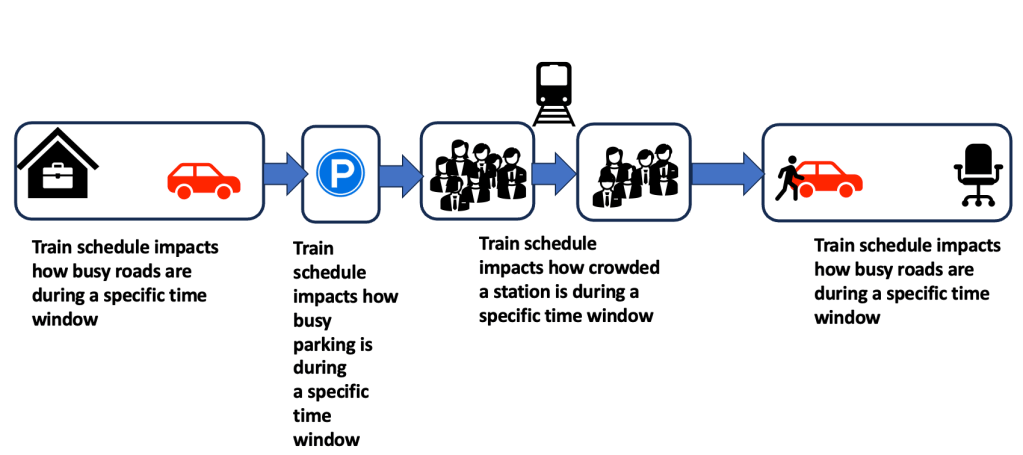
If you look at commuter train schedules, like Metra schedules, every effort has been made to optimize the schedule. More frequency and express trains during rush hours are examples. However, as with any process, in order to have an end-to-end optimized process, each process block must be synced to the central synchronizer (in this case, the train schedule). Remember that external elements are impacting the process shown in the illustration above, like office hours, that are outside the scope of this process and can not be influenced by transportation planning authorities. We will cover those scenario briefly towards the end of the article.
If, in the future, you could connect every element of the process above so that the end-to-end process becomes more streamlined rather than just the schedule, we can significantly streamline public transportation. Public transportation in the U.S. already leverages apps for many things, like ticketing and has robust IT infrastructure. These very same apps and tech, when combined with EdgeAI, smart cameras and AI algorithms, can bring real-time visibility and optimization into the end-to-end process.
The parking management example we covered in the first part was an example. But let us peel the layers of the onion further. None of the scenarios we will discuss need technology that is currently not being leveraged in the real world. However, putting a solution together requires meticulous design, planning, and project management. While these scenarios may currently seem like overkill in countries like the U.S., which is not experiencing a population explosion, the fact is that even the U.S. population is increasing, and the infrastructure has not been updated at the same pace for decades. Sooner or later, these solutions will become the need of the hour.
Examples of additional data points you can collect
I assume that the majority of commuters currently use commuter apps. If you can get them to share their residential addresses, you have a distribution of where your commuters live, and based on their ticket purchases on the app, the train station they generally use to commute.
Through a voluntary survey (with incentives like a free one-way ride), you can collect information like the transportation they use for commuting to the station. You can easily track those using their cars and park at the station. This survey will help you understand carpools, rideshares, and public transportation.
Let’s start with a typical scenario: Everything is running as planned, and trains arrive and depart as scheduled. Let us understand the synchronization opportunities that can be created using few scenarios.
Example Scenarios
With data on where commuters live, the stations they use, and the schedule of the train they take, the first step of the process, shown in the above illustration, can be optimized further. Urban transportation planning leverages real-time traffic flows to operate traffic lights. The normal train schedule gets automatically baked into the traffic flow data as the traffic increases when these commuters leave their homes for the train station, during rush hours. But can you leverage this information to “incentivize” commuters to take routes that will distribute traffic away from busier streets?
With the data points identified above, you will know exactly which commuters can be incentivized. This will help commuters as well. They will feel more confident taking an incentivized route, knowing that even though the route is, say, 5 minutes longer, it still brings a level of certainty that they will get there on time, as compared to busy roads where one crash can snarl the entire traffic. The gist is, there is an opportunity to shape traffic flows in real-time.
If you have ever been a daily commuter (I was one for only a short span of three months), you will observe that when a train is about to arrive at a station, commuters tend to concentrate in groups to board specific train cars. Then, once they are on the train, they may move from one car to another if they can’t find a seat. With data captured leveraging smart cameras, you can build a process to make boarding more distributed and organized.
Let us consider another scenario. The smart counters and cameras at one station, say Naperville, determine that the station has more commuters than usual. Leveraging this information in real-time, commuters can be incetivized to leverage the nearest train station of Lisle, to offset not only a crowding scenario at the stations but safe boarding of the train as well.
The above scenario incorporates another smart aspect as well. One of the data points that will be leveraged in the above station reassigning suggestion above will be parking slots available in Lisle. That is what the end-to-end optimization is all about. If you do not factor elements like parking, then while you may prevent overcrowding at a station, you may create a parking challenge at the other.
Next, consider the impact on public transportation from residential stops to train stations. The data can be leveraged to optimize routes, plan resources, and, like the examples above, incentivize commuters to take public transportation to train stations.
The list can be long enough to write a research report. But I hope you started getting a feeling of how powerful and transformative a capability like this can be for public transportation.
External factors
To conclude, let us consider external factors that may also be addressed. First, with their RTO mandate, many companies provide employees specific days during the week when they can be in the office. If public transportation and these companies can work together to optimize these days in a way that eases the stress on public transportation, it will help employee well-being as well as make their commuting less stressful. The other area is sanitized data sharing with ride-share companies to help minimize surge pricing and ease the burden on commuters.
The gist is, once you build an end-to-end, integrated infrastructure like this, possibilities of what you can do with it will only keep expanding.

 Designed Analytics Blog