
After months of using Uber to commute to the nearest Metra station, my wife decided to drive to the station this morning. We have a routine where once she boards her train, she sends me a text. This morning, she asked me a question as well, in addition to the “status update” text. Since she used the commuter parking for the first time in Chicagoland, she was curious how would they track violations. And that started a chain of thoughts for me.

The first thought obviously was that if the parking lot was gated, a smart camera is probably tracking license plate numbers. Since the plate number is required to pay, an algorithm can easily reconcile the plates with the payments data. But looks like the parking is not gated. So, other than banking on good faith and integrity, what else could the parking management be doing?
Many years ago, when the AI boom was not at its peak, I read that cops in a city were using EdgeAI to read plates for registration expirations, as they drove on the streets. It was in beta but was interesting. Cameras were reading plate numbers and algorithm was matching the plates with registration data. Essentially, it was doing what many cops do while driving on the streets, but in an extremely limited capability due to the manual nature of the task.
Cops do run the plates of cars they see on the street and, and for some reason, want to check on the details. This algorithm could do that in hundreds on a trip. Since this was years ago, I believe this technology would have matured and is maybe being used by cops in major cities.
Something similar is probably being used by the commuter parking authorities. An employee may be driving a car with smart camera through the parking lots and reconcile the plates with payments data. And as I envisioned this, my mind thought about many other possibilities of leveraging this infrastructure and data, as shown in the illustration below.
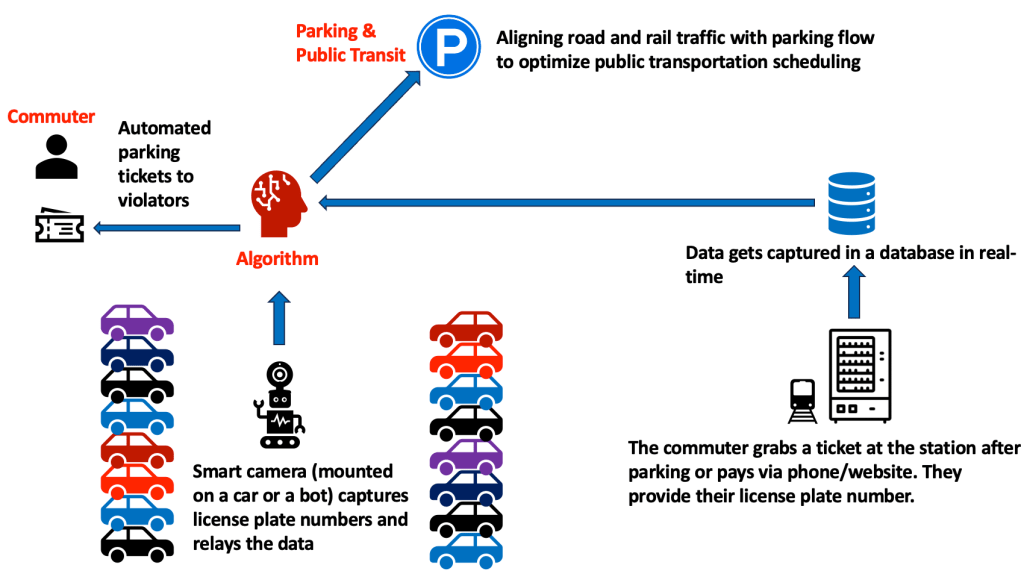
As you can see from the illustration above, the architecture that already exists in many locations, can be leveraged to bring more science into parking management. It can help understand the volume variations, and can help plan more optimal parking layouts and slots. But as shown, the data can be leveraged beyond parking. But for that, similar smart capabilities need to be embedded throughout the process. What process-you ask?
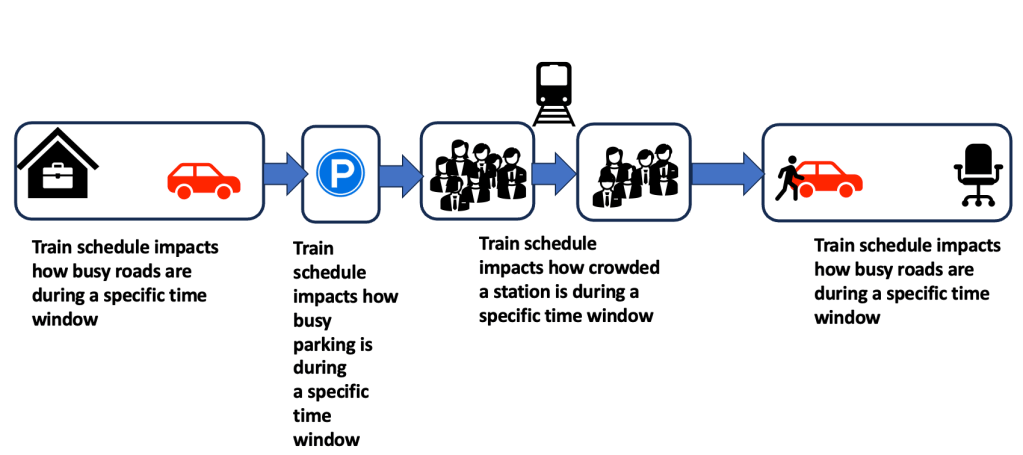
If you think of commuter rail transportation commute as a process, some of the critical elements of this process (one-way) are commuting to the station, boarding the train, commuting in train, exit the train, commute to work. We fail to realize that, like every other process, if this process is not planned from an end-to-end, integrated view, it will sometimes lead to bottlenecks. The figure below shows an example. If the stationary planning element is the train schedule, the whole process is dependent on this one driver. This means that in cases where resources become scarce, the process may run into bottlenecks.
The second part of this article will explore how AI can help optimize and streamline this process. It will be published on 04/17.

 Designed Analytics Blog