

Excerpt from Designed Analytics Report: “Innovating With the Cloud: The Starting Point“.
The last three chapters covered the capabilities that cloud and cloud-based solutions provide. They were primarily focused in the areas of data, analytics, and process management because if you dissect all possibilities of transformation and innovation that you can generate leveraging the cloud, these three will form the core enablers of that transformation or innovation. Also, just to reiterate, we are talking about innovation that leverages technology. In this case, cloud-based services are the enabler we are focused on. And within cloud-based services, these are the three categories that will be leveraged the most.
Pick any capability that you believe is an operational innovation fueled by the cloud. At its core, it is powered by at least two of these capabilities. That is the reason I decided to include those topics in the report.
So now we can start getting into understanding what the key essential steps to innovating with cloud. We have all the fundamentals we need. We explored the true meaning of innovation; hierarchies of innovation and the three types of impact cloud offerings can make. We overviewed the fundamentals of the three core areas of data, analytics, and process management. Now is the time to start putting all this together.
The report assumes that you already have a cloud strategy in place. If not, you need to first formulate one. Do not pursue a cloud strategy because everyone else has one. Do not use a template that was used by some other company in your industry. Your cloud strategy must be extremely tailored to your specific nuances. This will help you make the right choices in designing the right portfolio. We will proceed with the understanding that you already have a prudently designed cloud strategy. Also, you have hence invested in an optimal portfolio of cloud-based services, based on your cloud strategy. That becomes our starting point from a perspective on technology capabilities.
There is a generic high-level, common sense process that you take whenever you want to build a technology-enabled future state capability. Figure 9 captures the high level flow of that thought process. This also forms the basis of how you start formulating the roadmap of your cloud-based transformation and innovation journey.
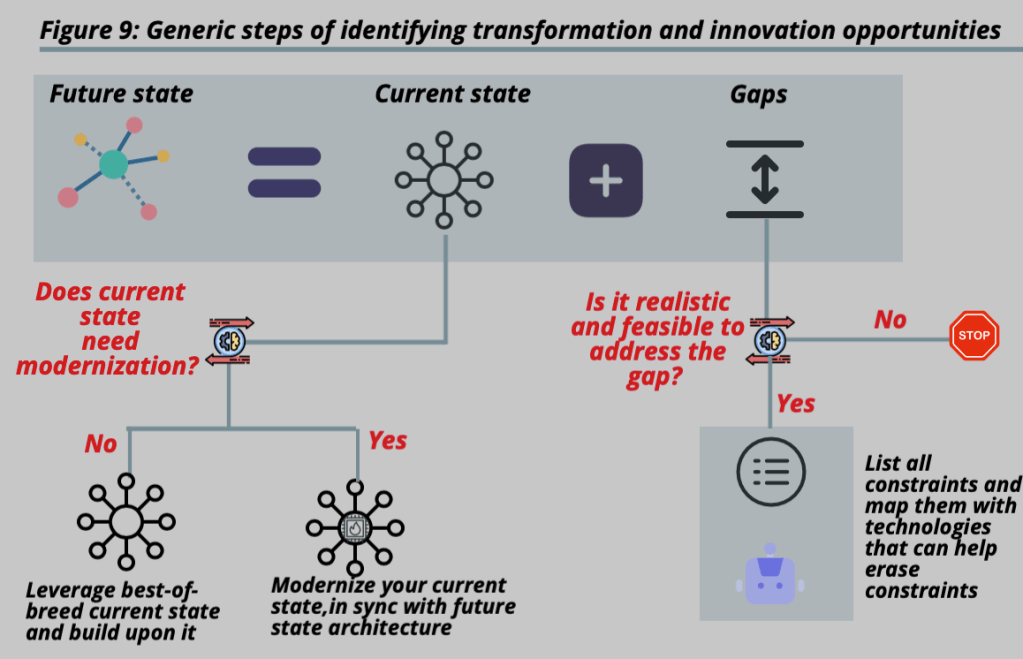
It should not be difficult to understand from Figure 9 why you need a robust, and customized cloud strategy to become a truly innovation-driven organization that leverages cloud to innovate at all layers. When you developed your cloud strategy, you envisioned a roadmap of progressive capabilities, something along the lines of the layers of efficiency, transformation, and innovation that we have discussed before. The cloud strategy bakes in the future state you want to build with the cloud, and hence you have good documentation of the details of every node of the process diagram of the process flow.
At a high-level, you start by understanding which current state capabilities currently can be leveraged into your future state. While you will be able to use components of your current state, often they may need some enhancements. In some cases, the current state components that can be used with the future state may not need enhancement but you may still want to upgrade so that it syncs perfectly with your modernized future state. If your current state is already best-of-breed, you obviously leave it as-is.
Then, you evaluate the gaps. There are a few different elements of this gap analysis. There are gaps that you can address with your on-premises capabilities. The other branch is where you can not address the gap areas with those current state capabilities. The reasons could be a couple. Either a mature technology does not exist or you do not have access to that technology.
If you can build or buy access to technology, you need to do a feasibility and effectiveness analysis to make sure that it is worthwhile to move ahead. Figure 10 in Chapter 8 illustrates this approach further.And when you decide to move ahead, you build a business case in terms of what new capabilities that investment can help build, how it will do so, the timeline, ROI and other jazz. While this flow was generic, it will form a critical basis of our methodology to plan and start cloud-based innovation. We will leverage this, in tandem with other concepts we have introduced earlier in the report, with an example, to understand the methodology

 Designed Analytics Blog