

This is an excerpt from the Designed Analytics report : “Innovating With the Cloud: The Starting Point“.
As highlighted earlier, innovation itself has hierarchies and so does transformation. There may be thousands of subtle transformations and innovations happening in your organization every year. This is why we will develop and understand a hierarchy of operational transformations and innovations in this chapter. That hierarchy will help us shape the starting point of our journey of innovating with the cloud.
Let us explore this further with another example. You have a new buyer who joins your procurement organization. This person, fresh out of college, realizes that most buyers are using their “experience” to place orders since the numbers the current procurement planning solution churns out are unreliable gibberish.
The rookie understands that the numbers are indeed gibberish, but they do not have much experience, so they decide to leverage their recent education to make decisions that they can use to explain their choices. Like millions of workers worldwide daily, they export the actual and forecasted data in Excel and then leverage analytics approaches.
None of the methods, formulas, or technologies they use are new to the business world, yet the process they have created is. It did not exist before. No one ever used this type of method before. If it works, though difficult to admit, it is innovation. It is what I like to call individual innovation.
And that individual innovation, sits at the bottom of the hierarchy of transformation and innovation. The operational innovation and transformation hierarchies are shown in Figure 3. We have an understanding of the individual contribution layer from the example we discussed. Let us explore the remaining layers.
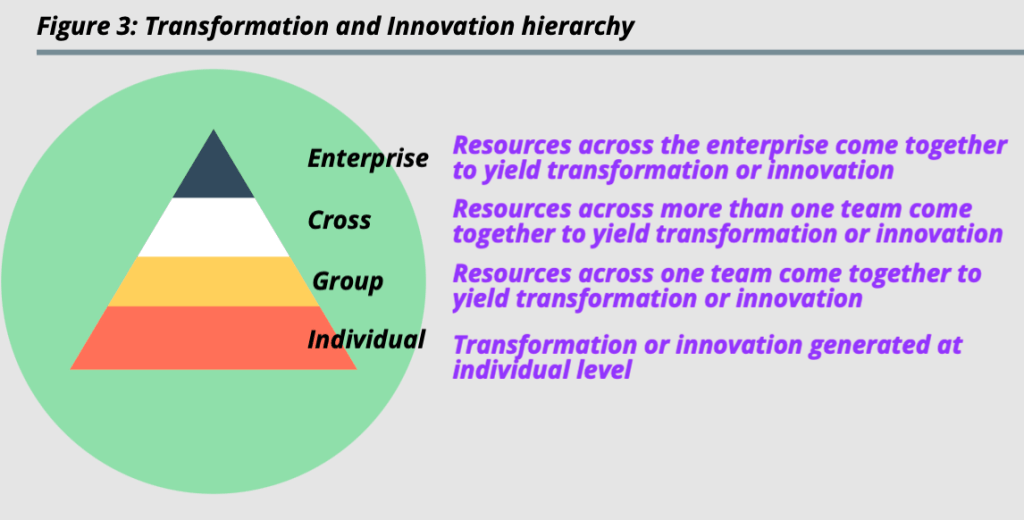
Group innovation occurs when more than one individual belonging to the same team collaborates to build new capabilities. Typically, this type of innovation is not feasible for one individual to accomplish alone.
Cross-innovation is when more than one individual belonging to different teams collaborates to build new capabilities. Typically, this type of innovation will not be feasible to accomplish by individuals belonging to just one team. These transformations and innovations are also not normally identified as innovation. But in the subsequent sections, we will explore why understanding these transformations and innovations is critical to generating true innovation with the cloud.
An example is when two teams collaborate to develop a new data-sharing process, leveraging technologies that already exist. At first glance, this also may not seem like innovation. However, approaches like data Products are based on similar postulates and are considered innovative approaches.
Innovation comes in many shapes and sizes!
The enterprise innovation level is the highest level of hierarchy, as shown in Figure 3. This is the level we generally tend to associate with innovation. This is what we generally see in the media. New drugs, compounds, new business models etc. While they may not seem apparent, enterprise level innovation is driven by all the other types of innovation collectively. It is this idea that can help us generate innovation, leveraging cloud technologies across all levels.
With this background, we can start interweaving cloud technologies with innovation.

 Designed Analytics Blog