

Excerpt from Designed Analytics Report : ” Innovating With the Cloud: The Starting Point”. Download the report here.
An innovation-driven organization is one where innovation is generated across multiple layers. Note that these layers do not pertain to organizational hierarchy but are more attuned to the impact of the innovation. As mentioned, something as trivial as an individual employee finding a new way to perform a task that did not exist in the organization before is a minuscule form of innovation. And unless we recognize and reward this aspect, we will not be able to build a genuinely innovation-driven organization. In a subsequent section, we will understand this innovation hierarchy in detail and explore why knowing how to innovate in the cloud is crucial.
Before we get into the innovation hierarchy, let us understand where innovation sits regarding the three layers of the benefits delivered by the cloud. Figure below provides an overview of the three layers of impact that can be created with the cloud. Please note that this is my perspective, and the definitions may not align with generally agreed definitions. However, these aspects are not science, and we must disagree more with what is “generally agreed” upon.
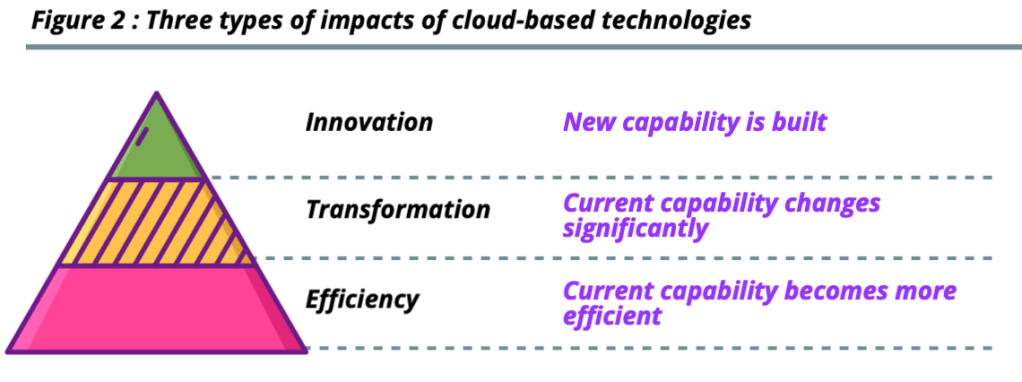
Efficiency: From cost to labor efficiency, there is no doubt that cloud infrastructure can generate a plethora of efficiencies. That has been the primary driver behind the popularity of the cloud. If an organization meets certain specific criteria, efficiency advantages are plentiful. A concrete example of efficiency will be reduced IT infrastructure expenditure and reduced staff requirements.
Transformation: Transformation pertains to the scenario where your business processes have changed in one or many ways from how they were when you were on-premises. This is the layer that is often confused with innovation. We see the term digital transformation being thrown around in many ways, with multiple interpretations, one of which hints that digital transformation is akin to innovation. That is not the case in my perspective. The simple approach to understanding if a change is a transformation or innovation is to use the “capability filter.”
Has the change led to something that can be considered an entirely new capability? If a business process was re-engineered but still delivers the same core capabilities after being transitioned to the cloud, it is a transformation, not an innovation. An example that you can think of from an analytics perspective is transitioning an analytics workload to the cloud. In the cloud infrastructure, you can leverage the infrastructure analytics and machine learning solutions that hyperscalers provide.
Innovation: Innovation is when you build a new capability all together. These include new processes and solutions that did not exist before. This is the category or layer we will harp upon in the remainder of this report.
Let us touch upon an example briefly. In the on-premises model, you had a retail analytics solution that collected data from your vast network of stores and dumped it all on servers that you could access maybe the next day, next week, or next month. Then, you decided to transition to a public cloud. This now allows you to access data with a lag of just a few hours, with better storage and access management, leveraging the solutions supplied by the hyperscalers. You can also leverage analytics solutions from hyperscalers, to minimize your analytics cycle time. The examples so far pertain to the efficiency and transformation layer.
Now that you have the infrastructure and technology to access this data in near-real time, you realize you can leverage an algorithm to shape demand while the foot traffic is still in the store. Essentially, you can extract “trends of the day” and then leverage them to send emails and messages (like today’s deals or trends at your store) to registered users of those respective stores. This new process did not exist before and hence will be considered a new capability. This is innovation!

 Designed Analytics Blog