
This article is the final part of a three-part article. In the first part, we introduced the concept of building digital twins of individuals. We shared how our edge devices like phones and watches already capture key data points of our lives. In this second part, we explored how digital twins can help us better manage our lives. We focused on the monitoring aspect. We will conclude this discussion in the third part by sharing how individual digital twins will help with the control, prediction, and transformation of our lives.
Like the previous two parts, I want to emphasize that I am attempting to illustrate capability through examples. These examples barely scratch the surface, but they will help us understand how powerful the individual digital twin can be. So, let us continue our journey of exploration.
Control
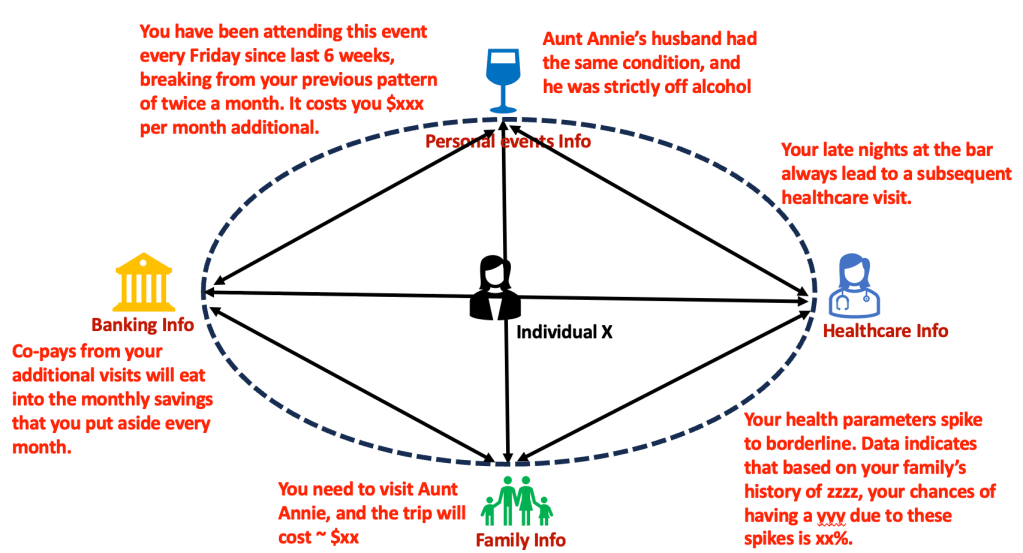
In the second part, I emphasized that the power of a complete digital twin is that it can go beyond siloed monitoring and, hence, implement controls that interweave multiple aspects. Let us consider an example that illustrates this. Let us say that Individual X has a medical condition that requires frequent healthcare visits. Though they have health insurance through their employer, they still have to pay a co-pay for every visit. X is fresh out of college, so they live paycheck to paycheck, with a little amount going into monthly savings. Also, any unscheduled visits that X has to make to see a healthcare professional are due to some lifestyle choices (like partying too much on Friday night).
As you can see, many aspects of our lives interweave to define who we are and what we experience. In this case, the financial element is impacted by healthcare aspects (co-pays), which are influenced by personality (and hence lifestyle choices). The digital twin can get more scientific about how we make our choices, what the best options are, and how our choices cascade in every facet of our lives. So, in this specific case, a digital twin will try to control our choices, as shown in the illustration below.
Prediction
The control shown in the illustration above, as you can see, also incorporates prediction. If designed and developed prudently, the digital twin can generate many layers of predictions, ranging from simple to complex. A simple prediction can be: “There is a very strong correlation between you attending Friday night events at “The Jack Sparrow Bar”, and an increase in unscheduled visits to healthcare professionals. These unscheduled visits eat into the $200 you put aside every month. If this persists for the next few weeks, you will be saving only $15 next month.”
As you can see, this prediction tries to control spending. We must remember that even though I used the example of my wife in the second part, the digital twin can not “ensure” that you stop partying. Your wife/spouse/partner can 😄. The digital twin’s method of control is by highlighting what you should not be doing.
An example of a complex prediction can be: “Your levels of hormone x have spiked every time you have visited a healthcare professional after attending an event at “The Jack Sparrow Bar.” Your levels were three times borderline high in the last six visits. Publicly available data for those with similar conditions, combined with your family’s health history indicates that these spikes may lead to… (something scary, with a caveat that this is not professional healthcare advice in any form ☺️)….”. We can create several prediction examples but I hope you get the point here.
Transformation
Transformation, as mentioned in the second part, happens as a result of the three categories of monitoring, control, and prediction. A twin that has an in-depth understanding of every facet of our lives (that can be captured with data), can share timely insights that may help us change undesirable and/or unhealthy habits and behaviors. It can provide a more holistic way to control and manage our lives beyond the current fragmented approaches.

 Designed Analytics Blog