
This article is the second part of a three-part article. In the first part, we introduced the concept of building digital twins of individuals. We shared how our edge devices like phones and watches already capture key data points of our lives. In this second part, we start exploring how digital twins can help us manage our lives better. We will conclude this discussion in the third part.
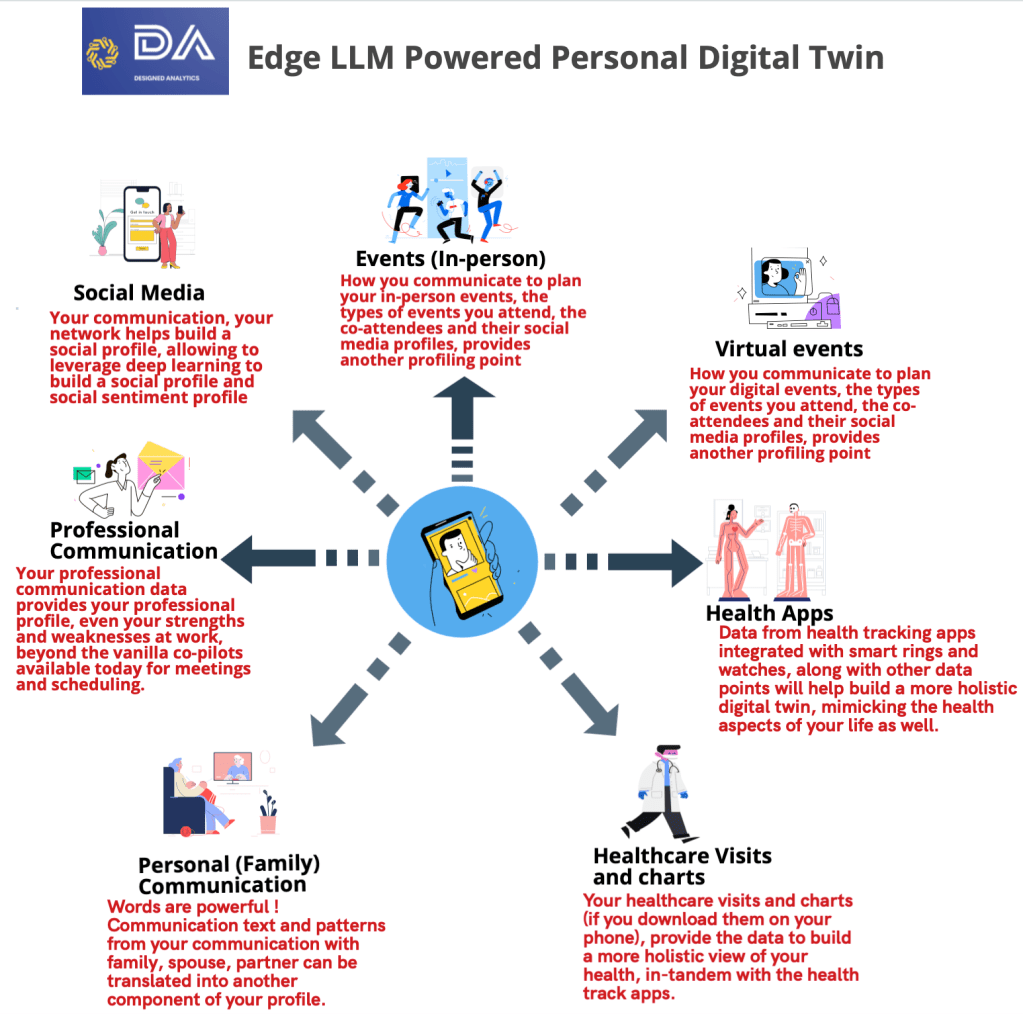
For reference purposes, let us reproduce the figure from the first part of the article, which highlighted that majority of data that helps define who we are, physically, mentally and professionally, is on our phones these days. The scenario is exciting from a technology perspective (at least for technology nerds like me) but also scary from a privacy perspective. An app, that you allow to leverage all the documents and data on your phone, to become your digital self, can still send information to the cloud.
In order to understand how our digtal twins can transform our lives, we first need to understand how digital twins impact the world of manufacturing. If implemented prudently, a digital twin in manufacturing helps in four broad areas:
- Monitoring
- Control
- Prediction
- Enhancement
To summarize, you can leverage a digital twin (which is real-time), to monitor your processes, control them if parameters need adjustment, predict the course leveraging data, and use that prediction again to apply preventive controls. Overall, with all the learnings from the three buckets, you should be able to continuously enhance your processes, whether they are manufacturing, warehousing or retail operations.
Our digital twins, powered by Edge LLM, should touch upon these very same four categories.
Monitoring
There are fragmented applications already on our phones or edge devices like smart watches that do a lot of monitoring. Prominent are health apps, sleep apps, or clinical edge devices like glucose tracking devices. We have apps to monitor our eating habits (self-reported). These are all fragmented, mostly.
In conjunction with additional statistics, like recent annual physical visit tests, they can help an LLM powered app build a more complete profile of your health, that remains on your phone. The twin can then monitor your health more holistically. And as we will see in a subsequent part of this article series, the twin should be able to link your health data with other aspects of your digital twin, like financial data.
There are plenty of apps that help you manage your finances better. First of all, they depend on you granting them access to your various accounts through logins. If they are not compatible with any account, then you have no visibility, unlike a LLM that can read your statements that you can download on your phone.
Another aspect is that they are generally descriptive when it comes to analysis. They can tell you if your relative spending increased or decreased and if there are any subscriptions that you may not be aware of. But our financial life does not stand in silo. What we are as a person defines our financial habits.
For example, my interest in tech leads to the only area where I sometimes overspend. My wife realized this years ago. She still uses iPhone 11 whereas I try to find an excuse to upgrade every year. So my wife started monitoring if I was making any big spends on tech I will seldom use 😄 (All our current accounts are joint accounts). If I purchased a product that I rarely use, she is alway there to “spend shame” me 😄.
The point of the rambling in the above paragraph is that we sometimes need to be shamed, or “managed” about purchases that are more driven by want vs need 😄. And we do not always have the privilege of being “spend shamed” by spouses, wives, or partners 😃. But an LLM can provide us a “shaming” type of monitoring.
And the same goes for health monitoring as well. Numbers are often not as impactful as adding context to them. For example, an LLM can provide a context to your physical exercise data: “Your new year resolution was to walk 5 miles daily. So far, in last 65 days of 2024, you have averaged only 2 miles daily. Research indicates that 87% of people are never able to meet their new year resolution. There is a term for it-“False Hope Syndrome”.
Ouch ! Right?
The powerful aspect of such type of monitoring is that by analyzing your personal communication, the LLM can understand what will hurt, or will be impactful, and hence inspire you to keep your resolves, whether they are physical, financial or professional. An example of professional monitoring is you trying to pursue a professional certification but are not disciplined enough. Your digital twin knows that this certification exam is on the horizon, can “force” or “shame” you to study for it, depending on how much leeway you give your twin.
By the way, if any of this is sounding futuristic, holler me once Edge LLM is in production state on smart phones. It can be built within months. What will be the most challenging part will be the privacy aspect. Getting end users to allow access to each and every data point.
End users need to trust that all the data will never leave the edge. Such an application can be the most powerful single point of data that marketers can ever have. The question is, do end users trust tech providers enough to go all in like this and share data pertaining to every facet of their life, even if the promise is that it will never leave the edge?
Control is where the silos of monitoring start connecting together. In the third and final part of this article, to be published on 03/12, we will discuss how an LLM can interweave aspects like health and financial monitoring to help manage our lives more holistically. We will then explore how the predictive capability of the twin can significantly enhance our quality of life in addition to productivity, and hence transform our lives in many different ways. As mentioned in the first part of the article, we will just be scratching the surface with these examples. Opportunities are limitless !

 Designed Analytics Blog