

This article is second and final part in a series of two articles. You can read the first part here.
Let us reproduce Figure 1 from the first part again for reference.
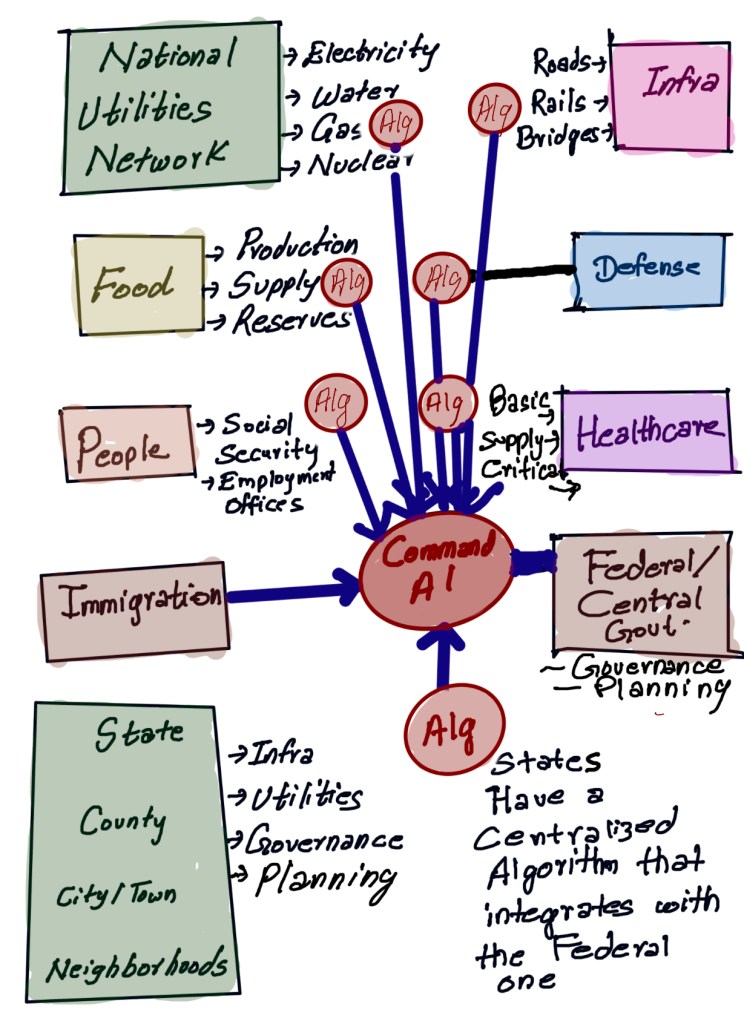
The components shown above are not exhaustive but they communicate the broader idea. The high-level architecture from a deep learning perspective will be federated architecture. The key aspects here are:
- Component “key entities” need to be created. The examples are blocks shown in the illustration above. Each state will be a “key entity.” Each key entity will have a centralized algorithm of its own. These algorithms will interface with a set of centralized algorithms.
- Under each key entity will be sub-entities: divisions, organizations, or governing bodies with separate infrastructure. These sub-entities will have centralized algorithms that interface with the entity-level algorithm.
As mentioned in the first part, like all key digital transformation initiatives, the most critical challenge is building a data foundation that can fluidly support the overlaying algorithms. This is when you need to understand the processes that have been digitized and for which data is available. Then, you will focus on understanding which data sources you need to tap and why, how you will tap those data sources, and what critical pieces of information you would require from these data sources. Understanding the underlying relationships will be the most vital part. For example, what information from state systems will be needed by the federal algorithm for monitoring and planning specific scenarios.
The next step is to evaluate if the current infrastructure of the data sources is robust enough to support the initiative. They should not just be ok for now, but ready for providing at least a decade of advanced deep learning level foundation. This will produce a gap report and the foundational upgrade requirement document across all entities.
Then comes the algorithm design, development, and training aspect. After the most challenging step of building a clean and harmonized data foundation, this is obviously the next most challenging part. The relationships of how data sources will be leveraged would have been decided at the previous stages. The blueprint will leverage those to finalize the algorithm design and interface. Development, training, and deployment will happen thereafter.
The points above are not exhaustive but just indicative of how nations can start thinking about fulfilling their “Nation AI Network” dreams.
Unless you know exactly what you are looking to achieve with AI, specifically deep learning in this case, and how it’s going to bring together the visibility across the entire nation, how it’s going to help plan all the way from one neighborhood to a town to a county, all the way up to the top, the initiative can not even start. Hence, I mentioned that there will be a need to spend a long time just working on finalizing the blueprint or design of the “National AI Network”.
Whether it is developed countries in America and Europe or developing major nations in Asia, the benefit of building this capability will be enormous. My firm belief is that developing nations if they build this kind of a network and can fine-tune and put it in place within the next decade, will accelerate their development journey significantly. Ambitious countries like India have big goals in terms of the size of the economy and becoming developed countries. This kind of “one nation- one AI” capability can fast-track their path to achieving those goals significantly.
On the other hand, for developed countries like the United States and some countries in Europe, this approach can help them take back the lead they probably had versus the rest of the world. The fact is that the kind of infrastructure capabilities, companies, and capabilities that the United States and European countries have still do not exist in many places. So by just upgrading, integrating, and optimizing what these countries already have, they can easily accelerate their own journies and take back the lead. For that, building this centralized AI capability is critical.
Madmen will still fight actual wars, but the fact is that most countries that care about progress will exert their dominance through geopolitics and technological progress. This foundational AI-enabled governance infrastructure will then become the competing ground for countries. The one with the best network wins!
In a few subsequent articles, I will explore some scenarios of such a centralized national AI network.

 Designed Analytics Blog