

I was a teenager when state governments in India started implementing the E-governance infrastructure. The goal of this initiative was to digitize the governance process all the way from villages to the very top to the chief minister’s office. System integrators specializing in setting up the infrastructure initiative were minting money, and networking equipment providers obviously were also enjoying the frenzy.
The underlying thought process behind this was to provide visibility, more specifically, centralized visibility, across all nooks and corners in these states. The same went for the central government. They also leveraged a similar initiative to build visibility across their governance network. In my opinion, this was the start of building the foundations upon which the modern-day Adhar card system in India is built, which is very similar to the Social Security network in the United States
But unlike the United States, which already had these Social Security processes in place before these processes went digital, Adhar was a much more difficult initiative considering that the people, processes, and technology aspects were all developed simultaneously.
Just like when it comes to businesses, the foundation is building that visibility and putting a data architecture foundation in place. That is something that governments across major nations have already implemented.
Governments across the world are now ready to take the next step. The next step is to build smart governance. Smart governance, beyond digitalization of the processes, and foraying into an era where artificial intelligence and machine learning can not only help governments run better and run efficiently but also optimize their resources, whether it is natural resources or human resources.
This smart governance capability should also allow governments to build many forms of security, from food and healthcare security to national security and defense.
At the high level, as mentioned earlier, the pathway is simple. But the simplicity aspect just ends there. All nations have their own set of unique challenges. For a developing country like India, the challenges may differ. For a developed power like the United States, the challenges may differ. For example, while in India, the challenge may be how to accelerate the development of logistics infrastructure to meet the needs of a rapidly growing economy, in the United States, the challenge would be how to maintain and upgrade a world-class infrastructure that already exists but may need an upgrade.
This is just one example, but the fact is a national AI network, one with an architecture where state and national-level AI networks integrate into one cohesive national AI network, can solve and address a plethora of issues.
As mentioned previously the task is mammoth, irrespective of whether a country is a developing country like India or a developed one like the United States. Specifically, when it comes to democratic countries like India and the United States, political consensus and bureaucratic aspects also come into play.
For this review, let us assume that there is consensus from a political perspective (we know that such a consensus is highly challenging to build in a democracy ). With that out of our way, the two key steps which will then break into hundreds or probably thousands of sub-projects are:
- Understanding or building a vision of what will be the components of a centralized national AI network and how will those components interact in the architecture
- How will the network be managed on a day-to-day basis
These two bullet points are obviously at a very high level. As mentioned previously, under each of these bullet points would be hundreds or probably thousands of projects that need to be executed to make these bullet points a reality or to execute them.
For example, the rough sketch below is a good way to start thinking about what would be the different interfaces of such an AI system.
Figure 1: An integrated national AI network.
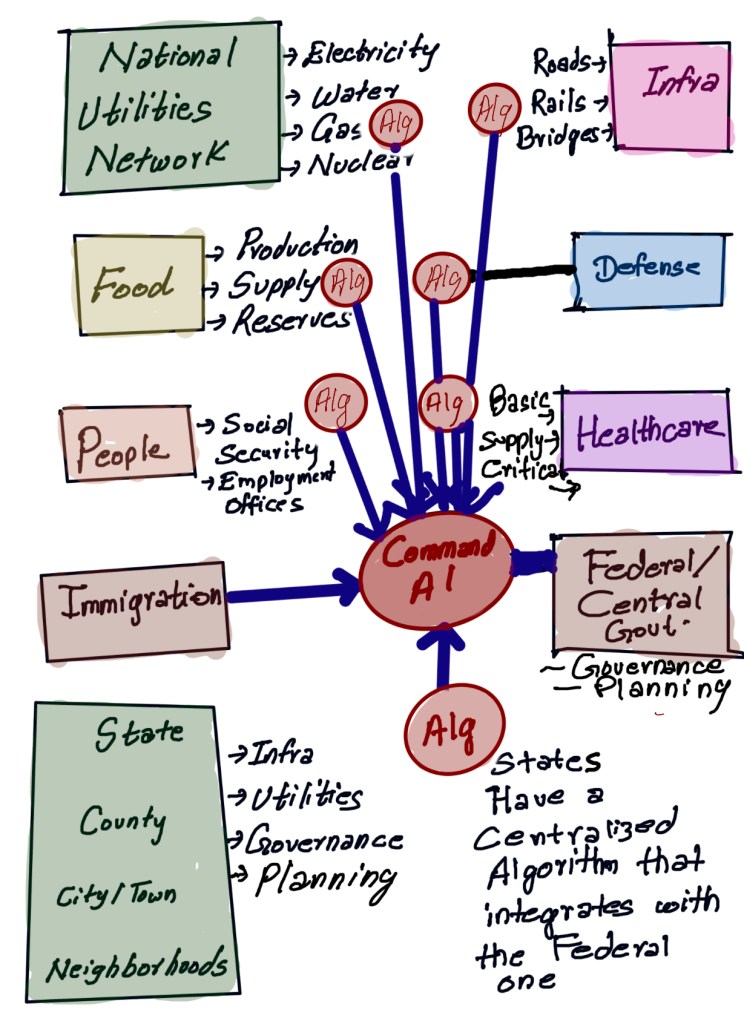
The example used is from a United States perspective, but the same interfaces, or almost the same interfaces, will exist in most countries. So, as you can see, the interfaces that need to be built are massive. Still, with the underlying infrastructure in place in most of these states, whether they are in India, or the United States, or European countries, a digital infrastructure in place for governance, both the algorithms at the state level as well as decentralized central or federal master algorithm, will at least have data sources to get started with for blueprint and design stage.
Obviously, there will be issues with data quality and legacy governance structures. For example, we should not forget the crisis that the state of New Jersey went into during the pandemic, because of the need for the use of COBOL programming language for the maintenance of its systems. That is one of the foundational steps to harmonize how the distal infrastructure across the States and the nation must be unified.
In the second part, we will continue exploring the concept shown in the illustration above to understand why this network is necessary, the scale of something like this, and the enormous benefits it can yield. The second part will be published on 02/07.

 Designed Analytics Blog