

This article is the second and final part of a two-part article series. In the first part, we introduced the critical factors for formulating a service strategy. We then started exploring how analytics can help in services strategy formulation. For recall purposes, the six key focus areas for service strategy, as identified in the first part, are:
- Staff friendliness and helpfullness
- Speed and convenience of service delivery
- Service pricing
- Service variety
- Quality of the tangible goods that are central to or accompany the service
- Unique skills that constitute the service offering
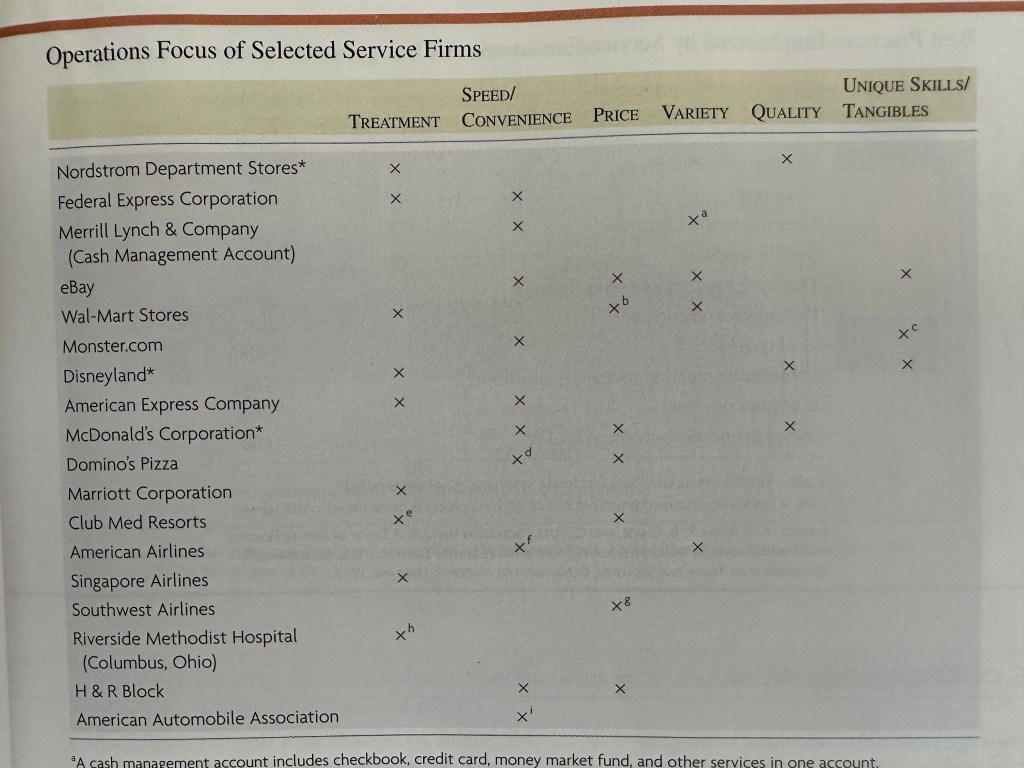
We covered the first two factors in the first part of the article. We will continue with the remaining four in this part. Below is an interesting table from the book referred to in the first part, where the authors have analyzed how some companies perform across these six factors.
Service pricing
I have written about this factor many times already. Some of the examples of articles are:
- Price Discrimination Analytics With AI
- Deep Learning for Dynamic Pricing
- Marketing Promotions and Deep Learning
I believe pricing is an area that can significantly benefit from advanced Analytics approaches, like leveraging deep learning. Having insights into pricing dynamics while devising your services strategy is priceless (see the pun?). Like all other focused strategies, one of the critical objectives of your service strategy is to increase revenue, and pricing plays a vital role in that. AI algorithms, like deep learning, can help you generate a much more granular view of pricing dynamics.
Service variety
Remember the good old market basket analysis technique in retail? For those unfamiliar with this term, this definition from Turing.com captures it effectively: “Market basket analysis is a data mining technique that analyzes patterns of co-occurrence and determines the strength of the link between products purchased together.” The approach can be extrapolated beyond physical products into pure services as well. What are the attributes that may lead to the customer buying associated additional services when offering a service?
As you can imagine, this is not as straightforward as the market basket analysis in retail, where you tend to find the strength of the link between physical products. It is easy to find the link between bread and eggs being bought together, but understanding the “why?” remains more challenging in pure service offerings. However, the answer is imperative to understand to formulate the right service strategy. And this is where deep learning can help. If a sufficient level of feedback can be gathered from the customers, it can be coupled with internally captured data to mine rules that we did not know existed in a service context.
Quality of tangible goods
In many cases, the service exists to deliver a suite of products. This product or group of products is central to or accompanies the service. An example is an oil change in your car while you wait. The quick service wows you, but the motor oil is the central tangible product. And the quality of that product is also critical to provide a holistic experience to your customers.
Fortunately, leveraging analytics to improve or enhance the central tangible product is more straightforward. From the design stage to the manufacturing stage, you can leverage analytics to improve the quality and value of the product. However, another interesting area to explore can be the product-service linkage. When customers come to Jiffy lube, what is their oil quality threshold vs the wait time tolerance? While customers expect a certain minimum level of product quality, you can leverage analytics to determine the tradeoff and understand what your customers value the most.
Unique skills
Many service propositions are associated with unique skills. Examples are acrobatic pizza making, unique hair styling, piano lessons for adult novices, and even brain surgery. Or this specific breed of ice cream sellers in Turkey.
What differentiates them is the unique skill associated with the service. While analytics can certainly NOT help develop those unique and creative skills, it can undoubtedly help gauge the importance of those skills in the customers’ minds. And that becomes an important data point for service strategy formulation.

 Designed Analytics Blog