

This article is the second part of a three-article series. The first part focused on exploring the critical components of a communication strategy. In the second part of this two-part article, we started exploring the logic of an algorithm that can help organizations formulate their communication strategy by generating more scientific input points. This exploration will be concluded in the third and final part of the article series.
The figure below, reproduced from the second part, summarizes the elements of a communication strategy we touched upon in the first part of the article. Since we will use this to understand the high-level logic of an algorithm, it makes sense to have this handy in this part of the article as well.
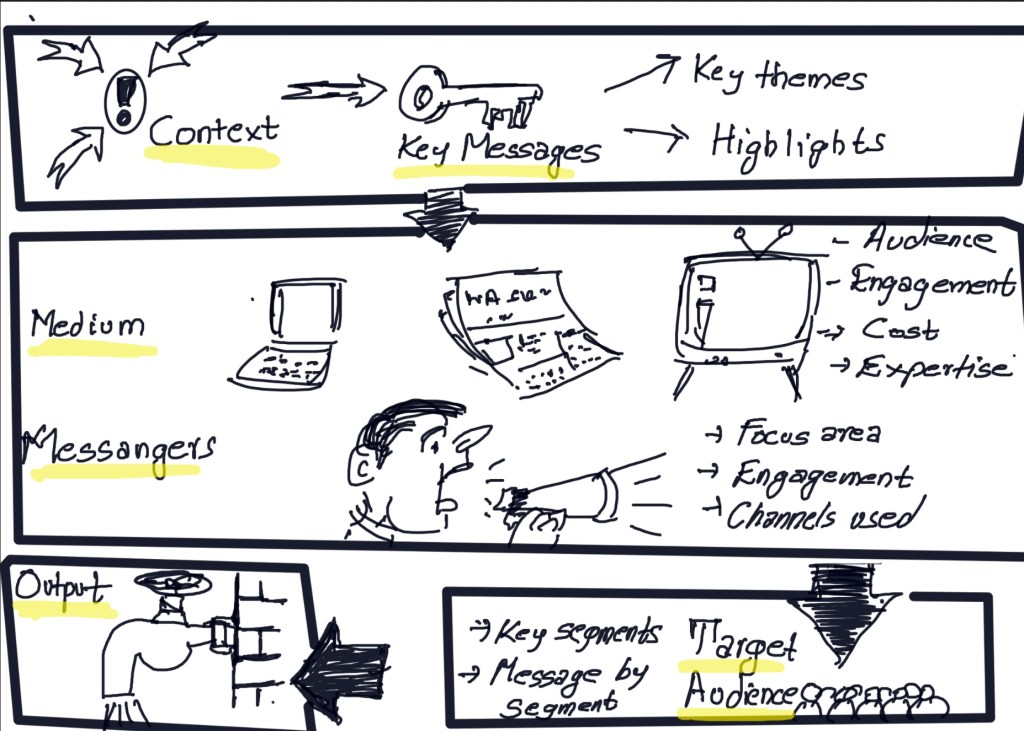
Let us revisit the questions that need to be answered to fine-tune a communication strategy:
- Who are we planning to communicate these messages to?
- What specific communication structure will each audience segment absorb?
- Which communication medium(s) should be used for each segment?
- How successful are we with our current strategy for each segment?
- How are competitors structuring their strategies?
- For successful campaigns in the industry, what is the mix of structure, content, media and messengers?
You can translate the answers to these questions into a set of choices that need to be made. This is the “optimal” set that the algorithm can help you with. Examples of sets are:
- Audience segments
- Medium by segments
- Keywords for each segment
- Communication structure for each segment
A deep learning algorithm can help you fine-tune your perceived list of audience. With access to the gigantic amount of openly available data, an algorithm can help decode if the perceived audience that you believe you need to target is the right one. It can also help add levels of granularity to your target customer segments. It can do so by analyzing existing communications designed for the same context. For example, the algorithm may analyze publicly available communications from many technology companies successfully communicating messages with the same context.
This is the most crucial part. As mentioned, machines are far from being as creative as we are. But we do not have the capability to scout the amount of data a deep learning algorithm can “learn” from what has already worked. Communication is more art than science. But having a foundational knowledge of what has worked for others can help create magic with the “art” element. This type of training and learning is already happening with most GPT models (and they are also getting sued). A model dedicated to this type of analysis can help create an exact set of elements listed above.
But that is just one part. Once you have leveraged your creativity and “art” on the suggested set and executed your external communication strategy, you also want to understand how it has performed. Not all external communication happens on social media channels like LinkedIn, where you can precisely measure likes, views, and comments (and analyze the emotions from the comments).
If a press release was published on the websites of ten different news agencies, how can you understand or evaluate the impact of that strategy? Feedback on this medium is more important than your LinkedIn page. If there are five analyst articles mentioning a recent event, and the keynote from that event, how do extract feedback from it? Remember that the feedback for these “third-party” pages includes aspects like:
- Emotion of the article
- Keywords and their relation to product/service attribute
- Engagement with the content
- Emotion of the engagement
While it may seem vague, as far as analyzing the content to extract these insights goes, the fact is it is very much possible. The other powerful aspect is that the algorithm extracts all the content to summarize the emotional impact of the communication as well. So you can not only understand how a specific medium is translating your strategy, but also gain an understanding of the overall impact. This information then goes as feedback to generate a more refined list of initial choice sets that can help you keep fine-tuning your communication strategy.
For marketing-heavy industries, it might make sense to invest in developing this type of algorithm. Eventually, this can be integrated with other marketing-related deep learning algorithms to have a deep learning algorithm that acts as an assistant to marketing executives when they formulate their marketing and communication strategy.

 Designed Analytics Blog