

This article is the second part of a three-article series. The first part focused on exploring the key components of a communication strategy. In the second part of this two-part article, we will start exploring the logic of an algorithm that can help organizations formulate their communication strategy by generating more scientific input points. This exploration will be concluded in the third and final part of the article series. The third part of this article will be published on 1/10.
The figure below summarizes the elements of a communication strategy that we touched upon in the first part of the article. We will use this to understand the high-level logic of an algorithm that can help fine-tune a communication strategy.
Figure 1:
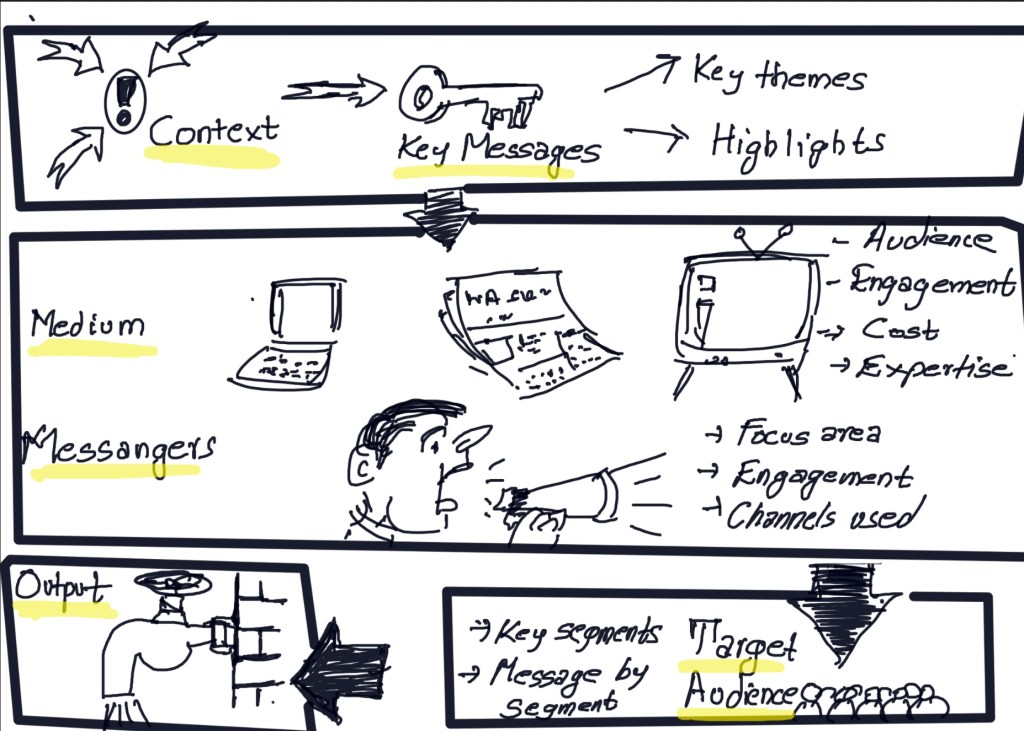
An important point to remember is that we are not seeking to build an algorithm that will spit out a foolproof communication strategy. However, this algorithm can provide insights and inputs that are currently difficult to obtain when formulating a communication strategy. Unlike marketing mix models, where you can evaluate a channel quantitatively, like via revenue generated, communication channel efficiency is a bit vague to quantify. But our algorithm can do that.
The key elemental areas of our communication strategy that the algorithm will help with are defined below:
Translating context and key message into identifiers
You have a context. As an example, say you are a large technology company that has the following context in mind before embarking on the journey of devising a communication strategy for the same:
We are a leading player in our category. However, with the rapid evolution of competing technologies, there may be a perception that we are a company from yesteryear. We want to communicate to our customers, shareholders, and stakeholders a fresh image of a technology company that is a leader in the new era of technology.
You can easily use this context to ask a well-trained generic Generative AI tool (try this with Chat GPT) to help identify several potential message options. But since humans are still more creative than machines, we can formulate our own high-level messages to get started, which are customized. In this example, some of the high-level key messages are:
- We have transformed out offerings, enabled by every cutting-edge technology.
- Our customers are leveraging the power of this transformation with amazing results.
- We have a robust roadmap of innovation lined up and the talent to execute.
And this is the point where a deep learning algorithm can start helping. Note that communication strategies have feedback loops. This means that every element needs to be factored into fine-tuning the next steps after key messages. Examples of factors are:
- Who are we planning to communicate these messages to?
- What specific communication structure will each audience segment absorb?
- Which communication medium(s) should be used for each segment?
- How successful are we with our current strategy for each segment?
- How are competitors structuring their strategies?
- For successful campaigns in the industry, what is the mix of structure, content, media and messengers?
In the third and final part of the article series, we will illustrate how a deep learning algorithm can provide insights to help us refine the answers to the questions above and make our communication strategy more precise.

 Designed Analytics Blog