

This article is the third part of a three-part article series. The first part introduces the concept of personality tests whereas the second part of the article starts exploring why organizational personality is important and how AI can help.
As highlighted in Figure 1 in the second part of the article (reproduced below), each keyword needs to be associated with a scoring hierarchy. Let’s revisit the “extroversion” example from the individual personality test in the second part of this article. It is easy to rate the individual personality test on a scale of 1 to 5 since you ask the person to respond on a scale (1 strongly disagrees and 5 strongly agrees).
As illustrated in Figure 1, that approach can not be the case for organizational personality. Since the traits need to be interpreted primarily from unstructured data sources (to be fairly evaluated), machine learning will obviously play a critical role.
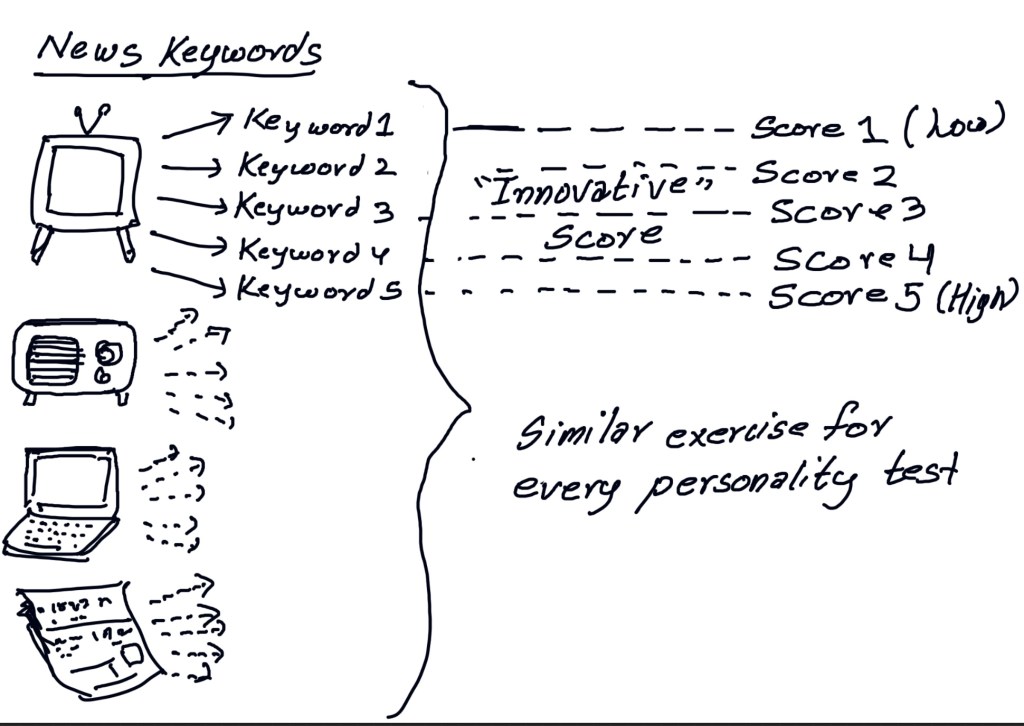
Let us try to understand this with an example. Let us say we want a scale of 1 to 5 for a specific organizational personality test, “innovative.” We want to derive the data from news articles published about the organizations during the last year. Hence, our initial task is to list keywords by score. Phrases like “Cutting-edge product” can be assigned a higher score. “Disappointing features” can be translated into a lower innovation score.
As you can imagine, it is not black and white. In this specific example, we considered only news at the data point. If we consider other data points as well, the complexity increases exponentially. Remember that we need to standardize the scoring across a varied range of sources, each with a different way of capturing a company’s personality sentiment. A deep learning algorithm can help us navigate this complexity. However, designing and training an algorithm like that requires a combination of art and science.
The algorithm, if designed and trained properly, can help you:
- First, select optimal keywords and their associated scores
- Perform the organizational personality assessment.
Why is it important?
But a key question that you should always ask is – So What? So what if we are able to develop an algorithm? What good will that do? There are two dimensions to the answer to the so what question.
The first is for companies that care about understanding how they are perceived and want to change their personality. This tool will provide insight into how your personality is perceived (not what you believe it is) and data related to it. For example, if the score indicates that you are a risk-averse organization, you can also find out the primary drivers of that result. This is important from two different aspects.
One is that if you want to influence your personality image, you can figure out a strategy to impact the input sources. For example, you believe that news data inputs are not harping on the innovation aspect enough. And you think that you are already generating enough innovation. Then, you can formulate a communications strategy to ensure the message gets delivered and published across all media channels. I have observed that many companies labeled “old tech” are actually treasure troves of innovation. That innovation and tech are fragmented, isolated, and “hidden”, thereby never making it into the communication channels. We will discuss more about this in a separate article.
The second one is that you believe you do not have the traits and products to be considered innovative. You can then also leverage the data from the algorithm to understand what your focus areas should be.
The second dimension to this are the companies that can develop, and help companies leverage their tool to:
- Capture current state of their personality
- Understand, in a data-driven way, what needs to change
This can be very lucrative in an era where the technology hype has skyrocketed. Understanding how you are perceived and how that perception can be “massaged” can be game-changing. Companies needing this service will happily pay if they can develop a practical algorithm.

 Designed Analytics Blog