

This article is the second part of a three-part article series. The first part of the article series can be found here. The third and final part of this article will be published on 01/06.
As touched upon in the first part of the article, individual personality assessment tests like the Big 5 test essentially evaluate personality based on a series of answers. But in the end, those answers are eventually translated into a specific, rigid list of personality traits. Another way to think about this is that each question hides a keyword associated with a specific personality trait. For example, a question may be ” “I like to unwind after work by mingling with people.” While no official documentation validates this, I believe this can be associated with the trait of extroversion. On a scale of 1 to 5, anyone who selects 5 (strongly agree) is probably an extrovert.
Hence, in my mind, the exercise of capturing the personality of a company consists of two essential tasks (followed by some additional tasks that are not as intensive as the first two). I am using the word “tasks,” not “steps,” because these two tasks must happen in tandem. We will now elaborate on these two tracks.
The first task is identifying the data sources for capturing the personality sentiment. This is very similar to current approaches to capturing an organization’s personality. Sentiment analysis is used to capture keywords. But that is where these methods stop. There is no standardization or universalization of these approaches. And that is because standardization is very difficult to do manually. And this is where AI, specifically deep learning, can play a significant role. And you can envision why this task is difficult.
First, let us list some examples of sources that you can use to collect the “personality” data. News articles, analyst reports, product reviews, product attribute analysis, employee personality test data, etc. You may be wondering why I included employee personality test data. In that case, my answer is that, in my perception, it is the most critical input data in evaluating your personality type. You can NEVER be perceived as innovative if a significant percentage of your employee base does not have that personality trait. Period.
You may have already imagined the challenging aspect of the next task. The next task is to:
- Capture keywords in each of these lists
- Translate them into a standardized scoring mechanism.
An example of what this means has been shown in Figure 1. And this is the challenging part.
Figure 1: Example of extrapolation challenge
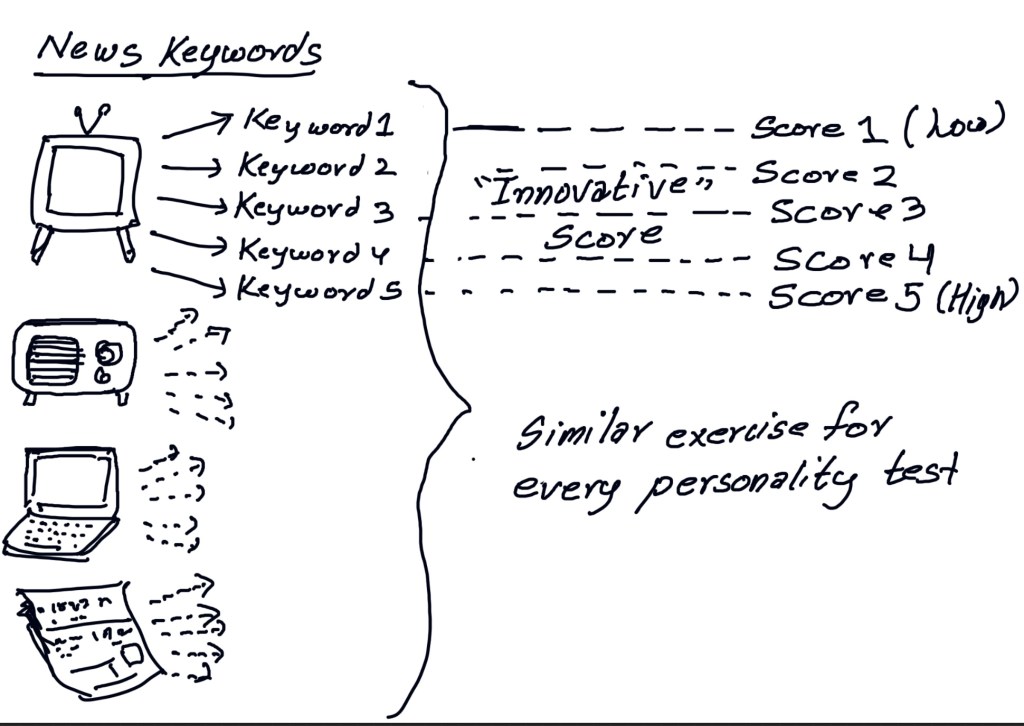
First, the keywords representing specific personality traits can differ in different reviews. A news article may not be as explicit as a customer review. Similarly, the individual personality tests will not be anywhere similar to the sentiment analysis approach because they are standardized tests. So, you essentially have a set of starkly disparate input data that needs to be converted into a standard approach. And this is where AI, specifically Deep Learning, can help.
The reason I emphasized previously that these two tasks are not sequential steps should be apparent now. The tasks of capturing and translating keywords into a scoring mechanism are tightly associated. And that is the tricky part. As you can imagine, unlike the individual scoring standardized tests, you have to associate each set of keywords for the same personality type with a score. In the third and final part of the article, we will explore this approach in detail and see how it will fit into the overall solution. We will also explore why developing a standardized test for organizational personality measurement is essential.

 Designed Analytics Blog