

This article is a part of a series of articles. The links to previous parts can be found in the appendix section.
Cuckoo Search Algorithm
A Cuckoo is a sly bird that leverages its intelligence to execute an avian con. Some cuckoo species lay their eggs in the nests of host birds of other species. Some host birds are not that dumb and can recognize the “outsider” egg by its design and patterns. For example, if a host bird discovers the weird-looking eggs, they will throw them away or abandon their nest. To counter this behavior, many cuckoo species have evolved to become very specialized in mimicking the colors and patterns of the eggs of a few chosen host species. The cuckoo search algorithm leverages this breeding behavior.
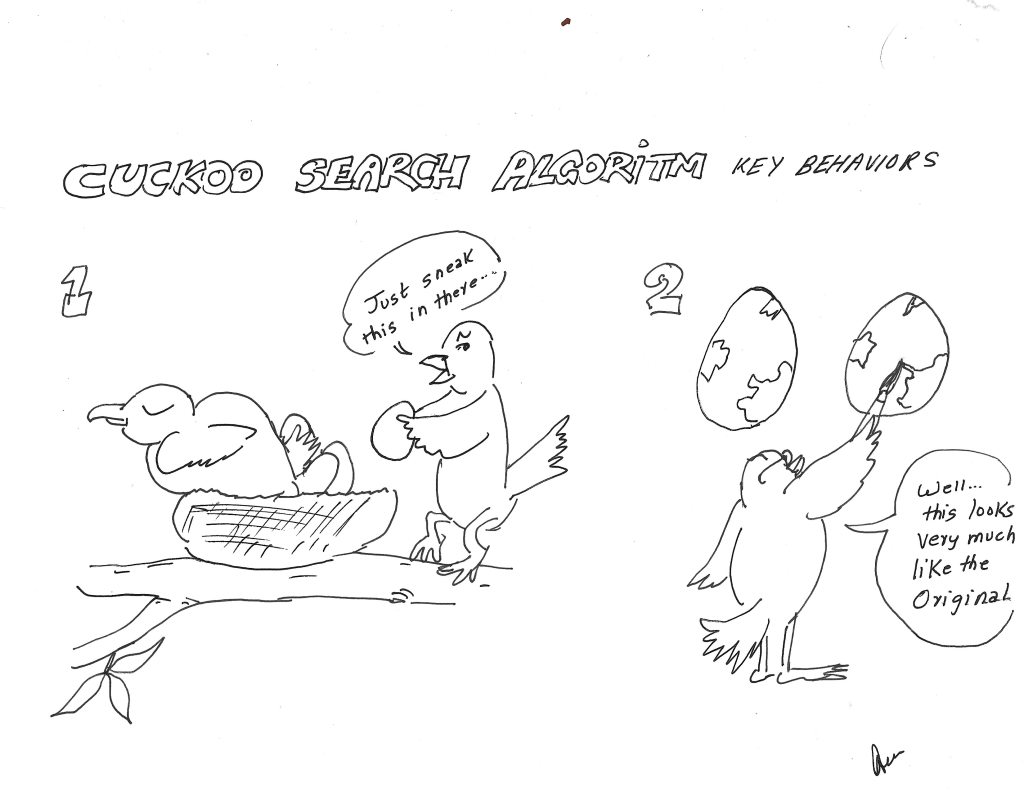
In terms of problem formulation, each egg in a nest represents a solution, and a cuckoo egg represents a new solution. The goal is to use the new (and potentially better) solutions (cuckoos) to replace a not-so-good solution in the nests. In the simplest form of the algorithm, each nest has one egg. The algorithm can obviously be extended to more complicated cases in which each nest has multiple eggs, hence representing a set of solutions.
Crow Search Algorithm
Unlike some of the algorithms covered in this series of articles, the crow search algorithm is used more often in the real world, beyond academic papers. And one of the key reasons behind that is the algorithm’s simplicity.
Crows are clever, and there is a scientific reason behind that. Among birds, the highest brain-to-body ratios are found among parrots and crows. Studies suggest that, unlike most other birds, crows can remember the faces of individual humans.
It is a well-known fact that crows hide surplus food. One of the markers of the cleverness of crows is their ability to remember the location of the hidden food. They tend to follow each other in search of better food sources, but when the crow suspects that it is being followed by other crows, it will try to change the hiding location of its food to avoid food theft.

Taking cues from this behavior, the crow search algorithm is based on the following principles:
- The “social animal” behavior
- Ability to remember the location of the hidden food
- Crows follow each other and may steal others’ hidden stash
- Crows will try their best to prevent their food from being stolen
Applications
The application areas of cuckoo and crow search algorithms overlap significantly. At a broad level, the application areas of different swarm algorithms are very similar (obviously). That often makes me evaluate whether I should keep pushing this article series or not since the theme is becoming repetitive. But for now, let us keep going and explore the applications.
Cuckoo search
A plethora of research is available on potential applications of cuckoo search algorithms. At a high-level, they can be categorized into the same application areas we have seen so far with other swarm algorithms. There is one exception, though. Applications in cloud computing efficiency and cyber security are more prominent in cuckoo search algorithms.
Cloud cost optimization
The algorithm finds good use in cloud computing efficiency
The deployment of virtual machines (VMs) in cloud data centers is a complex task. With the growing usage of cloud computing a high number of virtual machines (VMs) tend to be concentrated in a small number of data centres (DCs). Both crow and cuckoo search algorithms can help make placement of VMs more efficient.
Some research papers that you can refer to pertaining to this topic are:
- An energy-efficient cuckoo search algorithm for virtual machine placement in cloud computing data centers
- An Improved Cuckoo Search Algorithm for System Efficiency in Cloud Computing
- Effective VM Placement Mechanism in Cloud Computing using Cuckoo Search Optimization
It is not difficult to figure out extrapolations of this application in the supply chain world. Optimal inventory allocation, product placement, and merchandizing are example of areas where you can find good use of this algorithm.
Cyber security
This algorithm can help reduce the vulnerabilities and security threats on cloud-based information systems. Some research papers that you can refer to pertaining to this topic are:
- An Adaptive Cuckoo Search-Based Optimization Model for Addressing Cyber-Physical Security Problems
- Intrusion detection in networks using cuckoo search optimization
- An Enhanced Deep Neural Network Enabled with Cuckoo Search Algorithm for Intrusion Detection in Wide Area Networks
This specific category can also be extrapolated into multiple supply chain applications. There was so much hue and cry around the ability to predict supply chain disruptions during the COVID era. While Black Swan events like COVID can still not be predicted, cuckoo search can be modified to build a “monitoring” algorithm that can flag possible disruptions, while they are in their infancy.
Feature selection using the cuckoo search algorithm
Like most other swarm intelligence algorithms, cuckoo search algorithms can help remove unnecessary and attributes from the datasets. The goal is obviously to minimize the number of characteristics while improving the classification performance. Some examples of research in this area are:
- A Feature Selection Method by using Chaotic Cuckoo Search Optimization Algorithm with Elitist Preservation and Uniform Mutation for Data Classification
- Memory based cuckoo search algorithm for feature selection of gene expression dataset
- Feature Selection on Elite Hybrid Binary Cuckoo Search in Binary Label Classification
Application of this capability can be leveraged across the supply chain data to understand the dataset better. It can also help gain an understanding of what are the critical parameters within your supply chain operations. Combining this with deep learning-based planning can help transform supply chain planning at all levels.
Crow Search
As mentioned earlier, because of the simple nature of this algorithm, the crow search algorithm is already leveraged widely. However, at a high-level, they can be categorized into the same application areas we have seen so far with other swarm algorithms. Some prominent areas of applications are:
Power flow optimization
Like some of the other swarm intelligence algorithms, crow search can be used to solve the optimal power flow issue. Power flow is optimized by reducing total fuel cost, active power loss, voltage deviation, voltage stability index, and emission. Some examples of papers in this area are:
- Crow search algorithm for solving optimal power flow problem
- Application of Crow Search Algorithm to solve Real Time Optimal Power Flow Problem
- Solving Reactive Power Scheduling Problem using Multi-objective Crow Search Algorithm
As highlighted in previous parts, this capability can be extrapolated to orchestrate optimal end-to-end flow within a supply chain network.
Feature selection
Like cuckoo search algorithms, crow search algorithms can also remove unnecessary and duplicated attributes from the datasets provided. The primary goal is to minimize the number of characteristics while improving the classification performance. Some examples of research in this area are:
- Novel optimized crow search algorithm for feature selection
- A Robust Adaptive Hierarchical Learning Crow Search Algorithm for Feature Selection
- Improving binary crow search algorithm for feature selection
Application of this capability can be leveraged across the supply chain data to understand the dataset better. It can also help gain an understanding of what are the critical parameters within your supply chain operations. Combining this with deep learning-based planning can help transform supply chain planning at all levels.
Image processing
Crow search algorithms are effectively used with AI algorithms to improve image processing solutions. Some research papers in this area are:
- GWTM and Crow Search Algorithm for Face Recognition in Low-Resolution Images
- Boosted crow search algorithm for handling multi-threshold image problems with application to X-ray images of COVID-19
- Fuzzy-Crow Search Optimization for Medical Image Segmentation
Like other swarm algorithms, this algorithm can do better than other widely used classification algorithms. It has been tested in mage classification scenarios, combining it with Machine Learning (ML) algorithms like Support Vector Machine (SVM), like this example. This approach can be extrapolated into defect detections (quality management) in smart manufacturing environment.
Cloud computing
The deployment of virtual machines (VMs) in cloud data centers is a complex task. With the growing usage of cloud computing a high number of virtual machines (VMs) tend to be concentrated in a small number of data centres (DCs). Both crow and cuckoo search algorithms can help make placement of VMs more efficient.
- Crow search based virtual machine placement strategy in cloud data centers with live migration
- Virtual Machine Consolidation Using Enhanced Crow Search Optimization Algorithm in Cloud Computing Environment
- Cloud resource mapping through crow search inspired metaheuristic load balancing technique
As mentioned above, it is not difficult to figure out extrapolations of this application in the supply chain world. Optimal inventory allocation, product placement, and merchandizing are example of areas where you can find good use of this algorithm.
The next article in this series will be published on 12/7.
Appendix
This article is part of a series of articles. Previous parts of this article series can be found here:

 Designed Analytics Blog