

This article is part of a series of articles. Previous parts of this article series can be found here:
Cat Swarm Optimization Algorithms
This algorithm is inspired by two key behaviors that cats exhibit. Cats are stereotyped as lazy. We picture them lying down somewhere, taking a nap most of the time. However, if you observe a cat, you will find that despite being at rest, they keep opening their eyes in between to scan their environment. So, while a cat may seem to us entirely in the zone, it is still highly tuned to its surroundings and is tacitly alert. The gist is that cats are constantly scanning their environment.
In the parlance of cat swarm optimization algorithms, we call this behavior-seeking mode. This seeking mode, as shown in Figure 1, is the first sub-model of cat swarm optimization.
Figure 1: Overview of cat swarm optimization algorithm
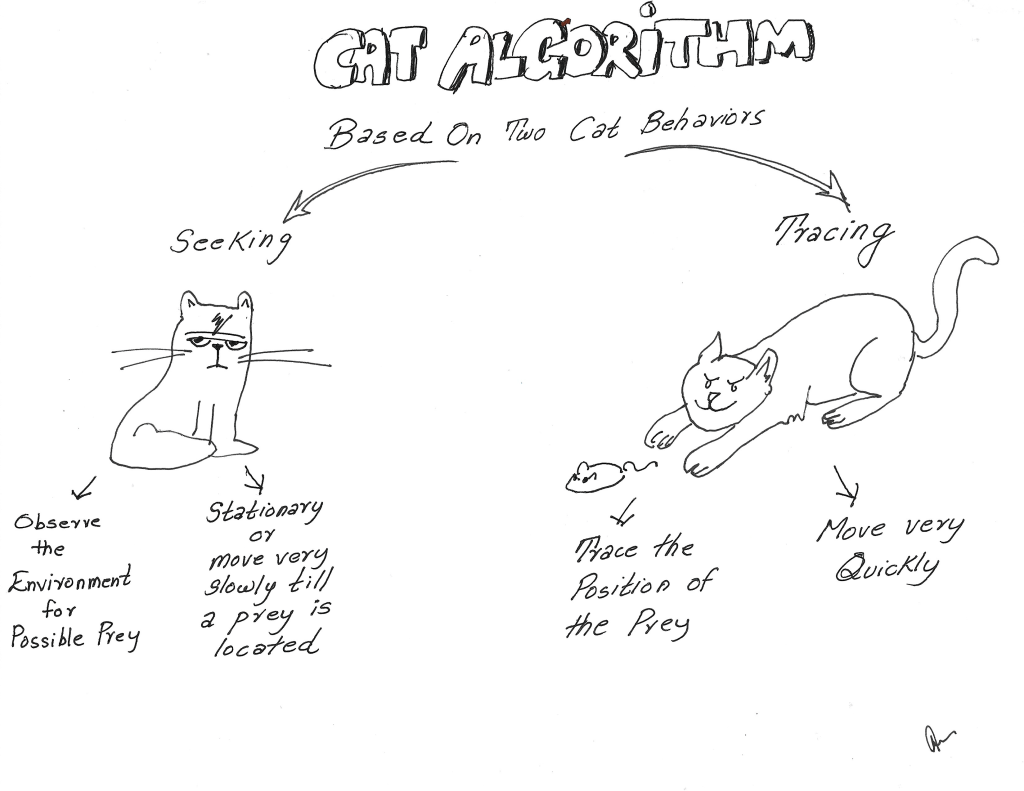
The key postulates of seeking mode are:
- Cats observe their environment before initiating a hunt
- They stay at any location in a stationary state prior to initiating the hunt
- They move very slowly during observing, if they move at all.
In the algorithm, we also need to specify how many cats should be engaged in each iteration and then run them through the algorithm. The best cat in each iteration is saved into the memory pool, and the one at the final iteration will represent the final solution. When translated into an algorithm, the seeking mode is captured through four parameters:
- Seeking Memory Pool (SMP): Points in the dimension that a cat can go to. The cat will move to one of these points (locations) as their next move
- Seeking Range of Selected Dimensions (SRD) represents the change rate of the area as well as the change rate of each dimension
- Self-Position Consideration (SPC) flags whether the position that the cat is about to move, includes a position that has already been passed
- Count of Dimensions to Change (CDC) represents the total number of dimensions that a cat will mutate into in the future
The next behavior, or sub-model, is the tracing mode. When cats find a target, they trace the position of the target and then move quickly to execute the hunt. As you can imagine, the key parameters in the tracing range are:
- Velocity
- Velocity range
- Updated position post the hunt
Overall, the high level steps this algorithm takes are [1]:
- Initial population, each cat has D-dimensional coordinate values
- Initialize the speed for randomizing the position of each dimension
- According to the mixture ratio (MR), the population is randomly divided into seeking and tracing modes
- On the basis of the cat’s flag bit, perform the corresponding position update on the cat
- Evaluate and record the fitness function value of each cat and keep the cat with the best fitness
- Terminate the algorithm if the conditions are met; otherwise, return to step three
Based on the description above, one application in the supply chain that may seem obvious is vehicle route optimization. A little research reinforced that notion. [1] This paper highlights how a modification of cat swarm optimization, adaptive cat swarm optimization, can be leveraged in vehicle routing problems.
Applications extend beyond operations and engineering. For example, this paper highlights how you can leverage this algorithm for classification in financial services. When combined with neural networks, these algorithms can be leveraged in emotion recognition in conversational AI, as highlighted in this paper.
Based on my interpretation, while VRP is definitely a classical application, the classification approach of variations of this algorithm can be pretty helpful in some supply chain analytics areas. For example, it can allow you to classify your inventory much more precisely than other algorithms, like k-means. Also, you can leverage this to infuse parameters that can not be taken care of if you leverage algorithms like k-means. In summary, the best fit is scenarios where improving classification capability will help significantly, and data volume equivalent to Big Data standards is involved.
In the next part of this article series, we will explore chicken swarm optimization. The next part will be published on 12/4.

 Designed Analytics Blog