

This article is part of a series of articles. Previous parts of this article series can be found here:
Bat Optimization Algorithms
“It is not who I am underneath, but what I do, that defines me” – Batman (Batman Begins, 2005)
So true! Despite being the inspiration behind many freaky folklore and horror stories, bats do some fantastic stuff that has fascinated scientists for decades. Bat Optimization algorithms, developed in 2010, are the latest in the series of technologies inspired by the mechanism that bats use to navigate. This book, from the pioneer of this algorithm, is a good read for nerds interested in exploring this and other nature-inspired optimization algorithms in detail (the mathematical formulations of the algorithm).
Figure 1 shows some key highlights of the algorithm, and how it captures the logic of echolocation. It is the science of echolocation that is captured and translated into the bat optimization algorithm.
Figure 1: An overview of Bat Optimization
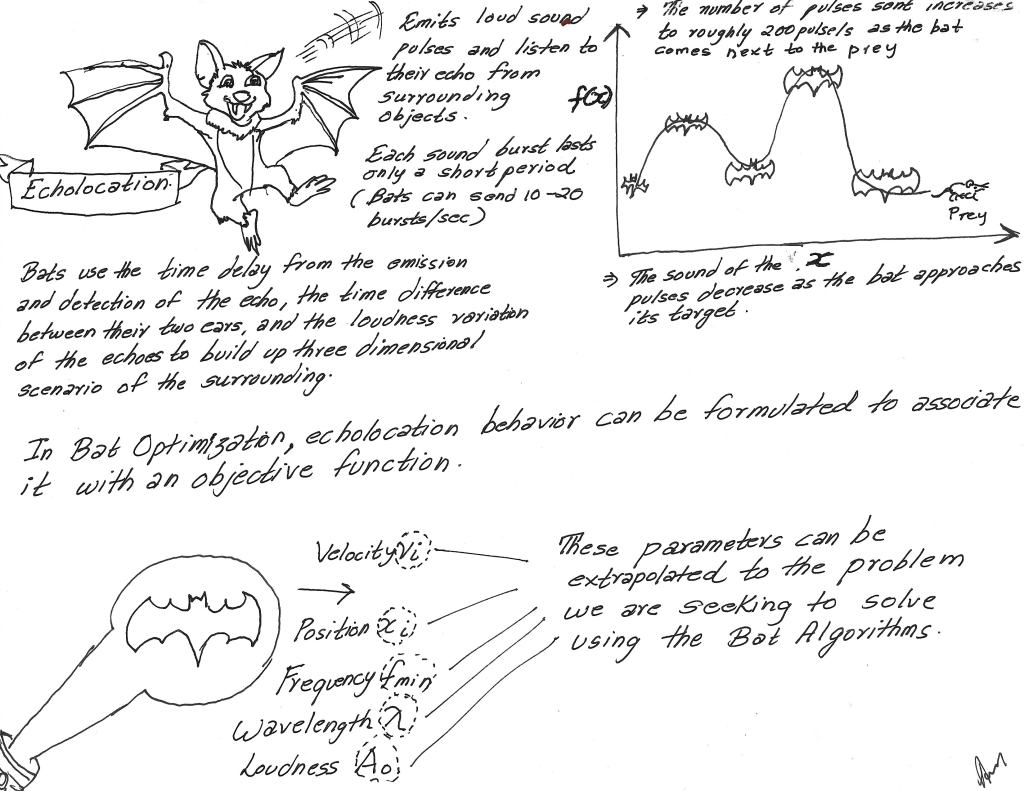
A bat emits loud sound pulses and then listens to the echoes as they bounce off its surroundings. Bats can determine their hunting strategy based on these echoes. These frequency-modulated signals can range from 25 KHz to 150 KHz and, fortunately for us, are in the ultrasonic range. Each ultrasonic burst lasts only briefly, and bats can send 10–20 sound bursts every second. The number of pulses increases to approximately 200 pulses/second once the bat is very close to the prey. Although a microbat sends load pulses as it searches for its prey, the sound of these pulses decreases as it approaches its target.
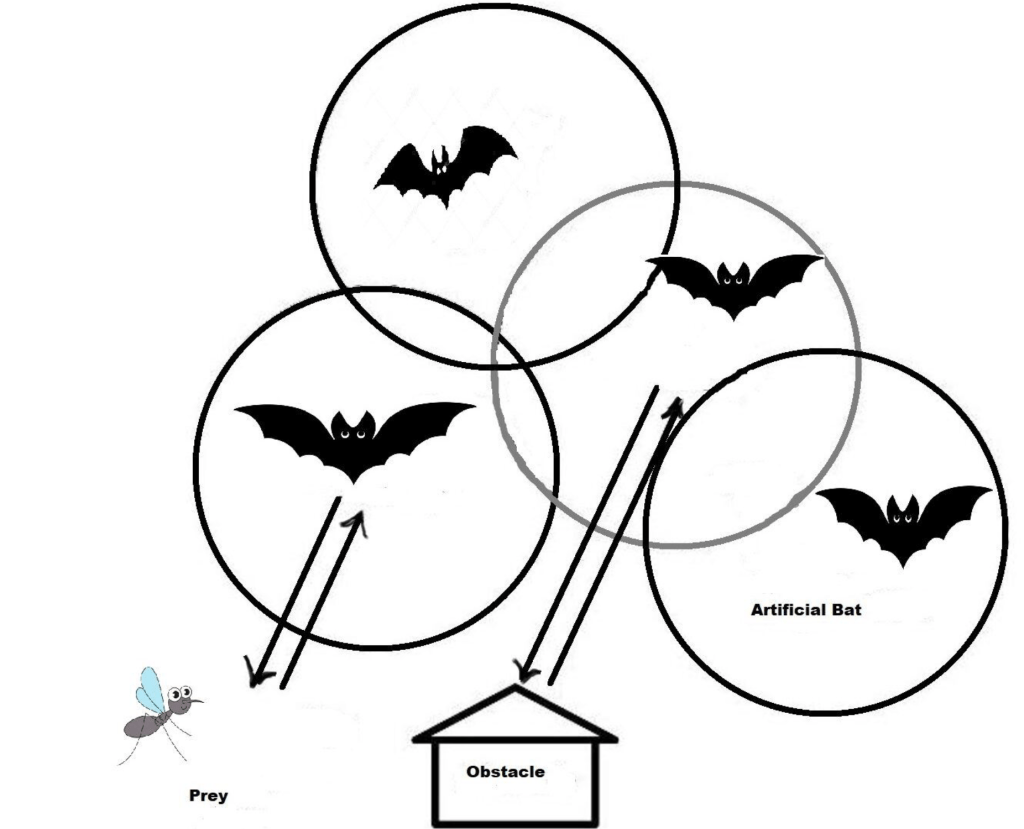
The graph in Figure 1 illustrates a possible trajectory of a bat during its hunting cycle. The trajectory starts with an arbitrary position. The position/location/coordinates are updated based on analysis of the emitted sound pulses and emission rates till a successful hunt is executed. This is shown pictorially in Figure 2.
Figure 2: Echolocation to hone-in on the prey
Source: https://www.baeldung.com/cs/the-bat-algorithm
As mentioned, once the bat finds its prey, the loudness decreases, and the pulse emission rate will increase. This approach has been extrapolated and captured in bat optimization algorithms and can be applied to various difficult-to-solve optimization problems. The following papers provide a good overview of the algorithm and its possible applications:
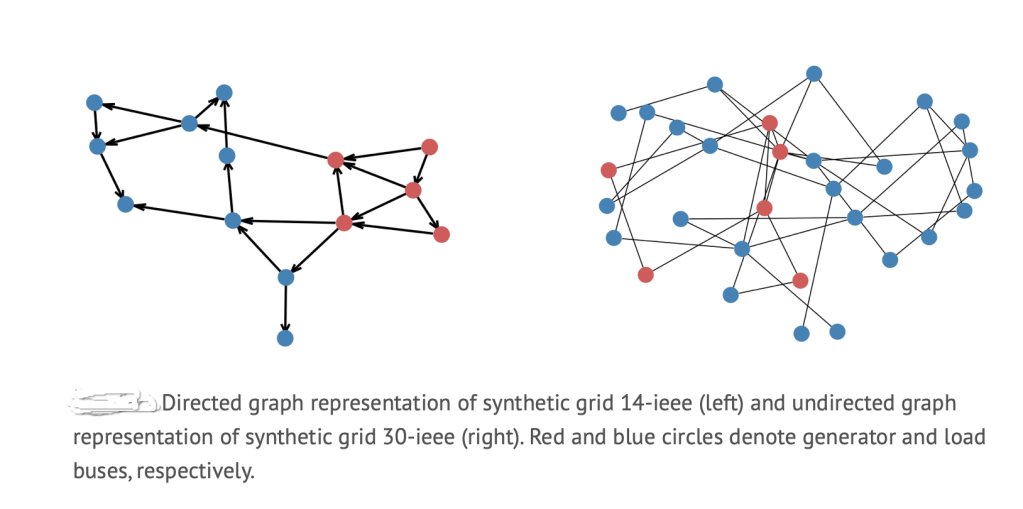
A well-established application of bat algorithms is in the power systems flow optimization arena (remember the economic load dispatch problem discussed in Part 3: Bacterial Foraging Algorithms?). If you are wondering why I keep highlighting that these electrical engineering algorithms, which are leveraged to optimize power flows in grids, can be extrapolated in the supply chain world, take a look at Figure 3.
Figure 3: Representing power distribution systems as a network graph
Source: IEEE
The high-level concept of nodes and flows between nodes allows for the extrapolation of this algorithm to the supply chain world. It can be leveraged to optimize real-time interactions and flows in siloed networks (like manufacturing networks or distribution networks) and the end-to-end supply chain. However, I think there is a better application, or another one, pertaining to the Industry 4.0 context, specifically smart warehouses. That gets us into the topic of Vehicular Ad-Hoc Networks (VANET).
Vehicular Ad-Hoc Networks (VANET)
VANET is a widely leveraged application of mobile ad hoc networks based on the principle of MANETs. MANETs (mobile ad-hoc networks) spontaneously create a wireless network for data exchange. When MANET is applied to the domain of vehicle traffic or flow, we get a VANET. VANETs are a key component of intelligent transportation systems (ITS).
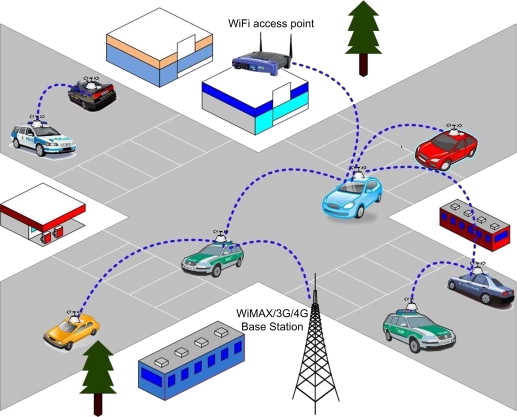
VANETs support a wide range of information dissemination over long distances, from one-hop to multi-hop messages. VANET leverages two types of communication. First is a purely wireless ad-hoc network, which is vehicle-to-vehicle. Second is the communication between the roadside units (fixed infrastructure) and vehicles.
Why can this approach help us extrapolate bat algorithms into an Industry 4.0 environment? To understand that, review the illustration in Figure 4. Figure 4 represents a typical VANET, where bat algorithms are leveraged.
Figure 4: A VANET network
Source: https://www.sciencedirect.com/topics/computer-science/vehicular-ad-hoc-network
You can develop a few use cases in the Industry 4.0 context by looking at this. Here is an example from a smart warehouse. Optimizing flows of bots, cutaway, picking, and loading bots, as well as smart vehicles (like forklifts). In busy, large-volume warehouses, which will be primarily automated in the future, regulating the flow of these mobile vehicles and bots optimally will be akin to the warehouse flow optimization problems we leverage today. Bat optimization-enabled, VANET-inspired solutions can be the answer. I say inspired because not all aspects of VANET come into play. As an example, the “long-distance” aspect is not applicable.
Whether the solution leverages VANET approach, a different approach or a different algorithm, the fact is that these solutions will be in demand.
In the next part of the article, we will discuss cat swarm optimization algorithms and their application in supply chains. The article will be published on 12/1.

 Designed Analytics Blog