

This article is part of a series of articles. Previous parts of this article series can be found here:
Bacterial Foraging Algorithms (BCO)
These algorithms are inspired by the movement of E. coli bacteria. While you don’t want these microscopic devils in your tummy, it seems they have some talent. The way they forage for nutrients is logically optimal. And when I say “they,” it essentially refers to the colony of bacteria. Bacterial foraging is about moving an entire swarm (the colony) toward an optimal objective, like all the other swarm algorithms we will discuss. Figure 2 shows the four steps or actions involved in the algorithms.
Figure 2: Four key elements of bacterial foraging optimization
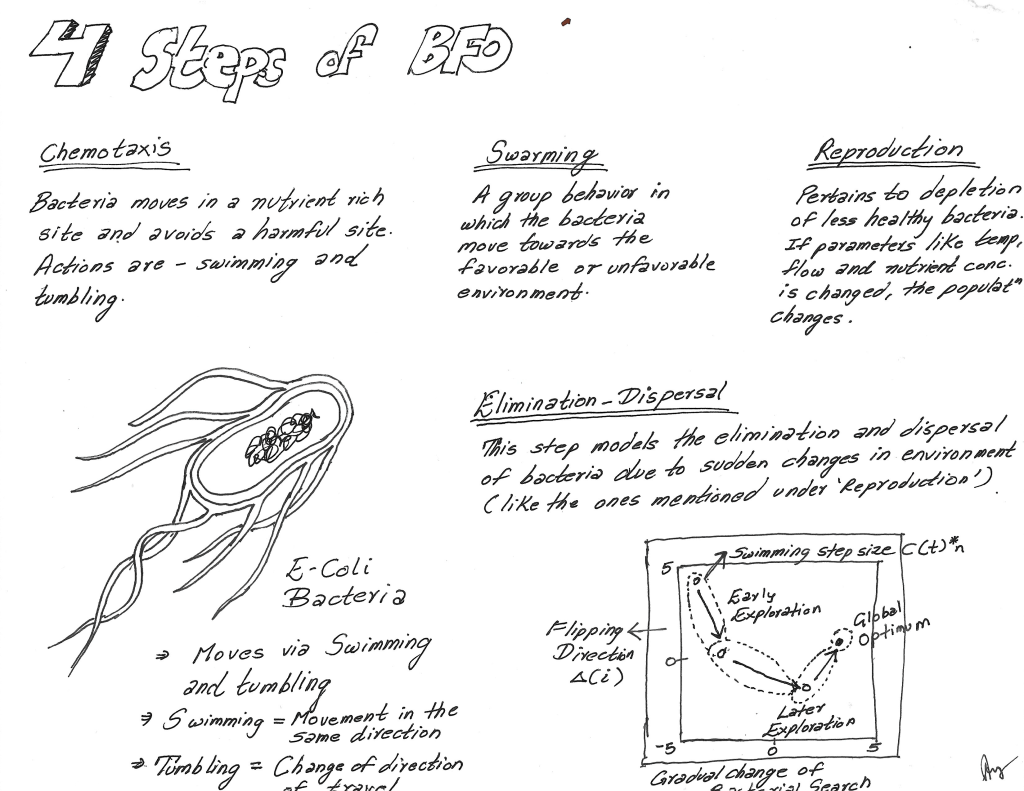
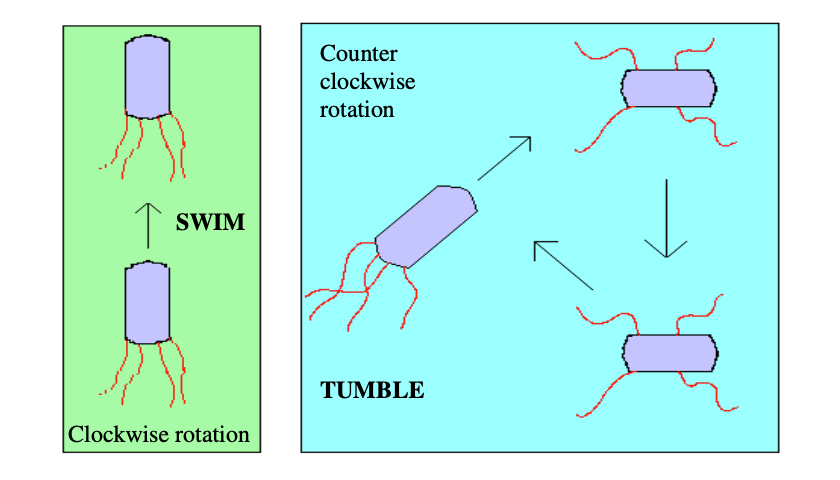
Bacteria obviously need to move to forage for nutrients. That movement, called Chemotaxis, consists of two types of movements that a bacteria can perform within an environment. Swimming is when the bacteria moves in a straight line without changing the direction. When a bacteria comes across something it deems harmful, it leverages a maneuver called tumbling to change the direction of the travel. Figure 3 illustrates these two movements.
Figure 3 (Source: ScienceDirect) illustrates the two movement types.
When the bacteria feel its environment is correct, it will reproduce. The decision to reproduce is based on nutrients and other favorable parameters like temperature, flow, and nutrients. While these two activities have been described individually, the behavior is generally a group behavior, hence swarming, where the colony, as a swarm, performs chemotaxis and reproduction as they forage for a favorable environment and nutrients.
The environment, however, may change. The change can be sudden or gradual. In an unfavorable environment, some bacteria may die, whereas others may disperse to other locations. Dispersed bacteria may disperse in different directions. Hence, this process generates multiple swarms with a new set of bacteria as the dispersed bacteria reproduce.
The applications of BCO are mostly theoretical, but if you are interested in exploring the applications in detail, below are links to some research papers.
As mentioned previously, applications of BCO are primarily theoretical, but I figured one application has been leveraged in the real world. It was more interesting to me because of my electrical engineering background. But as I analyzed it, it seemed like a good case that can be extrapolated in the supply chain world. Note that, like the previously discussed algorithms, BCO or Modified BCO algorithms also tend to be suitable for NP-hard optimization problems. The use case from the world of electrical engineering was leveraging BCO for economic load dispatching (Paper 1) above.
BCO for Economic Load Dispatch
Economic Load Dispatch, in simple terms, as defined by IEEE, is:
“Economic Load Dispatch (ELD) is an important task in power system optimization, which aims to allocate the generation power of each unit in the power system to meet the demand at minimum cost. Accurate prediction of the load sharing and cost can assist in the effective planning and management of power systems.”
You are obviously much more intelligent than me, so you have already grabbed the keyword from the definition-“allocation.” To simplify the definition above, ELD pertains to generating demanded energy (demand) with minimum cost. You allocate resources and leverage resources optimally to minimize cost. And now you can already see this algorithm’s excellent fit in the supply chain world. Aren’t we, the supply chain professionals, always obsessed with meeting demand and exceeding customer expectations while minimizing cost?
Again, you can not implement this algorithm effectively unless your underlying architecture is designed optimally. But if you have it, this algorithm is a much better “end-to-end” algorithm than the ant and bee algorithms discussed in the first two parts of the article. Powered by deep learning, this algorithm can allow you to manage your supply chain in real-time as fluidly as the fluid in which bacteria swims (yes- a bad joke !).
One specific example I was thinking of was in the area of monitoring and managing sustainability as well. There are plenty of sustainability monitoring solutions, but they are either fragmented (intelligent energy consumption monitoring, control, and reporting platforms) or manually reported by sustainability audit platforms and companies. A platform powered by algorithms like BCO can help automate monitoring, control, and reporting much more effectively. Obviously, an IT infrastructure to support this needs to be in place. As sustainability pressure mounts, companies will eventually have to consider such solutions.
The following article in this series will discuss bat optimization and its potential applications in the supply chain world. The article will be published on 11/30.


 Designed Analytics Blog