
This article is the third and final part of series of articles. The previous two parts can be read using the links below.
In the first part of the article, we postulated that distributed AI can help address the fragmentation of analytics. If you review Figure 3, it will highlight certain drawbacks of the Edge AI model to you.
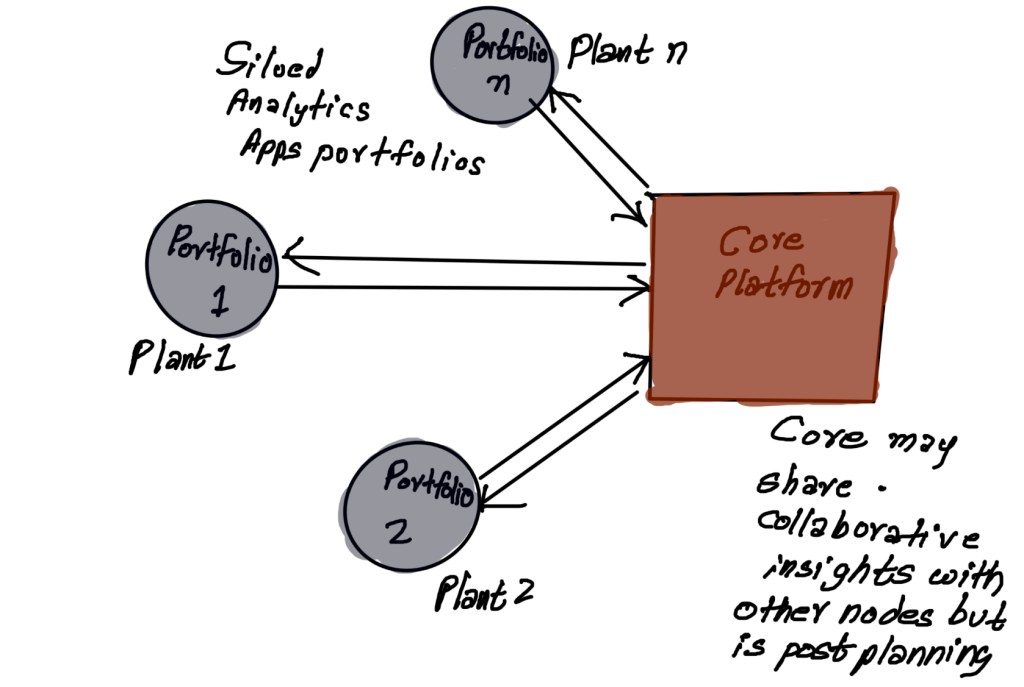
As you can see, while the Edge AI model certainly helps address some challenges of the Cloud AI approach, it still does not address the analytics silo challenge. It also does not holistically address the insights latency challenge. Some insights are still generated by algorithms that reside on the core cloud. The gist is that Edge AI is an improvement over the Cloud AI approach when it comes to eliminating analytics fragmentation and latency, but there can be a better approach.
I think we need to look at this from a “one analytics network” perspective when we talk about supply chains. This means that analytics algorithms across the supply chain work together to perform cohesive analytics. To understand what this means, let us quickly visit the concept of swarm intelligence.
The concept of swarm intelligence is inspired by nature, particularly from the behaviors of bees and ants. A bee hive or ant colony works synchronized in a “one entity” type. But that is achieved by the individual behaviors of bees, working in unison. So, to formalize the definition, swarm or collective intelligence comprises multiple agents(which are autonomous entities performing their respective tasks) that are decentralized and capable of self-organizing.
Supply chain networks have some inherent properties of hives and colonies. We call it a supply chain because many different teams, departments, and sub-functions come together to create one entity. However, to transform this entity into an actual hive or colony, we must go beyond the now-defunct approach of control towers, which are mere visibility instruments. And Distributed AI can be the answer.
Distributed AI in Supply Chains
Unlike Edge AI, Distributed AI takes a data-centric approach or in our context, an algorithm-centered approach. While in the Edge AI example, an Edge, at a broader level, was a plant or warehouse (essentially a physical node in the supply chain), in Distributed AI, the node is an algorithm itself. So, there may be more than one node within the same physical node, collaborating with algorithmic nodes across the supply chain. This concept is illustrated in Figure 4.
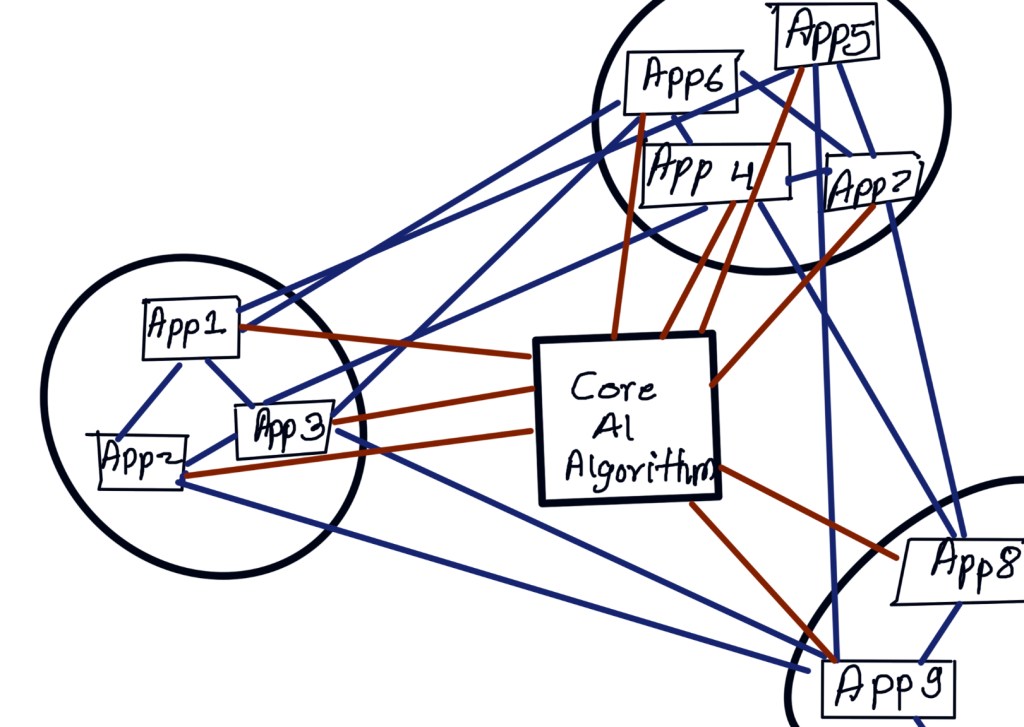
Back in 2019, I postulated something similar, proposing what I called “The Linking Algorithms”. The essence of that postulation was that no algorithm works in silo. They are productively linked to each other. Swarm intelligence is an advanced form of that approach. And Distributed AI can make it a reality. Due to their network-like behavior, supply chains are good candidates for leveraging swarm intelligence powered by Distributed AI. However, in its true sense, the multiple agents in a swarm are the same (like nature). However, that is not the case in the human world, particularly when discussing supply chains. So, we peel the layer to arrive at multi-agent systems. A critical difference between swarm and multi-agent systems is that agents have different behaviors. They are heterogeneous agents.
We will not get into the technical details, and different types of algorithms. The idea is to highlight opportunities.
If organizations want to build AI-enabled, semi-autonomous supply chains, the Distributed AI approach can make it happen. Sooner or later, all organizations who want to eventually have synchronized supply chain planning capabilities at all levels, like tactical, operational, and strategic, will have to leverage the Distributed AI model to build that capability.
This approach can be extrapolated beyond supply chains as well. The fact is, that planning systems are fragmented across functions. Eventually, organizations will get a handle on this fragmentation. And if they are also looking to build advanced AI-enabled analytics capabilities, the Distributed AI model seems to be a very well-aligned model.

 Designed Analytics Blog