

“Person with package seen.” That is a notification you probably get every time a delivery person is at the door if you use Google Nest. What I love is that when you remove the package, the camera also sends you a notification “Package no longer seen” immediately. An excellent feature for localities where package theft is frequent.
A problem with using emerging and advanced technologies is that we jump at building a big-bang transformative capability. That is the “perfection” approach to leveraging technology. While that is always one of the experimental opportunities, plenty of opportunities exist to build incremental capabilities. And eventually, many of these capabilities together can help organizations disrupt themselves.
Let us take an example. Take a look at the picture of the front entrance of my home. This was uploaded by a delivery person on GrubHub as proof of food delivery. You can see lush green foliage, my son’s Halloween decorations, and even an electric extension cord. The only thing you do not see is the food that was delivered.

The nest cam, however, captured the person dropping the food package. And notified me. When I looked at the delivery, I realized that the delivery had missing items. And this was the fifth delivery with GrubHub that had missing items. That includes my time in Massachusetts as well. Fortunately, here in the Chicago area, unlike Massachusetts, restaurants do not randomly cancel my order 20-30 minutes after I place the order (almost all the time, these cancellations were from McDonald’s and Wendy’s). But the missing items trend continues.
I rarely complain, and most of the time, what is missing is items like the main meal. One burger instead of two, for example. I can compensate for that by giving my share to the person who makes me order these meals- my son. But today, the missing item was the sacrosanct drink. My son was furious, so I decided to finally formally complain. That is when I looked at the above “proof of delivery” to ensure the delivery person did not put the drink somewhere on my property.
Complain aside, what occurred to me was how Grub Hub can nail a situation like this in the bud, even before it becomes a formal complaint. And with technology that is now very much mature. Yes, “the package identification” feature. Even an average Joe like me can train an algorithm to identify whether there is a package, any shape or form, in a picture. Some pictures will be slam dunk. The above one is a perfect example of a slam dunk. After all, it was taken “strategically” to not show the delivery. I now suspect previous ones may have been like this as well.
It was clear that this step of uploading the picture is just checking-off the box. And it is being gamed.
And that is the amusing part. We are obsessed with perfecting robots delivering things. One of the rationales is that it will take care of incidents like this. But the fact is that we may be years away from that dream. But we have technology available immediately to take care of these issues right now. Customer satisfaction is the sole purpose of the existence of service companies, more so for food delivery companies. Investing in technology centered around that should, therefore, be the priority.
So, in this case, a cloud-based tool should be able to “scan” a picture in real time and notify the delivery person and a service rep immediately if they do not see the package. This will either make the delivery person rectify the mistake or if they can’t, a real-time message from a service rep can provide a proactive resolution to the customer.
Let us take another example from the same experience. This time, to illustrate the optimal use of conversational AI. As you can see, I provided feedback that the delivery was incomplete initially. The conversation ends with “Thank You…Bye”.
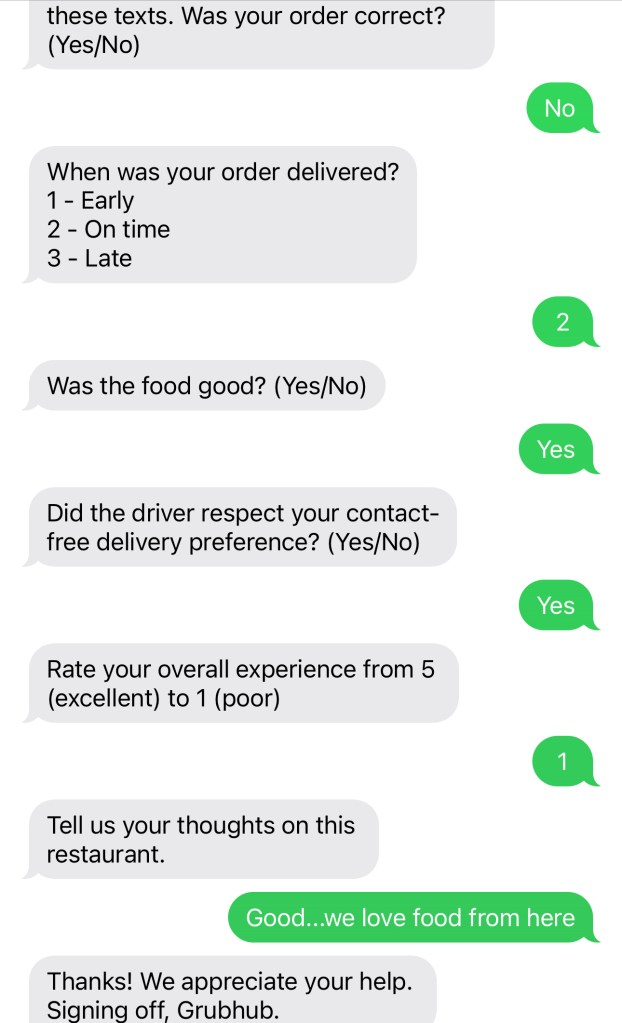
And this is an example of how we miss the very concept of Conversational AI. Conversational AI is different from automation. In its proper form, it should be, well, conversational. And in conversations, we frame our response based on the other side’s response.
Watch this week’s episode of Think About It for more.

 Designed Analytics Blog