

Undoubtedly, AI algorithms can help build truly transformational marketing solutions. However, as I consistently emphasize, the challenging part of the journey to build these capabilities is not the analytics portion. It is making sure that the underlying data foundation is optimal. This becomes much more challenging to build a comprehensive marketing analytics capability. The varied nature of data sources and data points needed adds to this difficulty level. This three-part article will explore examples of different types of data sources that need to be available in an underlying data architecture. Please note that it should be an obvious assumption that customer consent must be obtained to collect these data points.
Before we start going through those data sources, it is critical to know that there can be so many sources, based on your portfolio requirement, that one can write a book that covers all those data sources. This article will cover only the key categories of data sources.
Focus group data
Before other data types came into existence, marketers depended heavily on focus groups to understand customers’ perspectives. While additional data points available today eliminate drawbacks that focus groups had, focus group data is still widely leveraged. If you are thinking about the drawbacks of focus groups, one drawback is that you have to take the inputs provided by focus group members as accurate. Other data sources available today, like online behavior, present insights on what they actually prefer. Anyways, they are still leveraged widely for:
- Testing a product or service
- Gathering ideas for product and service improvement
- Understand customer preferences and perceptions
I believe AI algorithms can help create more robust focus groups than the traditional approach. A more aligned and unbiased focus group means more accurate data points.
Product/Service review data
When making a significant purchase online, on sites like Amazon, you most likely look at reviews left by other customers. Marketing analytics professionals leverage NLP algorithms to extract sentiments from the review data, as well as to gain an understanding of which product features are more attractive. For example, if you look at Amazon reviews, right at the top is a list of keywords, precisely product attributes, that customers have provided reviews on. Figure 1 shows an example of product reviews for the Google Nest outdoor camera.
Figure 1: Product attribute extraction from product reviews
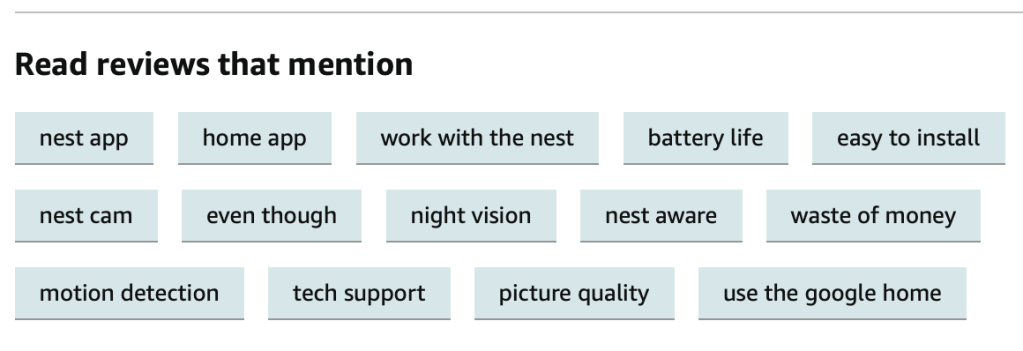
Source: Amazon.com
However, there is potential to leverage review data beyond these current approaches. We will cover some additional opportunities in a separate article.
Customer service data
In my opinion, one of the most critical data sources has become much more valuable in today’s age of AI. While some data about aspects like customer satisfaction, product attributes, etc., has always been extracted, the opportunities today expand beyond these traditional data points. AI algorithms can help extract aspects through approaches, such as voice-to-text and voice analysis, to better understand the customer. This type of data, however, needs to be used in conjunction with other marketing data types.
Survey data
While I am not a big fan of survey data, many companies, specifically marketing research companies, still need to leverage it in some form to gain input. I am not a fan of this type of data because you reach out to a set of people for information, but like focus groups, you do not know how accurate those data points are. Also, if you offer some form of incentive for your survey, the chances of survey data getting biased due to the non-relevant population providing responses are high. Sometimes, if a survey question ranks vendors, vendors may circulate survey links within their user groups to rank their solutions higher. Overall, I believe there are much better ways to research in today’s world. However, if you have really been meticulous and have a tight group of respondents who you know are actual experts and will share unbiased opinions, this method can still provide relevant data.
Weather data
Using weather data for marketing is an old practice. However, typically, it was seasonal data, which was much apparent, that was used for marketing products or services specific to that season. Some common sense examples are promoting snow blowers in winter and lawn mowers in spring and summer. However, today, the opportunities to be more granular exist in specific industries, like consumer goods. Granular weather-related data points like temperature, humidity, precipitation, storms, etc., can be leveraged to further personalize the marketing emails. Also, if you have enough data, you can use AI algorithms to find a correlation between these weather indicators and customer behavior.
Housing market data
Sometimes embedded within demographic data, housing market data is a precious data point for marketers. The housing data for every market speaks a lot about market vibrancy and consumer behavior. The National Bureau of Economic Research article provides a good perspective on how house prices affect consumption. This data must be leveraged with other data types, like loyalty data, to gain valuable insights.
Conclusion
There can be several other data points that have not been included in this article, like cost of everyday goods data, non-conscious media consumption data, etc. The key to successful marketing strategy execution is precise marketing analytics. And the key to successful marketing analytics is to
- Understand the data points needed.
- Make sure that the data architecture absorbs these data points in the desired format.
- Ensure that a data architecture that will support the types of analytics approaches, exists.

 Designed Analytics Blog