

Undoubtedly, AI algorithms can help build truly transformational marketing solutions. However, as I consistently emphasize, the challenging part of the journey to build these capabilities is not the analytics portion. It is making sure that the underlying data foundation is optimal. This becomes much more challenging to build a comprehensive marketing analytics capability. The varied nature of data sources and data points needed adds to this difficulty level. This three-part article will explore examples of different types of data sources that need to be available in an underlying data architecture. Please note that it should be an obvious assumption that customer consent must be obtained to collect these data points.
Before we start going through those data sources, it is critical to know that there can be so many sources, based on your portfolio requirement, that one can write a book that covers all those data sources. This article will cover only the key categories of data sources.
Demographic data
For decades, demographic data has been leveraged for marketing analytics approaches like customer segmentation. Typical demographic data includes age, sex, marital status, income, education, religion, household composition, political affiliations, etc. These data points can then be used to customize the marketing message for the segment. Thanks to technology, many of these demographic attributes have yielded insights not quantified. For example, a study done at Stanford leveraged Google Street View images to quantify by what percentage of people in Red states love big trucks more than people in Blue states. While this data point can also be explored using DMV data from states, the approach used here was exciting and has promising applications in many other areas.
Economic Index data
Economic index data tracks the health of the economy from many different perspectives. While doing so, it generates specific indicators that highlight the state of the economy from that specific perspective. An example is a cost-of-living indicator. Another standard indicator you may have heard about is the consumer price index. While they are also helpful as standalone indicators, you can leverage many of these indicators in tandem to generate a better picture of your segment from a particular perspective. You can pair this dataset with other data points to customize your marketing message further.
CPC Data
Cost-per-click (CPC) data, used popularly in online advertising, is a fee charged based on how a prospect interacts with an online advertisement. The composition of paid-search advertising has become increasingly complex with time, but at the core is the CPC bid, essentially the highest amount an advertiser will be willing to pay for individual clicks. The search engine, most prominently Google, will sell the link placement to the highest bidder. From the consumer behavior perspective, the keyword’s volume of clicks is an important data point. AI algorithms can help you tie these top keyword clicks with other elements of your marketing analytics.
Stock market data
While we look at stock market data primarily from a financial perspective (and some indicator of consumer sentiment), a deeper exploration can help you understand how your specific industry, specifically the perception of your specific industry, competitors, and your company, has evolved over time. Using NLP and other AI algorithms, you can use online media and stock market data to understand what drives lower and higher interest in companies.
Digital media consumption data
A significant percentage of your customers use a variety of digital media channels. As a marketer, you need to have an in-depth understanding of those channels and your customers’ behavior for each of those channels. Digital media consumption data reveals the percentages of those using different media formats. It is evident that the increase in digital media usage comes at the expense of traditional media, as illustrated in the graph in Figure 1.
Figure 1: Media consumption:Time spent on traditional media
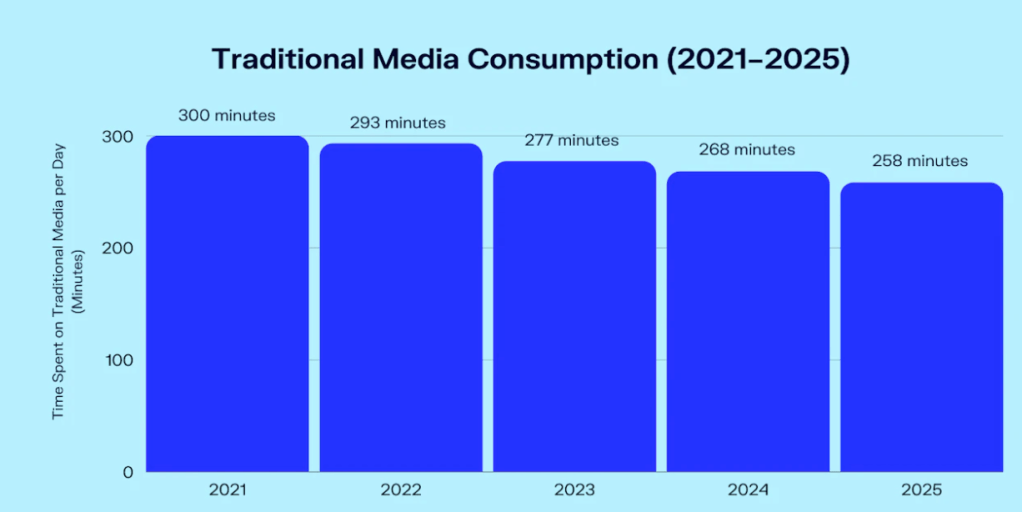
Source: eMarketer
In the third and final part of this article series, we will discuss the following data sources:
- Focus groups data
- Reviews data
- Customer service data
- Survey data
- Weather data
- Housing market data
The second part of this article will be published on 10/14/2023.

 Designed Analytics Blog