

It is not news for any executive planning to or already on the journey of supply chain Digital transformation- that the use case pilots you will leverage as the basis of a full-scale business case are highly critical. So much so that, in my perspective, a wrong choice of those use cases can even decide the magnitude of the success of your digital transformation initiative.
You need to tread a fine line when selecting these use cases. For example, if you focus solely on cost savings, the chances are that not all of that will materialize, as the savings that emerged from the pilot may have been at the cost of other processes.
Despite the pilots playing such a critical role in the success of digital transformation initiatives, our approach towards selecting pilots is still not mature. We either select our pilots based on “areas where sh*t is hitting the fan,” or the external partner may suggest use cases based on their experience. While it does not mean that these use cases will never be right, these approaches have many potential drawbacks.
The most critical flaw is that you may show significant savings in one area, whereas in the “big picture,” the impact of the use case (say implementing an inventory reduction algorithm) in one area may lead to inefficiencies in other areas. Also, if your objective is end-to-end transformation, you must select pilots in a way so that they are all pieced together to present the whole story.
Building this big-picture view is not easy, and one of the critical challenges is the lack of an approach to thinking about this big-picture. You must start with a comprehensive view. From a supply chain perspective, the good aspect is that there are numerous frameworks (like SCOR) that you can leverage to chart a comprehensive “Pilot plan”.
Let us use the Logistics Bridge Model, proposed by Goldsby and Martichenko, to explore how we can think about the big picture when selecting analytics use cases. Please remember that this is just an example. There are multiple ways to think about it, and you can similarly use frameworks developed for other functions to plan your analytics pilot journey.
The logistics bridge model is postulated for Lean Six Sigma Logistics. As you can see in Figure 1, I have broken down the elements of the Logistics Bridge model to the lowest granular level. And once you get to that level, you identify, define, and plan the use cases.
Figure 1: A modified adaptation of logistics bridge model
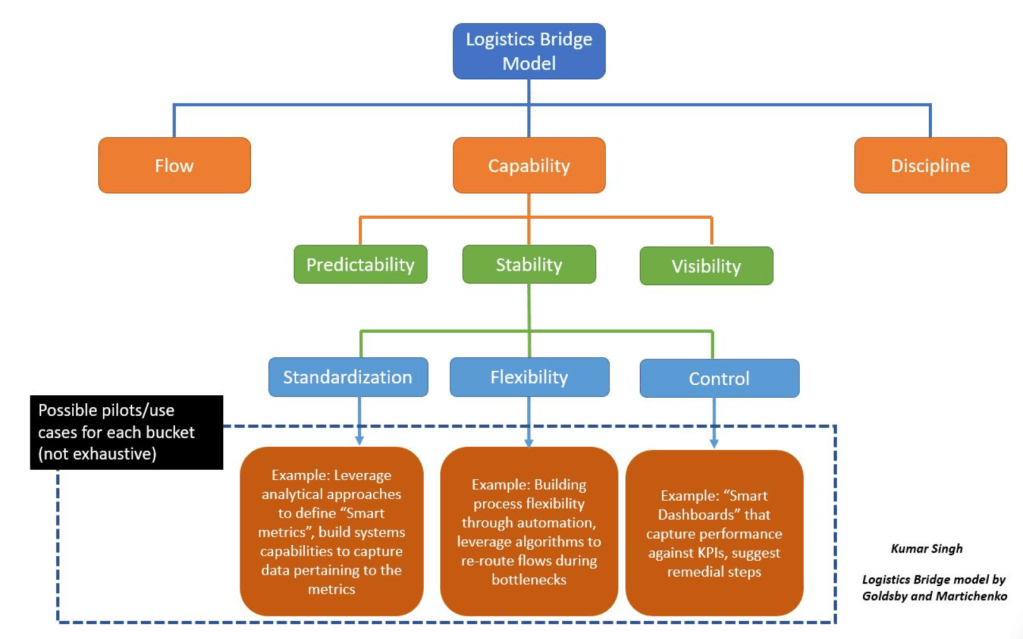
Source: Lean Six Sigma Logistics, Goldby and Martichenka
What are the advantages of leveraging this approach?
There are many, in my opinion, but the two high-level, most important ones are:
(1) It allows you to look at your Supply Chain or Logistics Digital transformation opportunities under the lens of a best practices framework
(2) After you have defined the use cases, as shown above, you can then leverage an approach (like system dynamics modeling) to determine how the result expected, may impact a use case under another branch.

 Designed Analytics Blog