

When we lost Clayton Christensen, I made a post on LinkedIn about how his work, specifically his books, helped an ignorant person like me develop some fundamental skills and insights.
One of my favorite areas is translating relatively softer disciplines into the world of hard and applied sciences, like analytics and technology. While definitely still learning the ropes of it, I enjoy doing that. And a significant part of the credit of my interest goes to books from Christensen. One of his books that I loved was “The Innovator’s DNA”.
In his book “The Innovator’s DNA”, Christensen highlights five skills that innovators possess. These skills, shown in Figure 1, are critical for any function that can act as an enabler to generate innovation (like technology). Analytics is obviously one of them.
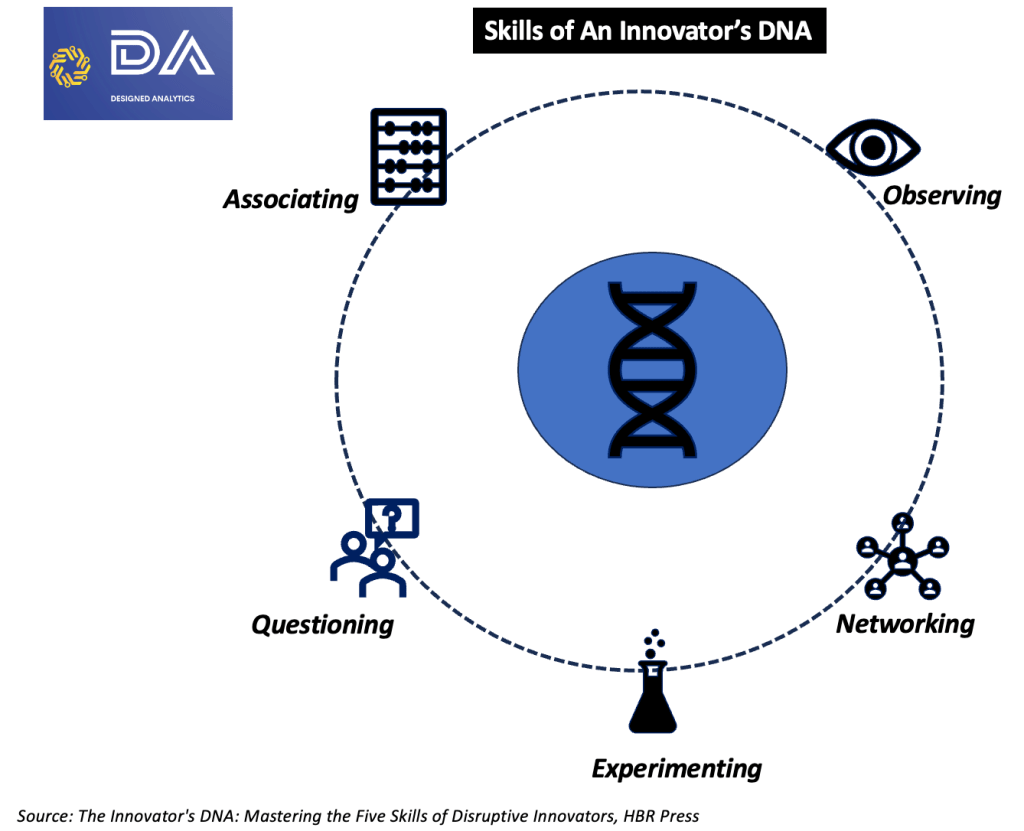
In this article, we will discuss how these skills can help generate innovation in analytics function. Before we move forward with that discussion, here is something to ponder about. Look at the skills in Figure 1 and then evaluate if you measure your prospective analytics candidates on these five. I can give you the answer beforehand-you DO NOT. I am familiar with the interview and evaluation process for data science across all key organizations. None of them span more than three of these and most of them are limited to two.
You can design a process that can evaluate across all these five skills. That will also mean that your recruitment cycle time will increase. But then the goal is not to hire x data scientists or analysts. The goal of recruitment is to hire brains that can make a difference. The goal of a leader is not to solve all problems themselves but to inculcate a culture that embraces problem-solving. This is a different topic, and we will try to address this in a separate article. So, for now, let us do a deep dive into the relevance of the five skills shown in Figure 1 in the world of analytics.
In the first part of the article, we discussed the first three skills of associating, questioning and observing. In this second part, we will discuss networking and experimenting.
Skill 4: Networking
You probably jumped on this one- I am a good networker. Unfortunately, chances are significantly high that you are a resource networker (that most executives are) vs. an ideas networker. This resource networking, though essential, hurts companies when it comes to innovation.
Resource networking these days is more like “you scratch my back and I will scratch yours”. While in some functions like sales, this is an imperative, it can cause harm in the digital transformation journey of many organizations. The fact is, resource networking, while beneficial at individual level, has many drawbacks when you look at an organizational level.
When executives start leveraging their resource networking to return favors, the resulting product or services, while they may do the job, may not be the best choice for the organization. If you are stuck with a massive investment in technology and wondering how you got here and why did the organization procure a specific solution, the chances are the answer may be hidden in resource networking. Typically, executives have solid resource networks with certain vendors; hence, when they move from one company to another, these vendors move along. And there is no formal evaluation of whether these vendors are the best fit.
Executive tenures these days are short-lived. They are hired to be change agents, and there is an expectation that there should be drastic, immediate changes. The executive moves in with their own vendors who have experience making the executive look good. The exact recipe gets played for the next few years. By the time the mid and long-term impact should be visible, the executive has moved on. This cartoon from Tom Fishburne captures that idea effectively.
Figure 2: “Change Agent”

Source: The Marketoonist.com
Hence, resource networking, though beneficial for the individual, rarely works well for the organization. Everyone understands it, but very few admit it. Sometimes, I wonder who has the skin in the game for many large public companies? A handful of C-level executives may have their skin in the game, but a leader is a collective representation of their team. but that is not the focal point of discussion here anyways.
Idea networking is a “non-material” networking. What this means is that there are minimal gains at the individual level. Since there are no tangible benefits for those who see networking solely as something that can be leveraged for tangible benefits, idea networking is not popular. Who wants to spend time networking to procure ideas for helping an organization they work for when they can use that time to build resource networks to help themselves.
But assuming that you are that offer who associates themselves with their employers and wants to bring in new ideas. There are other challenges associated as well. Free exchange of ideas between companies has confidentiality issues. And intra-company idea exchange sometimes becomes a painful experience due to intra-company rivalries. However, idea networking is relatively easy for analytics professionals.
The explosion in the world of analytics means that analytics leaders today have access to a wide range of resources, online portals, conferences, seminars, MOOCs, etc. At the start of each year, build a plan for your analytics team focusing on idea networking. Examples of inputs for designing the plan are questions like Which courses they should take and whether they will get opportunities to network with their peers. These seminars will allow them to gain insights on relevant topics for your company. We currently follow a very ad-hoc approach to idea networking primarily because we do not see individual-level gains from this exercise.
Skill 5: Experimenting
“I haven’t failed . . . I’ve just found 10,000 ways that do not work.”
—Thomas Edison
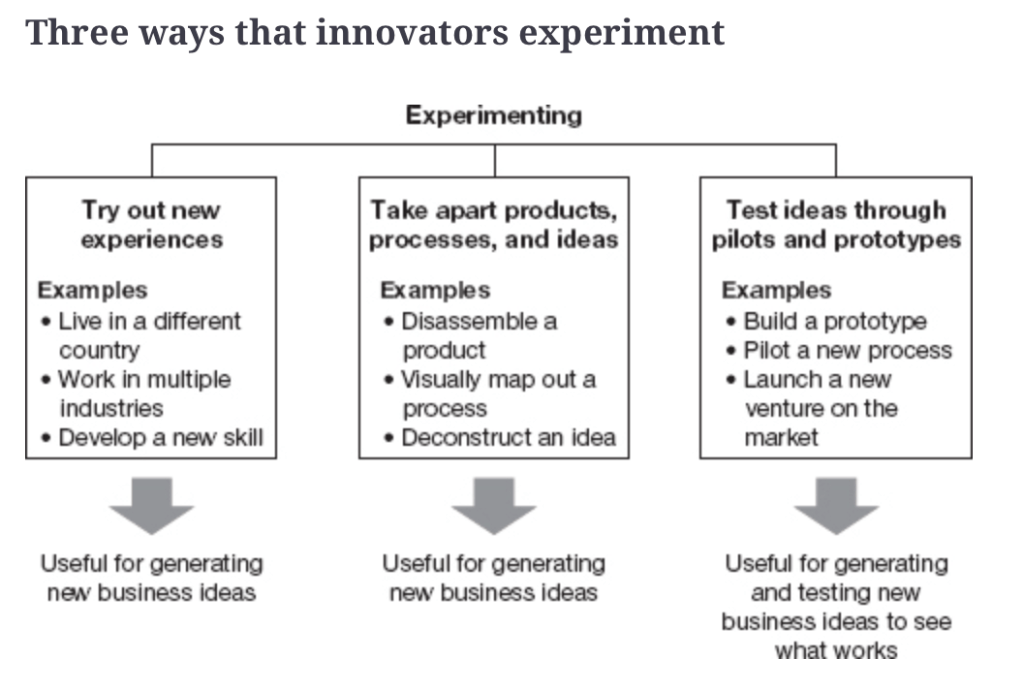
Before we start discussing this in the context of analytics, take a few moments to digest the three ways of experiments from the book “The Innovator’s DNA”, in Figure 3.
Figure 3: Three ways that innovators experiment
Source: The Innovator’s DNA, HBR Press
Let us start with a question. You are a “data-driven” executive in a regulated industry who has been assigned to hire an analytics leader in your team. It is a certainty that you will want to hire someone with extensive experience in that industry. Why? Because with no concrete process to evaluate analytics professionals based on foundation skills (like the ones mentioned in this article), extensive experience in the same industry at least guarantees that they know their sh*t. The challenge is that they know the same sh*t and have done the same sh*t over and over, and to play safe in their new role, they will leverage the same sh*t.
But if you bring in someone who has actually worked in few different industries, there are two primary advantages, among few others:
- They have no other option but to take a look at everything from a rookie perspective, but with deep knowledge of how to leverage analytics (the generalist data scientist).
- They have done this before and have a fair handle of how to do this quickly and effectively.
And that is why experience in multiple industries is one of the three experimenting categories illustrated in Figure 3 above. I would instead hire an analytics professional with excellent fundamental skills who has the skills to quickly develop functional insights through other skills mentioned here, like observing, questioning, etc.
Analytics professionals rarely get a chance to take apart an existing process. They are expected to have their heads buried deeply in data and numbers. The resulting challenge is that analytics problems rarely address the underlying process challenges. Often, the functional process owners would not like their processes challenged. You can, however, change the paradigm by giving your analytics professionals a free hand to challenge the processes associated with the problems they have been assigned to build models for.
The result of the questioning will mean that your analysts may get “flagged” by other teams to you, but you stand your ground. Eventually, your team members will develop a fearless attitude of questioning the unquestionable, and innovative ideas will start floating around.
The only type of experimentation we analytics professionals do frequently is the pilots. But we do not do that in the best way possible. But for now, let us give that a pass to keep this article short. We will discuss that in a separate article.
The key to building an analytics team that can help generate innovation is fundamental- an ability and courage to do something beyond what has been done for decades.
References:
- The Innovator’s DNA: Mastering the Five Skills of Disruptive Innovators, HBR Press

 Designed Analytics Blog