
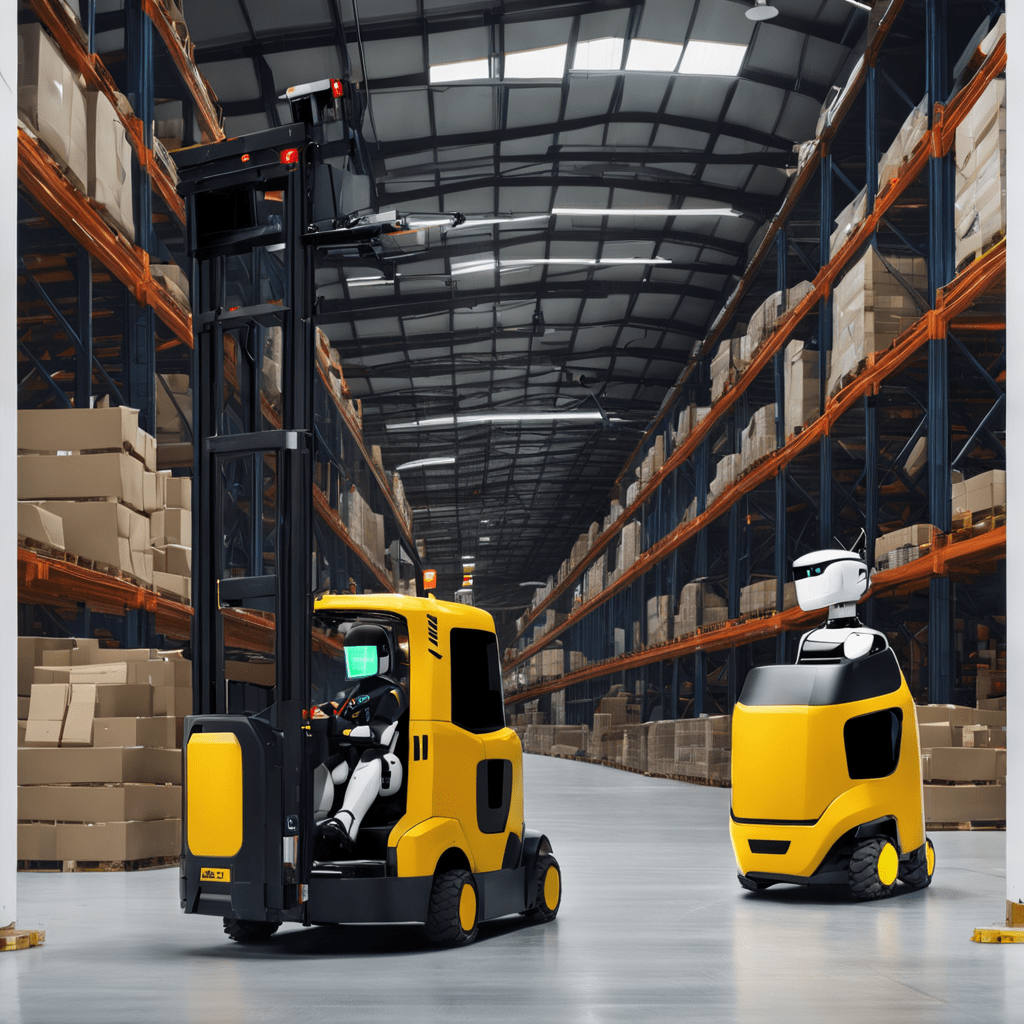
Sensors remain a crucial source of data in the Industry 4.0 context. Sensors were used on manufacturing floors to collect data before the arrival of Industry 4.0 hype. Sensors can be pretty rudimental (like legacy switches and variable resistors) or advanced (like LIDAR and thermal imaging), but from an Edge AI perspective, what is critical is that they are a source of data for our Edge AI devices.
This three-part article will overview prominent types of sensors leveraged in the Industry 4.0 context in logistics. While you may see many examples of Industry 4.0 in a manufacturing context, examples from warehouse operations are scarce. So, this article will explore the types of sensors in an intelligent warehouse context.
The first part of this article explored acoustic and motion sensors, whereas the second covered visual and force sensors. In this third and final part, we will explore the optical, electromagnetic & radiation sensors categories and environmental, biological, and chemical sensors in an intelligent warehouse context.
Optical, electromagnetic and radiation
Sensors in this category measure:
- Electromagnetic fields
- Magnetic fields
- High energy particles
We mentioned in the second part of this series that ACME’s warehouses are smart and Green buildings. Let us explore how ACME is leveraging this category of sensors in their warehouse operations as well as smart building infrastructure.
Spectroscopy sensors: These photosensors measure the absorption of light wavelengths and their reflection. ACME used them extensively to design an effective and efficient lightning system for the warehouse that ensures proper lightning and minimizes energy costs. Based on this analysis, reflective panels were installed throughout the building to ensure proper lighting while saving on energy costs. They also leverage these sensors intermittently to gauge the level of illumination.
Inductive proximity sensors: These sensors are used to detect metals and are widely used to detect vehicles for monitoring traffic. So, needless to say, ACME uses these, in conjunction with other sensors, for collision avoidance for manually operated warehouse vehicles.
Current and voltage sensors: These are used to measure the flow of current and voltage. These are widely used in industrial equipment to monitor current and voltage fluctuations. All industrial equipment on ACME’s warehouse floor powered by electricity leverages this sensor for monitoring.
Environmental, biological and chemical
This category of sensors allows Edge AI to gauge the environment around them, precisely the composition of the environment. Let us explore some of these sensors and see how ACME uses them in its warehouse operations.
Temperature sensor: This suitable old sensor detects precisely what the name suggests-temperature. One of the oldest types of sensors being used, it has evolved with technology. More advanced technologies, like infrared, can be leveraged to measure the temperature of an environment that is not nearby. As you can imagine, ACME uses these sensors in various areas within its warehouse operations. From monitoring the temperature within the warehouse to the temperature monitoring of industrial equipment and surfaces, plenty of these sensors are spread throughout the warehouse.
Gas sensor: This category encompasses a plethora of sensors. Common types include humidity, volatile organic compounds, and carbon dioxide sensors. These are embedded within ACME’s warehouse infrastructure as a part of their intelligent building setup.
Chemical sensors: A category encompassing many types, primarily helps detect the presence of chemicals or their concentration. ACME leverages these on the floor and in its intelligent building infrastructure for safety purposes.
Conclusion
The categories covered in this series of articles are comprehensive. However, the specific list of sensors listed within the categories is not comprehensive. As an example, you may see that ACME does not leverage bio signals sensors, particulate matter sensors, semiconductor detectors, Magnetometers, etc. in their operations. If you want comprehensive knowledge in this area, I will suggest the references at the end of this article.
References:


 Designed Analytics Blog