
Every organization wants a piece of the so-called data science revolution cake. However, only a few are equipped to successfully implement useful and functional AI capabilities. The word “useful” here is extremely important. You need a solution that delivers that helps your business. It’s not a tool that checks a box but does not deliver value. Don’t do Data Science just because everyone else is doing it.
Careful planning must be done before starting the AI and Data Sciences journey. However, this post is not about those steps that need to be taken or the infrastructure/architecture you need to build. We will keep this post focused on one of the tools that can help in the planning stage to lay the strategic framework of an AI solution: AI Canvas.
The critical components of the canvas have been explained below, with examples for each block of the canvas, from a supply chain perspective.
Before we jump into designing an AI solution/Predicting machine, we need to understand the aspects of the tool like (not exhaustive):
- What is the objective?
- What kind of inputs are required?
- What are the metrics to test the outcome?
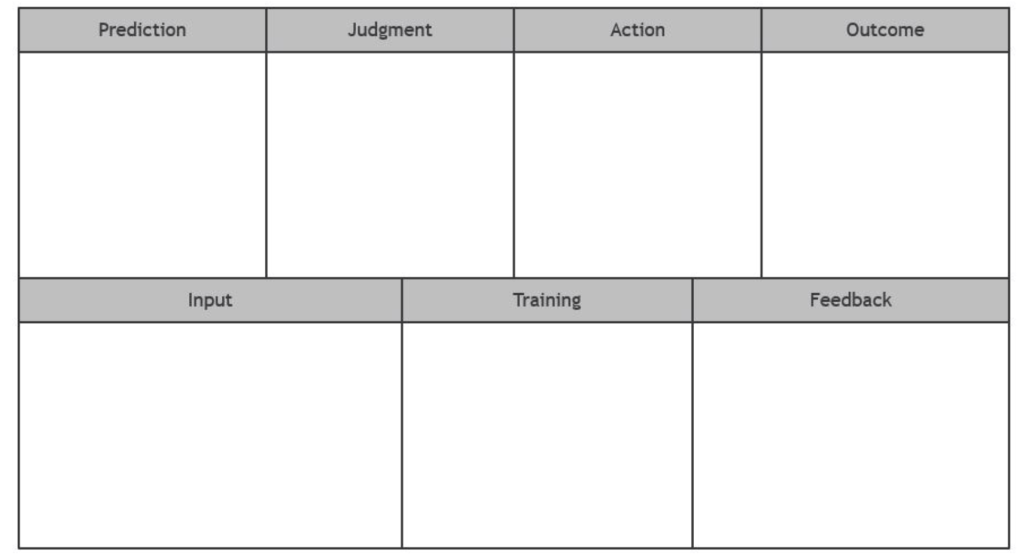
- Prediction: This is the prediction objective. Example-predict whether the shipment, which has certain traits in terms of origin, destination, product type, mode, day/month of shipment etc., will be delivered in time.
- Input: Based on the prediction objective, what data to you need to run the predictive algorithm. As indicated in the example above, the inputs for predicting on time delivery would be origin, destination, product type, mode etc. It is important to get a handle on the inputs, as this will enable you to plan your data collection/availability accordingly.
- Judgement: How will you value different outcomes and errors. You need to determine the value of correct prediction verses false negatives verses false positives etc.
- Action: What is the step/decision that you are trying to take that needs the output from the tool? Essentially, what is the action you will take based on the tool? In this example, it could be switching carriers on a particular mode.
- Outcome: What is the business objective you are looking to achieve through this analysis? In this case, say the problem is customers are complaining about late deliveries and you are trying to figure out which lanes or modes are your problem so that you can work on that. The outcome desired is improved customer satisfaction.
- Training: What data do you need to train the algorithm ? In this example, you want to use the planned outbound shipments data to train the algorithm.
- Feedback: How can you use the outcome from the algorithm to make your algorithm perform better? This goes hand in hand with judgement
I found this framework leveraged in the book “Prediction Machines” and loved the combination of simplicity and efficacy. The book has multiple examples of leveraging AI Canvas, which will help you understand the tool better. A little bit of practice and you should be able to take a business problem (that a prediction algorithm can help mitigate), and translate the problem into an AI solution using the canvas. This will ensure that you don’t realize midway through the project that you are on the wrong path.

 Designed Analytics Blog