
Every prospective vendor, white paper, think tank, analytics body of knowledge, and survey- is screaming one thing loud and clear in your ear: Building analytical capabilities within your operations is a must to compete and thrive in today’s age of analytics boom.
Yet, most surveys agree on one thing -most initiatives that focus on building internal advanced analytics capabilities do not deliver the desired result.
There is no paucity of resources that organizations are willing to invest. Significant investments are being made in people, processes, and technology- so then, where is the disconnect? In my opinion, the disconnect is in the fact that the analytics capabilities that we build are siloed. The drawback of these siloed solutions is that different “layers” in the organization may be seeing operations data from a different aspect, thereby creating confusion rather than efficiency.
The need is to build “Scalable” analytics solutions. These solutions can scale upwards and downwards to cater to multiple organizational levels.
In this article, we will leverage an example of Manufacturing analytics to showcase what “Scalable Analytics” means. We will discuss how to architect your Manufacturing Analytics solutions so that they can “talk” to multiple layers in your organization.
An Overview of Manufacturing systems hierarchy
So we know very well that data fuels Analytics solutions and engines. The “fuel” is generated by multiple systems within the organization. So to start with, let us take a quick look at the hierarchy of Information systems in the manufacturing world, shown in the illustration below:
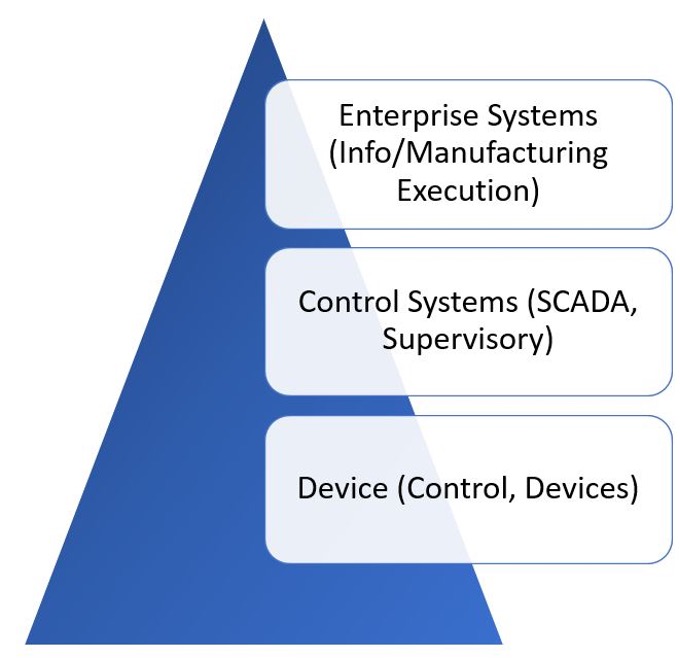
Most of the Manufacturing Analytics solutions that exist today interface only with some of these levels of systems shown above. A graphical representation of where most of the systems interface is shown in the illustration below:
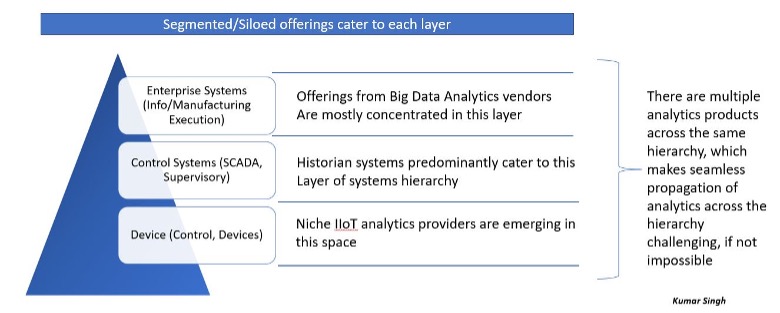
As you can see, most historians also only interface in a siloed way, which essentially takes away the true potential of leveraging these analytics solutions. There are multiple analytics products across the same hierarchy, which makes seamless propagation of analytics across the hierarchy challenging, if not impossible.
Remember, the key is:
Produce, analyze & react to information as close to the source as possible, leveraging the same Analytics architecture and infrastructure. The need is to develop a platform close to the source of data across all three layers and generate insights for any of these layers on the same platform.
A truly scalable solution will probably have to be custom-built.
The complexity level and value of a scaled Analytical solution is shown in the illustration below. Note that these solutions rank high on the “Complexity” aspect, as seen in the illustration below. But the increase in value you can generate also increases from the offering.

Also, note that as shown in the illustration, most of the Industry 4.0 analytics shelf offerings available today are focused primarily only on Device Analytics and Embedded Analytics buckets. To develop a solution that encompasses these two buckets AND extends all the way to control system and enterprise analytics, you will probably have to develop a customized solution.
So what will scalable Manufacturing analytics encompass?
A vision of a scalable analytics solution is shown below. In order to illustrate the different layers, I have used the following buckets for types of Analytical approaches:
- Descriptive
- Diagnostic
- Predictive
- Prescriptive

Now let us review the illustration above to understand what scalable analytics capability entails. As you can see in the illustration, scalable analytics implies that once deployed, an analytical approach (like predictive, prescriptive etc.) can be leveraged across the three layers indicated, with the ability to use the same platform for all three levels. Examples of each type of analytics lever and the scaled information is shown in the illustration above.
Conclusion
The framework used in this example is just an approach to illustrate the importance and the reason behind having a scalable analytics platform. There can be several variations to it hence it is not cast in stone. The key aspect here is to understand that Analytics solutions need to be built and integrated across various levels to deliver the best possible value to your organization.

 Designed Analytics Blog