

Understanding the linkage through an example: Developing supply chain analytics capabilities for a manufacturing company
Let us walk through an example to help us understand how analytics strategies should be ideally formulated. Following the journey that starts with a business strategy and goes all the way to defining required analytical capabilities will provide you with insights that you can use to determine if any of the fancy, advanced analytics tools that you are being sold are useful and will help propel your company’s strategy.
Our hypothetical company
Let us assume that we are in charge of formulating the strategy for a company that manufactures LCD TVs and displays. We have already leveraged some levers like low-cost country sourcing and manufacturing, but so have all our competitors. We are now brainstorming a strategy path to differentiate our brand in a crowded marketplace and have formulated specific business strategies.
Business strategy
One of our business strategies is to offer a product that has the same quality as the competition but is cheaper than the competition. To summarize it in a sentence- “Offer lower prices with high quality.”

Supply chain strategy
Now leveraging the above business strategy, we define a supply chain strategy. In the illustration below, the supply chain strategy has been laid below the business strategy since it needs to support it.
Formulating a supply chain strategy is not exceptionally difficult at a high level. To be an efficient manufacturing and distribution organization, you need to develop a supply chain that minimizes cost/waste across all subdomains of the supply chain.
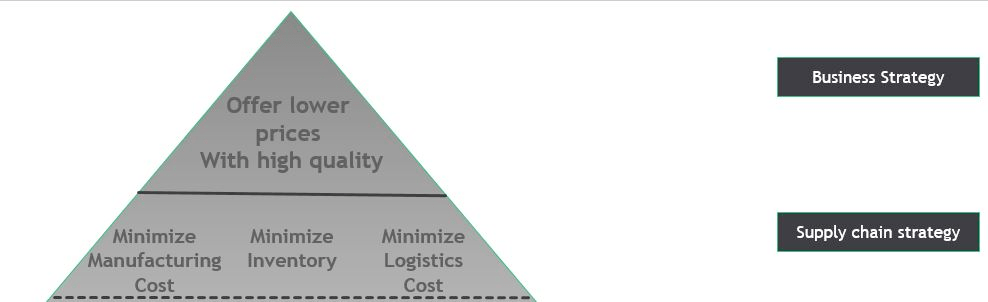
Defining components of supply chain strategy
But then, there are more granular aspects to supply chain strategy. Based on the MIT Center of Logistics and Transportation’s proposed Strategy operations continuum, a supply chain strategy has three high-level components that add structure and pathway to the supply chain strategy. Let us review and define those for this specific example:
Principles: General objectives for the supply chain
Imperatives: Specific goals for the supply chain
Choices: Specific decisions made to support specific objectives
What these mean will become clear from examples in the illustration below when we split the high-level supply chain strategy mentioned above into these three supply chain strategy components.
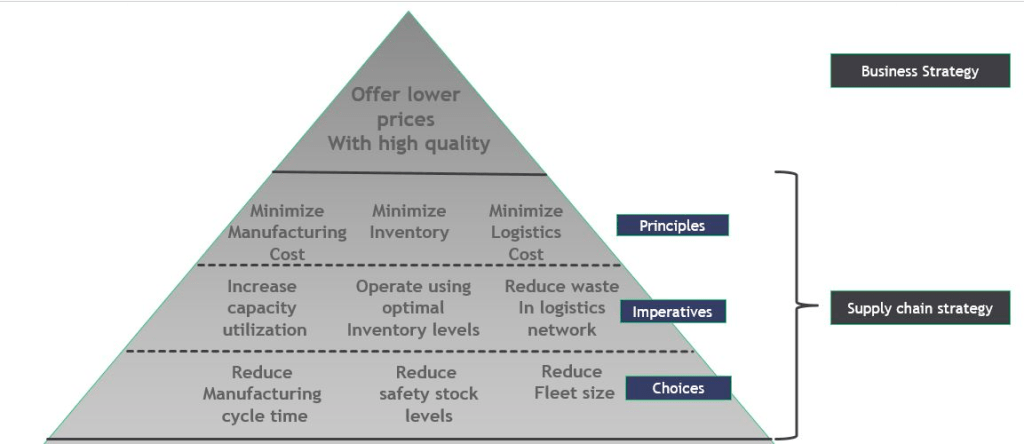
Principles: Minimize manufacturing cost
Imperative: Increase capacity utilization-which means you produce more leveraging the same assets.
Choices: You can achieve the imperative above-increase capacity utilization by leveraging a few things. We can increase utilization by reducing manufacturing cycle time for simplicity’s sake.
For each principle, there can be multiple imperatives and choices, but for the sake of simplicity, we will use one example of imperatives and choices.
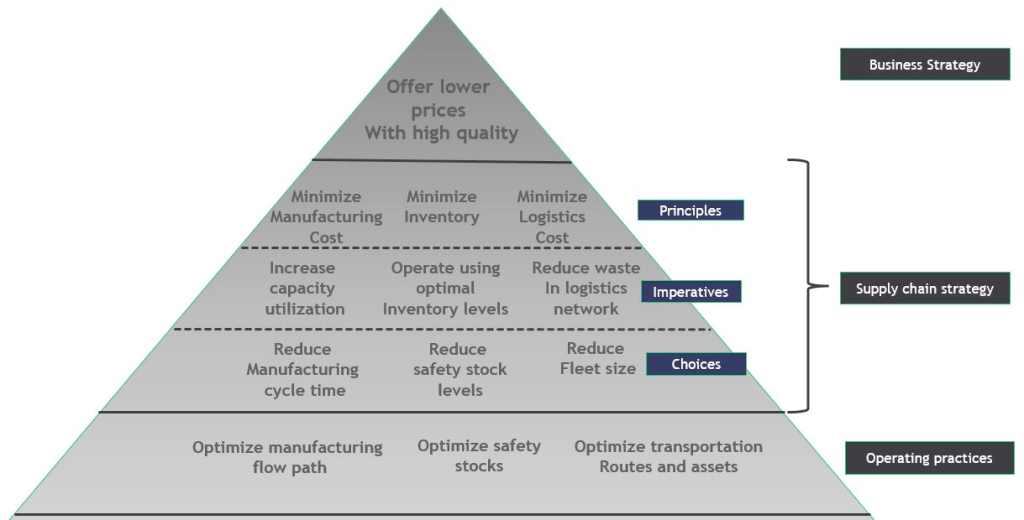
Formulating operating practices
Now that you have defined a granular supply chain strategy, you can hypothesize that each of the supply chain policies/choices impact your operating practices. For example, you need to optimize your routes and transportation assets to reduce fleet size. Again, each option can have many operational procedures, but to keep the example simple, we will use just one practice for each supply chain strategy choice.
Determining analytics enablers
Now that you know what operating practices you need, we can focus on defining the required analytics type.
Force-fitting cookie-cutter solutions without understanding how it relates to an organization’s objectives will lead to initiatives that “also ran” for a few years and eventually faded away.
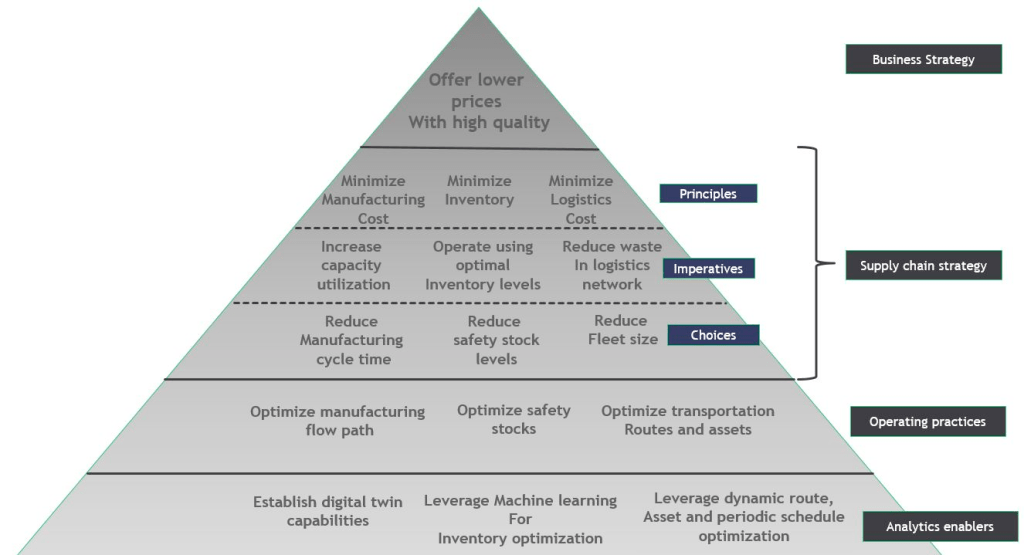
So if you want to optimize manufacturing flows, you want to leverage a simulation tool, at the very basic, to simulate your manufacturing flows and run simulation scenarios to determine what the optimal path will be. Then eventually, in the long term, you want to have a capability called digital twin-a imaginative factory scenario where you can allow a digital “twin” of your manufacturing processes to run and optimize manufacturing.
Conclusion
Trying to leverage analytics just because everyone is trying to do it will never give you any competitive edge. To use analytics as a true competitive differentiator, you need to consider it an enabler, not a strategy. When linked correctly with strategic objectives, you can leverage it as a true differentiator.

 Designed Analytics Blog