
Earlier this week, I wrote an article on the powerful potential of combining geospatial data with IoT data. Coincidentally, during my reading this week, I came across some interesting use cases that fall in this intersection.
For example, in the book “Machine Learning, Big Data and IoT for Medical Informatics”, chapter 2 focuses on this topic. In the chapter titled,”Geolocation-aware IoT and cloud-fog-based solutions for healthcare”, author Jaydeep Das shares an interesting use case in the field of healthcare.
Back in 2021, I posted on LinkedIn about the power and lucrative potential of healthcare data generated by devices in the fog. With the current pace of acceleration of technology, applications and the opportunities to capture data points leveraging devices in the fog has increased.
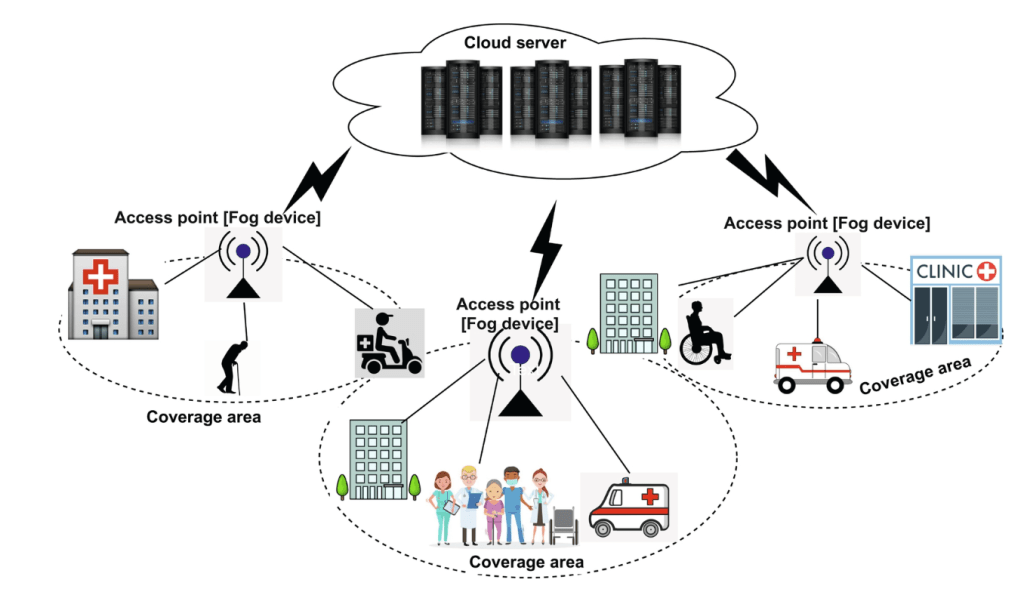
In the use case from the book, healthcare data is collected leveraging IoT devices, and analytics is performed leveraging the fog node cluster and cloud server. Geospatial data can come into play in various situations. An example quoted is when the data indicates a health crisis. Automated dispatch and routing can be executed, combining the geospatial data of the patient with health data.
The proposed architectural framework is something that is already leveraged in some other solutions. It is shown in this illustration from the book and we will not get into the details of it.
Source: Machine Learning, Big Data and IoT for Medical Informatics
As I read the research paper, one aspect that emerged in my mind was that many devices that we wear already capture both health and geo data. In this article, we explore how these devices can be used to design innovative solutions in other functions.
Examples of applications in supply chains are not only obvious, but also, I suspect, are already being tested or implemented. So let us focus on a use case example in marketing and promotions. This is a simple example and one that leverages an existing device customer owns. Also, I exclude the concept of health data sharing across apps since that is something that is not going to be easy due to regulations.
The era of real-time marketing promotions
If you observed the architecture above, the key portions are the access-points. “Fog” is just the jargon for the edge where these devices reside. We already use many devices that act like fog devices, capturing data, including geolocation data.
So let us explore the possible use case of real-time marketing promotions. Please note that this is a simplified scenario. The use case can be made much more precise and granular. Customer consent may be needed for additional variations.
Marketing promotions are not only becoming more frequent, but also more personalized. Digital technologies allow companies to offer more targeted promotions, as well as promotions that are aptly timed. However, a key capability in many industries need to be to decrease the lag between a the exact time a customer is going to fulfill their need and the promotion of a relevant product.
Essentially, minimizing the time between the instance a customer feels the need for something, and the time he sees an attractive promotion for a product that fulfills that need. And this is our use case.
The foundation for this already exists and have been perfected beyond the boundaries of privacy concerns of some. You start searching for products on your devices, you start seeing advertisments for that and related products, on multiple platforms. This approach, which has become a mature technology, was considered proactive early on. In the context of Industry 4.0, this is more like a passive approach, where you know that customer has a need, is researching products, you throw promotions at them so that they consider that in their research.
But what if we are able to influence the customer when they are going to take an action to fulfill their need? Customer privacy and customer data issues will not change much, as compared to the current approach. If the data is being leveraged with customer consent, the approach will remain the same.
I want to paint my ceiling and started researching for paints on my system. As always, I start seeing advertisments. Say three hardware national chains promote that they sell awsome collection of paints. I think chain A would have a larger collection. I decide to visit their store.
I have a smart watch that is paired with my phone. The phone has all the apps that I frequently use, like search, maps, geolocation etc. The watch also has apps for the store chains A and B.
Now I decide to step out for the purchase. I have already decided to visit store A’s retail location in city C. I search for the address. On my way to the store location at city C, I pass through two locations of store B. I have consented to share my geo data across apps.
Every time I get close to, say a one or two miles radius of a store for chain B, I get a ping on my watch for a x% coupon for a specific paint brand I was searching, from chain B. There are two pings within the geofence of a 1 mile of that store, to make sure I noticed that.
The ping may read like this:
” Attractive savings ahead- get a x% discount on BM paints. Take a left ahead at …….. Tap this link to get routed to this store. Use code ijgig . Terms and conditions apply.”
So my smart phone, a device in the fog, provides data that can be leveraged to generate the type of real-time promotions that can impact last minute decision making of customers.
As mentioned earlier, this was just one example and a simple one. Variations, and enhancements where a fog device is offered to customers for free, or under some promotion, can be leveraged in industries like CPG. The gist is, Industry 4.0 promises the “customer segment of one” and marketing needs to leverage Industry 4.0 to cater to that segment of one.

 Designed Analytics Blog